Cantilever pipe racks are the standard storage solution for long, cylindrical, and irregular materials that cannot be palletized — steel pipes, PVC piping, HVAC ductwork, copper tubing, bar stock, timber, and profile sections. Because these materials extend well beyond standard pallet dimensions and typically need to be loaded from the side rather than the front, conventional pallet racking cannot accommodate them safely or efficiently. Cantilever pipe racks solve this problem with an open arm design that eliminates front-facing uprights, allowing pipes and long materials to rest across the arms while forklifts, side-loaders, or overhead cranes handle loading from the aisle.
This article explains what a cantilever pipe rack is, examines its structural components, reviews the main types available, and outlines the selection process for choosing the right configuration for a specific pipe or long-material storage operation.
What Is a Cantilever Pipe Rack?
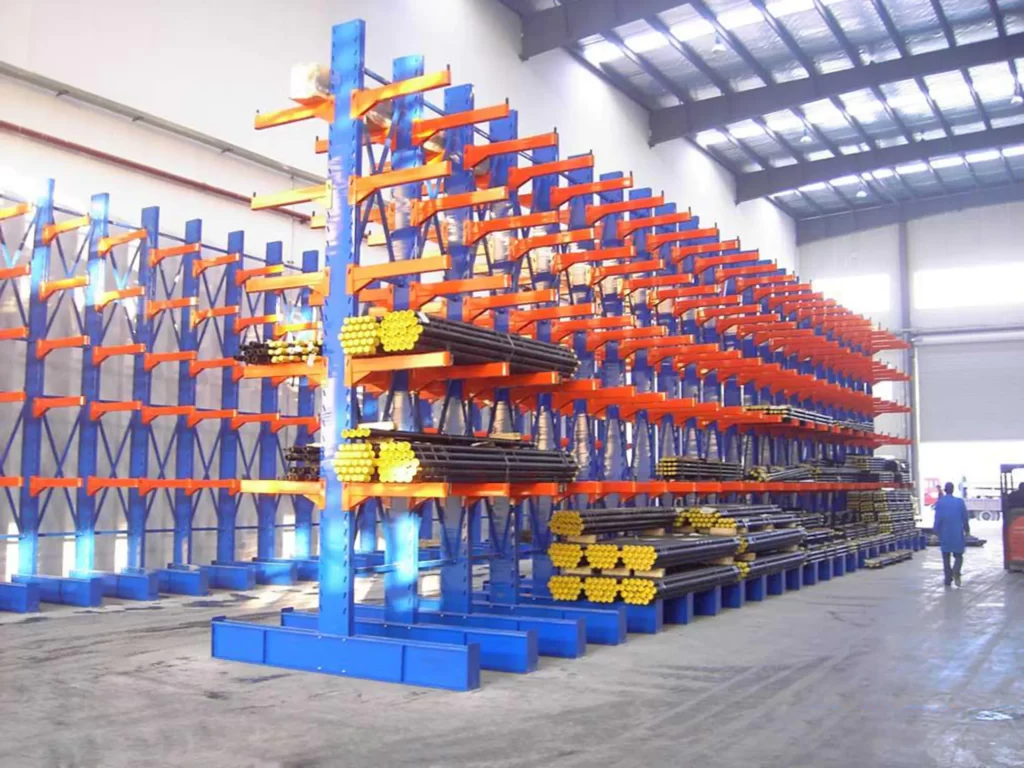
A cantilever pipe rack is a specialized storage system consisting of vertical columns with horizontal arms extending outward from one or both sides, designed to hold long, cylindrical, or irregular materials such as pipes, tubes, bars, timber, and profile sections that cannot be efficiently stored on standard pallet racking. The arms provide continuous horizontal support along the length of the load, while the absence of front uprights allows unrestricted side-loading access for forklifts, side-loaders, or overhead cranes.
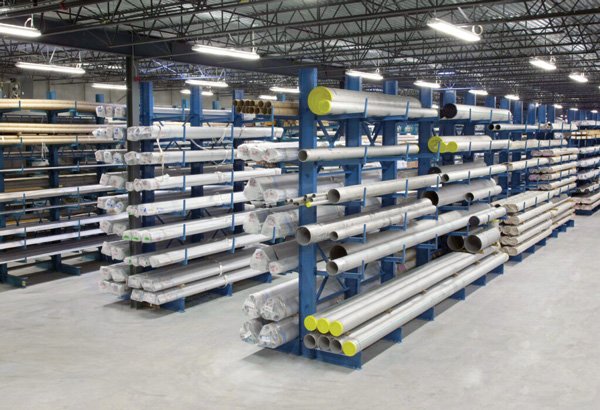
Cantilever pipe racks are engineered around load weight per arm, arm length, arm-to-arm vertical spacing, and column stability. Because the load is unsupported on the outer end of the arm, cantilever engineering must account for bending moment at the arm-to-column joint — a fundamentally different structural challenge than standard pallet racking, where load is symmetrically supported between two uprights. Detailed technical foundations of cantilever design are covered in dedicated resources on cantilever racking systems, which apply directly to pipe rack specification.
Main Components of a Cantilever Pipe Rack
Six components define a standard cantilever pipe rack structure.
Vertical Columns. The main load-bearing columns that transfer arm loads down to the base. Columns are typically I-beam, C-channel, or heavy-duty roll-formed sections depending on load rating and whether the system is structural or roll-formed.
Base or Base Plates. Horizontal foot sections extending forward from each column to counterbalance the outward moment of loaded arms. Base length is typically 0.7–0.9 times the arm length to prevent tipping under peak load. Bases are usually anchored to the floor.
Cantilever Arms. Horizontal arms extending outward from the columns to support the stored material. Arm length ranges from 600 mm to 2,400 mm or more, with capacity ratings from a few hundred kilograms to 2,000 kg or higher per arm. Arm-to-column connection is typically bolted for heavy-duty systems and pinned or hook-in for roll-formed systems. Detailed variations in cantilever arm profiles and load ratings directly affect pipe rack capacity and configuration.
End Stops. Small vertical uprights at the outer end of each arm to prevent stored pipes from rolling off. End stops are critical in pipe rack applications where the load is cylindrical and prone to lateral motion.
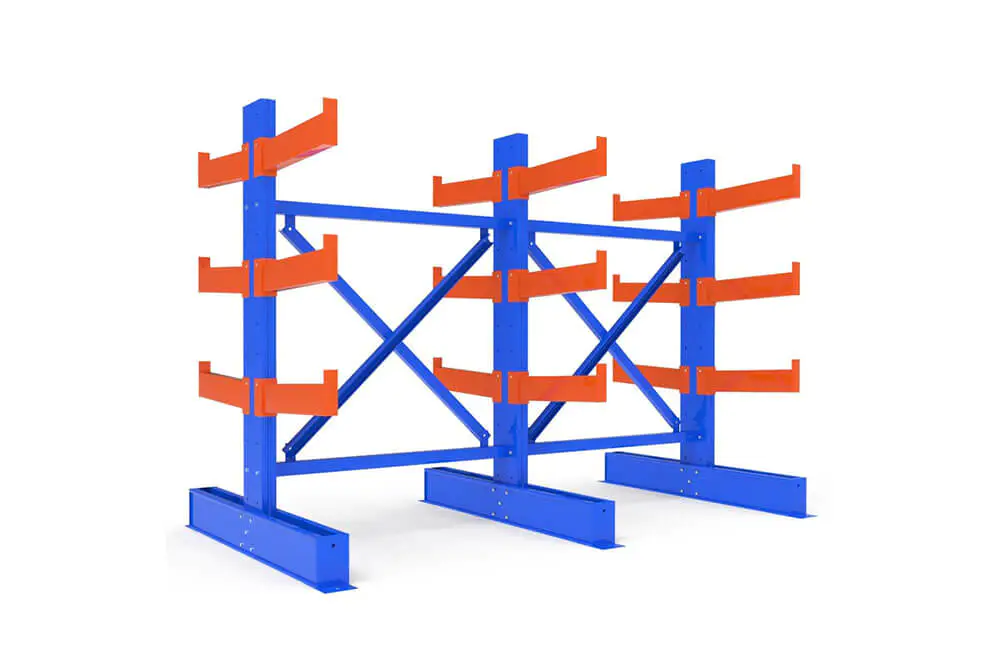
Horizontal and Diagonal Bracing. Cross-braces between columns provide lateral stability, particularly important in double-sided configurations and taller systems. Bracing is typically bolted or welded and follows the column pattern.
Column Guards and Protectors. Column protectors at the base absorb forklift impact — a common risk in pipe rack operations where forklifts approach the rack from the side and may strike the column while turning.
Main Types of Cantilever Pipe Racks
Cantilever pipe racks are available in several configurations, each suited to a different combination of load, environment, and access pattern.
Single-Sided Cantilever Pipe Rack. Arms extend from one side of each column only. Suitable for installation against a wall or in narrow aisles where only one side of the rack needs to be accessible. Single-sided racks require deeper bases or additional bracing because the load is asymmetric on the column.
Double-Sided Cantilever Pipe Rack. Arms extend from both sides of the shared central column. This configuration doubles storage capacity per column footprint and self-balances the load. Double-sided racks are common in central-aisle warehouse layouts where forklifts can access from both sides.
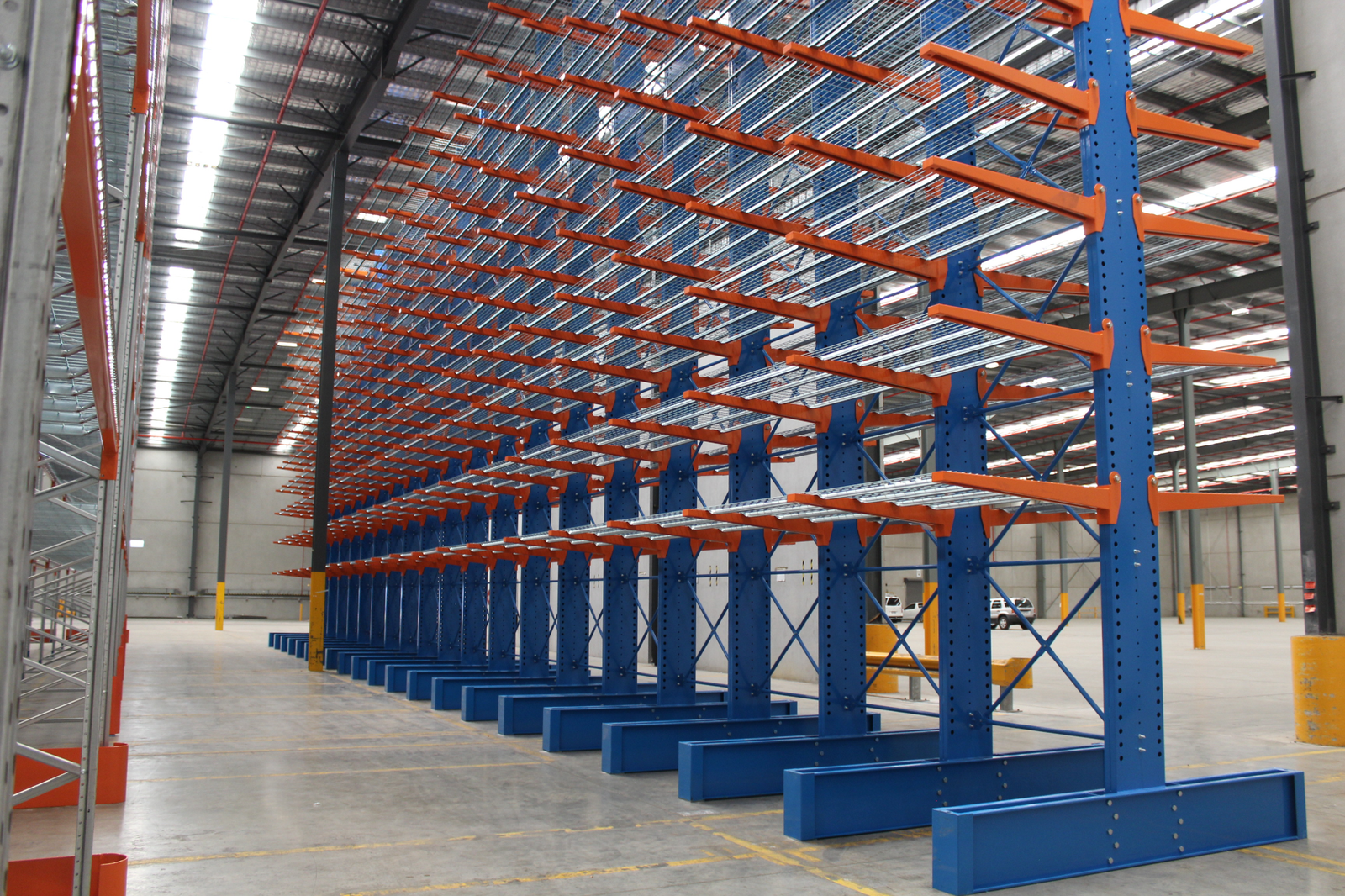
Structural Heavy-Duty Cantilever Pipe Rack. Built from hot-rolled I-beam or C-channel sections with bolted arm connections. Structural pipe racks support high individual pipe weights (steel pipes, thick-walled tubing, structural sections) and withstand higher forklift impact. Typical arm capacity 1,500–3,000 kg or higher.
Roll-Formed Cantilever Pipe Rack. Built from cold-formed steel with pin or hook-in arm connections. Roll-formed systems suit lighter loads (PVC, thin-wall tubing, plastic profiles, timber) and provide fast arm-level adjustment. Typical arm capacity 300–1,500 kg.
Outdoor and A-Frame Cantilever Pipe Rack. A-frame designs (double-sided with a triangular structural profile) and dedicated outdoor cantilever racks with hot-dip galvanized finishes serve pipe yards, construction sites, and lumber depots. Similar considerations apply to broader outdoor pallet racking applications where corrosion protection is the primary design driver.
Load Capacity and Sizing Considerations
Cantilever pipe rack load capacity is specified at three levels that must all be verified together.
Per-Arm Capacity. The maximum load one arm can support at the specified arm length. Longer arms carry less because bending moment increases with arm length. A 1,200 mm arm rated at 1,000 kg may drop to 600 kg at 2,000 mm arm length.
Per-Level Capacity. The maximum load across a full level (all arms on one horizontal plane at a specific height). Per-level capacity is not always the sum of per-arm ratings because column and base stability may become the limiting factor.
Total Column Capacity. The sum of all level loads supported on one column, plus the safety margin required by applicable design standards. Total column capacity is often the most restrictive constraint in tall systems.
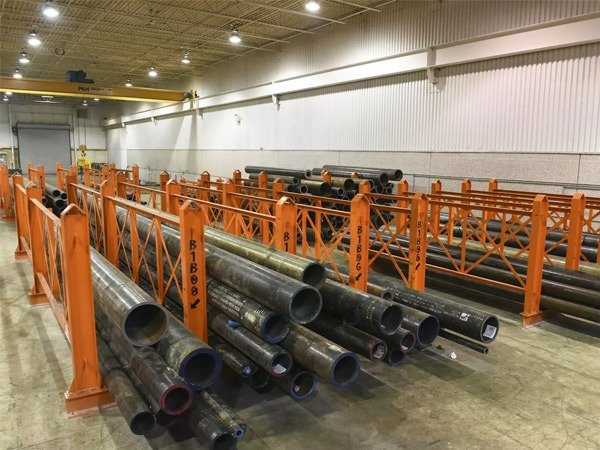
Arm length should exceed the longest pipe by at least 100 mm to prevent overhang. Vertical spacing between arm levels should exceed the largest pipe diameter plus handling clearance. Structural design must comply with cantilever rack standards published by the Rack Manufacturers Institute (RMI) and equivalent regional standards.
Materials and Coatings
Because cantilever pipe racks are frequently used outdoors or in humid environments, finish specification is critical.
Standard Powder Coating. Suitable for indoor ambient use. Typical thickness 60–90 microns. Not suitable for outdoor exposure or humid warehouses over extended service.
Hot-Dip Galvanization. The default finish for outdoor pipe yards, construction supply, and coastal facilities. Zinc coating thickness typically 70–120 microns. Adds 20–30% to material cost but extends service life by 10 years or more in aggressive environments.
Duplex Coating. Hot-dip galvanization followed by additional powder coat. Used in the most demanding outdoor environments — coastal, industrial, and chemical exposure. Highest cost but longest service life.
Steel Grade. Q235 and Q345 structural steel are standard. Grade Q345 is preferred for heavy-duty structural systems because higher yield strength allows thinner sections at equivalent load capacity.
Applications of Cantilever Pipe Racks
Cantilever pipe racks are deployed across several industry segments where long, cylindrical, or irregular materials are the primary inventory.
Pipe and Tube Distribution. Wholesale distributors of steel pipe, PVC piping, copper tubing, and HVAC ductwork rely on cantilever racks as core storage infrastructure.
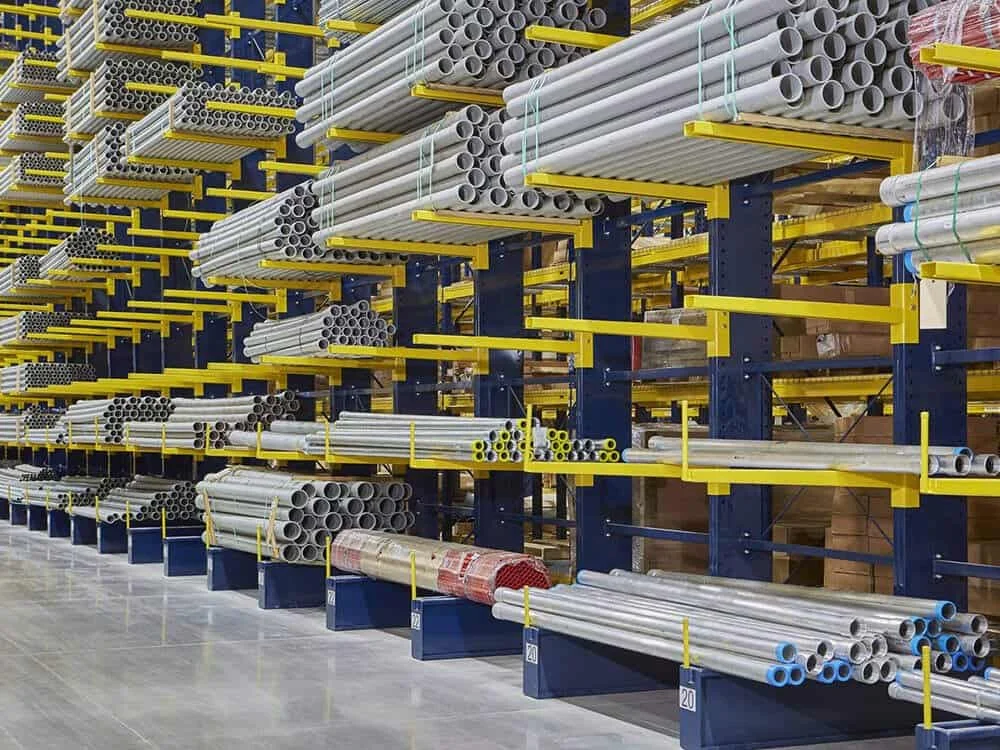
Plumbing and HVAC Supply. Plumbing contractor supply, HVAC parts distribution, and mechanical contractor warehouses store diverse pipe diameters and lengths that require flexible arm spacing.
Construction Supply and Lumber Yards. Long timber, metal profiles, rebar, and construction pipes are stored on outdoor cantilever racks with galvanized or duplex coatings.
Oil and Gas. Well casing, tubing, and pipe joints require heavy-duty structural cantilever racks capable of supporting individual pipe weights of several hundred kilograms per meter.
Automotive and Exhaust Parts. Exhaust pipes, tailpipes, and long automotive components are stored on smaller cantilever racks in parts distribution warehouses.
Metal Service Centers. Steel bars, aluminum extrusions, and profile sections require both indoor and outdoor cantilever storage with heavy load capacity per arm.
Comparison Table: Cantilever Pipe Rack Types
| Configuration | Typical Arm Load | Best Use Case | Typical Environment |
|---|---|---|---|
| Single-Sided Roll-Formed | 300–1,000 kg | PVC, light pipes, tubes, timber | Indoor |
| Double-Sided Roll-Formed | 300–1,500 kg | Mixed light pipe distribution | Indoor |
| Single-Sided Structural | 1,000–2,500 kg | Steel pipe, thick-walled tube storage | Indoor / Outdoor |
| Double-Sided Structural | 1,500–3,000 kg+ | Heavy pipe, oil & gas, metal service | Indoor / Outdoor |
| Outdoor Galvanized A-Frame | 500–2,000 kg | Pipe yards, construction supply, lumber | Outdoor |
The optimal configuration depends on pipe weight per meter, pipe length, indoor or outdoor location, and available forklift equipment.
How to Choose a Cantilever Pipe Rack
Step 1: Define Pipe Characteristics.
Document pipe diameter, wall thickness, length range, weight per meter, and total inventory per SKU. Weight per meter is the decisive input for arm load specification.
Step 2: Determine Access Pattern.
Confirm whether one-sided or two-sided access is required. Single-sided is appropriate against walls; double-sided suits central-aisle layouts.
Step 3: Specify Arm Length and Level Spacing.
Arm length must exceed the longest pipe by at least 100 mm. Vertical spacing must accommodate the largest pipe diameter plus handling clearance and end-stop height.
Step 4: Calculate Load Ratings.
Sum the intended load per arm, per level, and per column. Verify against manufacturer specifications with a safety margin appropriate to the operating environment. Additional context is available in the complete guide to cantilever racking.
Step 5: Choose Structural or Roll-Formed Configuration.
Heavy pipe loads, high forklift traffic, or outdoor exposure typically favor structural. Lighter pipe loads and indoor use typically favor roll-formed.
Step 6: Specify Finish and Corrosion Protection.
Indoor use warrants powder coating. Outdoor or humid use requires hot-dip galvanization. Coastal or chemically aggressive environments warrant duplex coating.
Step 7: Verify Safety Compliance.
Confirm anchoring, base stability, and end-stop specification meet workplace safety guidance from OSHA and applicable regional rack design standards.
Key Takeaways
- A cantilever pipe rack uses columns with horizontal arms to store long materials such as pipes, tubes, bars, and profiles that cannot be palletized.
- Main components include columns, bases, arms, end stops, bracing, and column protectors.
- Configurations include single-sided, double-sided, structural heavy-duty, roll-formed, and outdoor A-frame variants.
- Load capacity is specified at three levels — per-arm, per-level, and per-column — that must all be verified together.
- End stops are essential in pipe applications to prevent cylindrical materials from rolling off arm ends.
- Finish specification (powder coat, galvanized, duplex) is critical for outdoor or humid environments.
- Selection depends on pipe weight per meter, length, access pattern, environment, and available handling equipment.
Frequently Asked Questions
1. What is a cantilever pipe rack used for?
Cantilever pipe racks are used to store long, cylindrical, or irregular materials that cannot be stored on standard pallet racking — including steel pipes, PVC piping, HVAC ductwork, tubing, timber, bar stock, and profile sections. The open-arm design allows side-loading access without front uprights.
2. How much weight can a cantilever pipe rack hold?
Per-arm capacity typically ranges from 300 kg on roll-formed racks up to 3,000 kg or more on heavy-duty structural systems. Total column capacity depends on the sum of all levels supported. Arm length directly affects capacity — longer arms carry less because bending moment increases with length.
3. What is the difference between a single-sided and double-sided cantilever pipe rack?
Single-sided racks have arms extending from one side of each column only, suitable for installation against a wall. Double-sided racks have arms on both sides of a shared column, doubling storage capacity per footprint and self-balancing the load.
4. Can cantilever pipe racks be used outdoors?
Yes, provided they are finished with hot-dip galvanization or duplex coating. Standard powder-coated indoor racks corrode rapidly in outdoor environments. Outdoor cantilever pipe racks are widely used in pipe yards, construction supply, and lumber depots.
5. What is the maximum arm length on a cantilever pipe rack?
Standard arm lengths range from 600 mm to 2,400 mm. Longer arms up to 3,000 mm are available for specialized applications but require deeper bases and stronger columns to counterbalance the increased moment. Arm length should always exceed the longest pipe by at least 100 mm.
6. Do cantilever pipe racks need to be anchored to the floor?
Yes. Because loaded arms create outward bending moment on the columns, floor anchoring is essential to prevent tipping. Anchor specification depends on column load, base length, seismic zone, and floor construction.
7. What are end stops on a cantilever pipe rack?
End stops are small vertical projections at the outer end of each arm that prevent cylindrical loads such as pipes from rolling off. End stops are critical for pipe applications and should be specified whenever cylindrical materials are stored.
8. Are cantilever pipe racks compatible with standard forklifts?
Standard counterbalance and reach forklifts can operate with cantilever pipe racks, though side-loaders and four-directional forklifts are often preferred for handling long materials. Overhead cranes are common in heavy structural pipe storage.
Conclusion
Cantilever pipe racks solve a specific but critical storage problem — the safe, organized storage of long materials that cannot be palletized. Their open-arm design, engineered load ratings, and configurability across single-sided, double-sided, structural, roll-formed, and outdoor variants make them the default choice for pipe distribution, HVAC supply, construction materials, oil and gas, and metal service center operations. Because arm length, load per arm, base stability, and coating specification all interact with the specific pipe or long-material inventory being stored, cantilever pipe rack selection deserves engineered evaluation rather than off-the-shelf ordering.
For warehouse operators and pipe distributors evaluating cantilever pipe rack suppliers, the specification typically covers arm length, load per arm, column profile, base design, and outdoor coating options — decisions that vary significantly by pipe diameter, weight, and storage environment. Mracking is one of the Chinese manufacturers producing cantilever racking systems configured for pipe, tube, bar, and long-material storage, with single-sided, double-sided, roll-formed, and structural heavy-duty variants engineered with powder-coated or hot-dip galvanized finishes for indoor and outdoor applications across pipe distribution, plumbing supply, HVAC, construction supply, and industrial storage operations.