Aisle width is one of the most consequential — and most misunderstood — decisions in warehouse rack design. The choice between wide aisle and narrow aisle racking determines forklift specification, storage density, floor plan geometry, throughput, and long-term operating cost, and once installed it is difficult and expensive to reverse. Warehouse operators frequently choose an aisle configuration by default rather than by analysis, ending up with either wasted floor space (aisles too wide) or forklift constraints (aisles too narrow for the fleet). Understanding the differences between wide aisle and narrow aisle racking, and how each interacts with forklift equipment and building envelope, is essential for any warehouse design or retrofit.
This article compares wide aisle and narrow aisle racking in depth, examines the extension to Very Narrow Aisle (VNA) systems, and outlines the framework for choosing between them.
What Is Wide Aisle Racking?
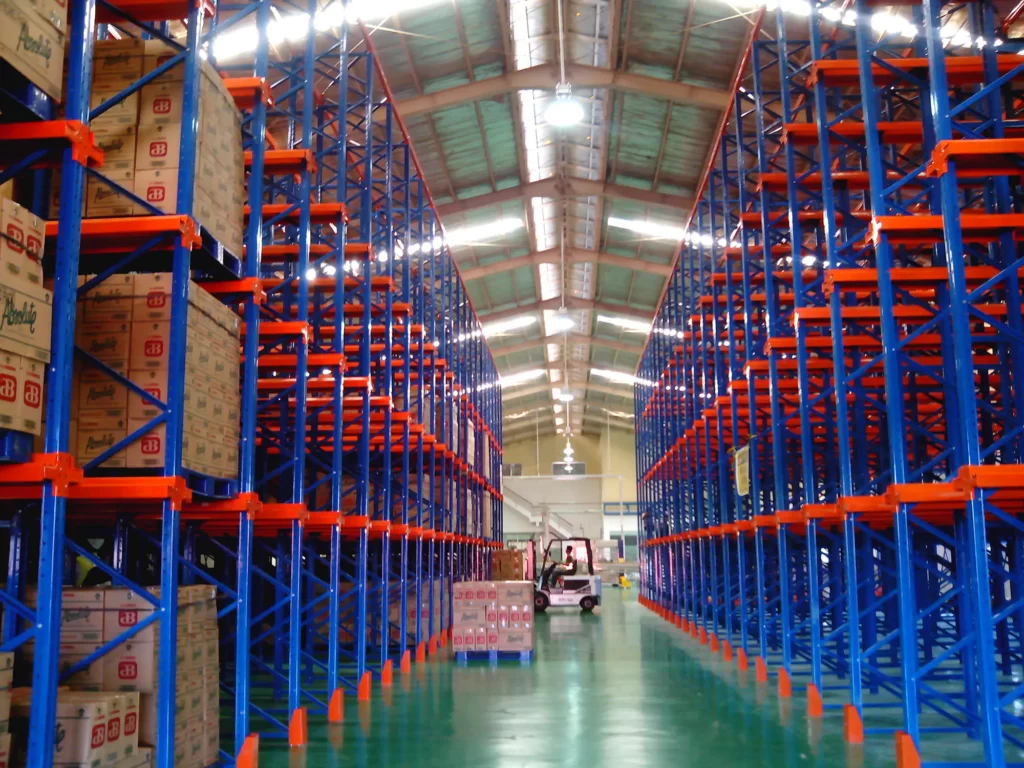
Wide aisle racking is a standard pallet rack configuration in which the aisle between rack rows is typically 3.0 to 3.5 meters (10 to 12 feet) wide, allowing conventional counterbalance and reach forklifts to enter, turn, and lift pallets without specialized guidance or precision-controlled equipment. Wide aisle configurations remain the most common form of pallet racking globally because they combine full pallet accessibility with simple forklift operation and low capital cost.
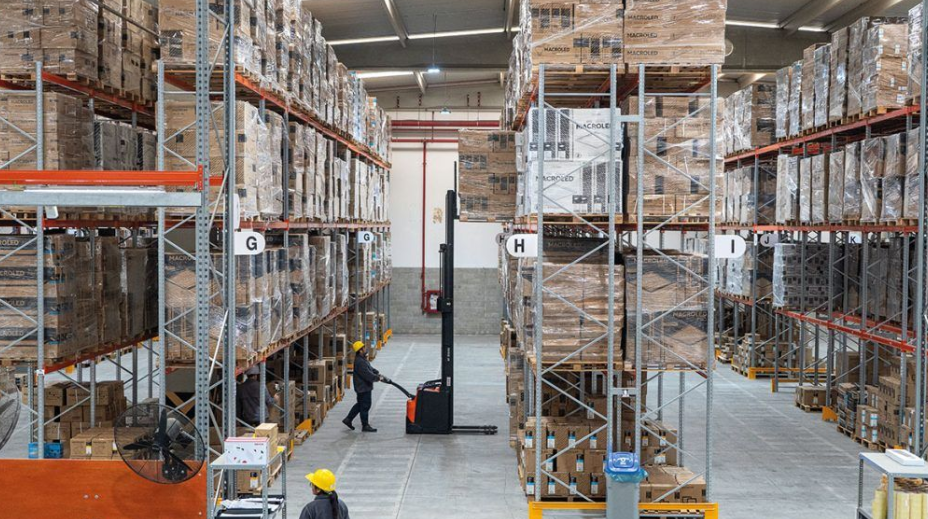
Wide aisle systems typically use selective pallet racking with standard box beams and roll-formed uprights. The wide aisle allows counterbalance forklifts to approach a rack head-on, rotate 90 degrees, and place pallets in the rack in a single continuous motion. Aisle width can be reduced to approximately 2.7 meters where reach trucks with pantograph forks are used instead of counterbalance forklifts. Detailed geometry and benefits of wide aisle pallet racking are covered in dedicated references for readers evaluating specific installation constraints.
What Is Narrow Aisle Racking?
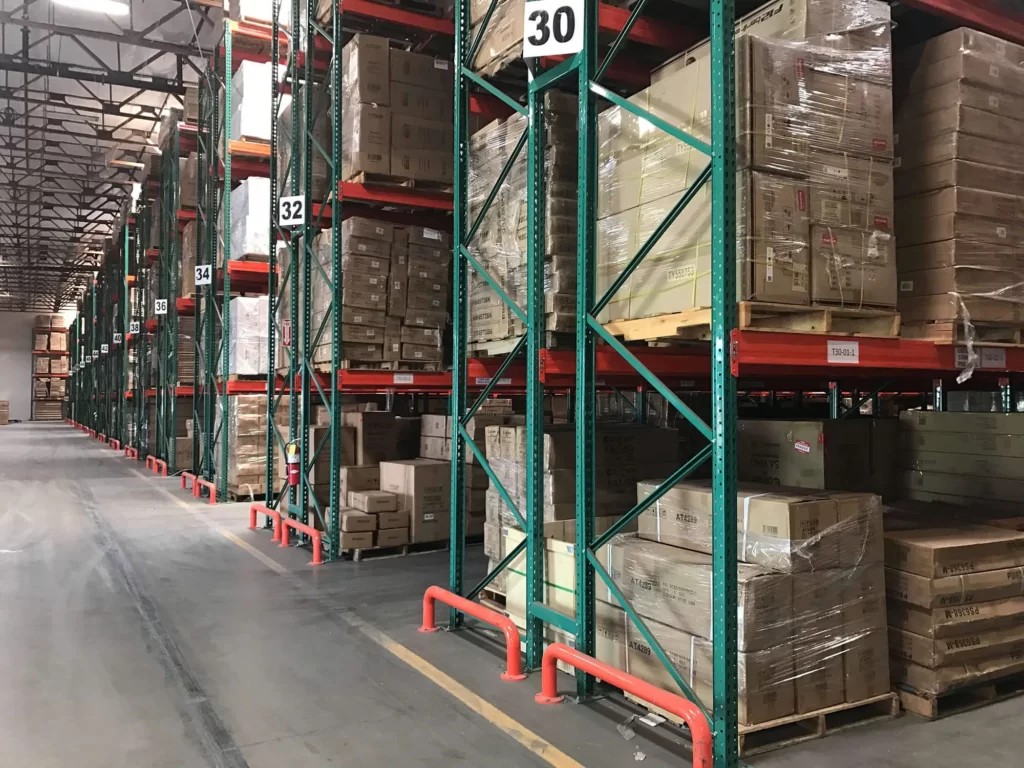
Narrow aisle racking is a pallet rack configuration with aisle widths reduced to typically 2.0 to 2.5 meters (6.5 to 8 feet), requiring dedicated reach trucks or narrow aisle forklifts to operate safely and efficiently within the reduced clearance. Narrow aisle systems increase storage density by 25 to 30% compared with wide aisle configurations on the same footprint, while maintaining full pallet selectivity.
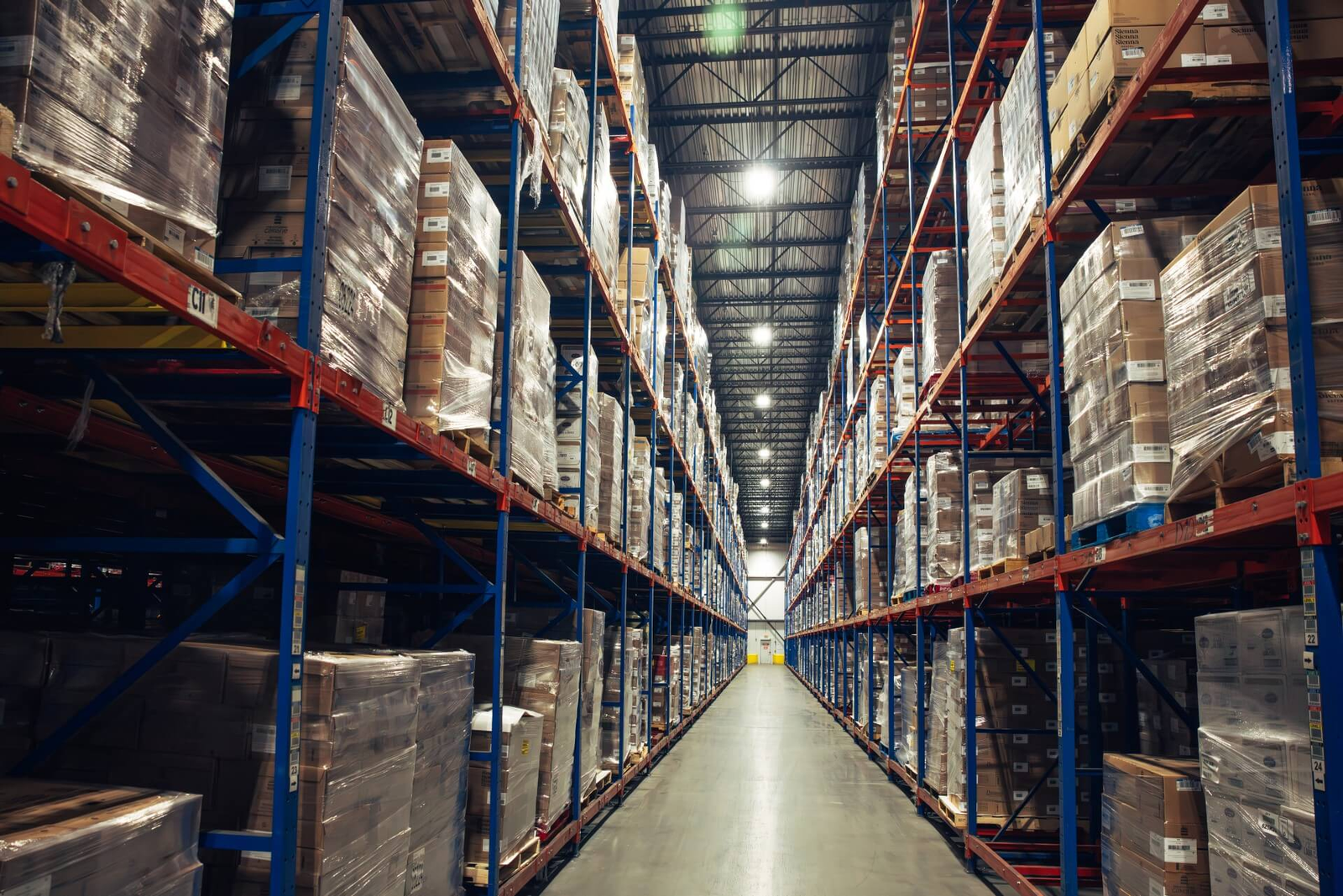
Narrow aisle operations require careful coordination between rack geometry, forklift specification, floor flatness, and warehouse management software. Forklifts operate at higher lift heights than in wide aisle configurations, and precise pallet placement matters because the reduced margin does not tolerate misalignment. Guidance on how narrow aisle pallet racking works covers the specific interactions between rack design and forklift capability in more detail.
Key Differences Between Wide Aisle and Narrow Aisle Racking
Six dimensions define the practical differences between the two configurations.
Aisle Width. Wide aisle typically 3.0–3.5 m; narrow aisle typically 2.0–2.5 m. The difference of one meter across every aisle in a facility translates into significant floor space savings.
Forklift Type. Wide aisle accommodates standard counterbalance forklifts and reach trucks. Narrow aisle typically requires reach trucks with articulated forks or dedicated narrow aisle forklifts. VNA extends this to guided turret trucks.
Storage Density. Narrow aisle configurations achieve approximately 25–30% more pallet positions in the same warehouse footprint by converting aisle space into rack space.
Throughput. Wide aisle operations typically deliver faster individual pallet movements because forklifts can operate freely. Narrow aisle throughput is comparable in most operations because higher pallet counts per meter of travel offset the slightly slower forklift movement.
Building Requirements. Wide aisle requires standard warehouse floor flatness. Narrow aisle typically requires FM2 or FM1 floor flatness specification, particularly at higher lift heights. VNA installations require even tighter tolerances.
Capital Cost. Wide aisle uses lower-cost standard forklifts. Narrow aisle requires dedicated forklift fleet, higher-precision floor construction, and often column protectors and guide rails, resulting in higher total capital cost per pallet position for the material handling equipment even though rack cost per position is lower.
Comparison Table: Wide Aisle vs Narrow Aisle vs VNA
| Feature | Wide Aisle | Narrow Aisle | VNA (Very Narrow Aisle) |
|---|---|---|---|
| Aisle Width | 3.0–3.5 m | 2.0–2.5 m | 1.5–2.0 m |
| Forklift Type | Counterbalance / Reach | Reach truck | Turret / guided VNA truck |
| Typical Lift Height | Up to 8 m | Up to 10 m | 12–15 m or higher |
| Storage Density Gain | Baseline | +25–30% | +40–50% |
| Floor Flatness | Standard | FM2 typical | FM1 / FM2 required |
| Selectivity | Full | Full | Full |
| Throughput | Highest per forklift | Comparable | Slightly lower per lift |
| Forklift Cost per Unit | Lowest | Medium | Highest |
| Total Rack Cost per Position | Highest | Medium | Lowest |
| Typical Best For | General distribution | High-SKU distribution | High-density, high-value |
The right configuration depends on the balance between land cost, forklift fleet economics, throughput requirements, and building constraints.

Very Narrow Aisle (VNA) as an Extension of Narrow Aisle
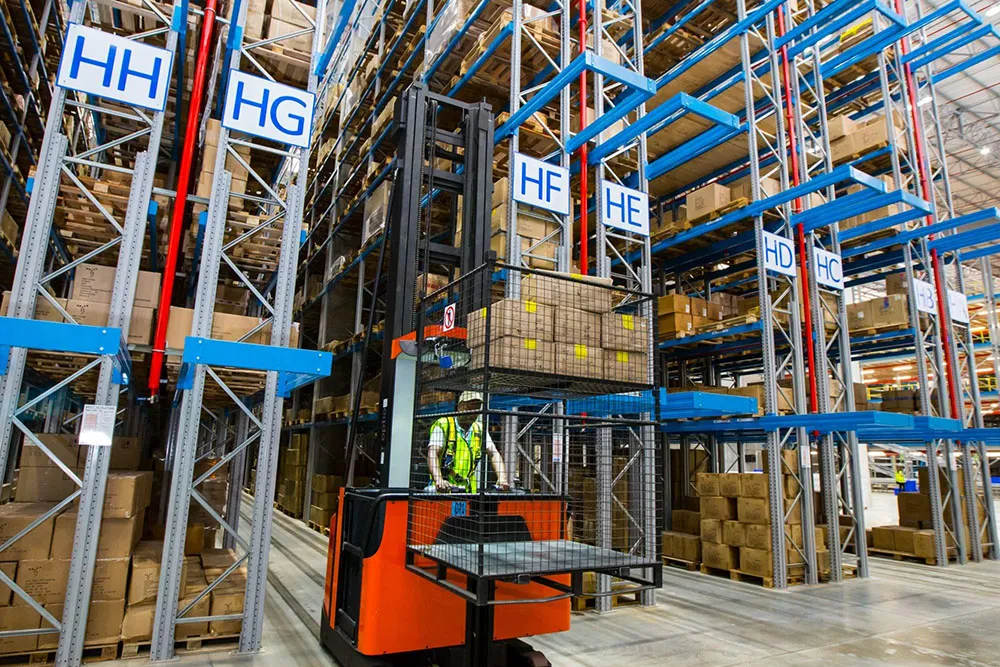
Very Narrow Aisle systems extend the narrow aisle principle further, reducing aisle width to 1.5–2.0 meters and requiring specialized turret trucks or guided VNA forklifts with wire, rail, or laser guidance. VNA delivers 40–50% storage density gain over wide aisle configurations, making it the standard choice for warehouses where cubic space utilization is decisive. VNA operations require flat floors specified to FM2 or FM1, precise rack installation tolerance, and integrated warehouse management software that supports position-level slotting. Detailed engineering specifications for VNA pallet racking systems address upright profile, beam configuration, and guide rail requirements. VNA sits within a broader set of high-density storage solutions that operators evaluate together during facility design.
Advantages and Limitations of Each Configuration
Advantages of Wide Aisle Racking
Lowest total capital cost for both rack and forklift fleet. Compatibility with standard forklifts available on any market. Faster individual pallet movements due to unrestricted forklift operation. Lower floor flatness requirements reduce building construction cost. Easier to reconfigure or expand when SKU profile changes. Widely available operator training and spare parts.
Limitations of Wide Aisle Racking
Lowest storage density per square meter of building footprint. Higher land cost per pallet position, which matters most in regions with high real estate prices. Requires larger buildings for equivalent capacity, increasing energy and operating cost in cold storage applications.
Advantages of Narrow Aisle Racking
25–30% storage density gain reduces warehouse footprint for the same pallet count. Compatible with reach trucks widely available on major markets. Full pallet selectivity maintained despite reduced aisles. Lower rack cost per pallet position at facility scale due to more efficient footprint utilization.
Limitations of Narrow Aisle Racking
Requires dedicated forklift fleet, restricting equipment sharing across zones. Higher floor flatness requirements increase building cost. Reduced tolerance for misalignment increases the training burden on operators. Column protectors and guide rails typically required, adding cost.
Best Use Cases for Each Configuration
Wide Aisle Is Well-Suited For:
- Small and medium warehouses where land is not the binding constraint
- High-throughput operations where forklift movement speed matters more than density
- Facilities with mixed forklift fleets shared between multiple zones
- Retrofit projects in older buildings with limited floor flatness
- Operations where operator turnover is high and specialized training is difficult to maintain
Narrow Aisle Is Well-Suited For:
- Warehouses in high-cost real estate markets where every square meter matters
- High-SKU distribution centers where selectivity and density are both required
- Cold storage facilities where cubic volume drives refrigeration cost
- E-commerce fulfillment centers combining density with fast retrieval
- Any operation where a 25–30% capacity increase justifies specialized forklift investment
How to Choose Between Wide Aisle and Narrow Aisle Racking
Step 1: Analyze SKU Profile and Volume.
Estimate the total pallet positions required and the throughput per hour at peak. High pallet counts with moderate throughput per SKU tend to favor narrow aisle.
Step 2: Evaluate Land and Building Cost.
Calculate the land cost per pallet position for both configurations. In high-cost markets, narrow aisle savings on footprint typically justify the higher forklift and floor cost.
Step 3: Assess Forklift Fleet Economics.
Include acquisition, maintenance, energy, and operator training costs over the expected equipment life. Wide aisle forklifts have lower unit cost but require more units per unit of throughput at scale.
Step 4: Verify Floor Flatness Feasibility.
Confirm whether the building floor meets — or can be modified to meet — the required flatness specification. Existing buildings often cannot economically be brought up to FM2 or FM1 standard.
Step 5: Consider Operator Availability and Training.
Narrow aisle and VNA operations require specialized training. In markets with high operator turnover, the training burden may outweigh the density gain.
Step 6: Verify Safety and Compliance.
Confirm compliance with rack design standards published by the Rack Manufacturers Institute (RMI) and workplace safety guidance from OSHA, including aisle width safety margins and forklift operating rules.
Step 7: Model Long-Term Scalability.
Consider how SKU count, throughput, and volume are likely to change over 10 to 20 years. Wide aisle is generally easier to reconfigure; narrow aisle offers more density headroom in the same footprint.
When to Combine Wide and Narrow Aisle in the Same Facility
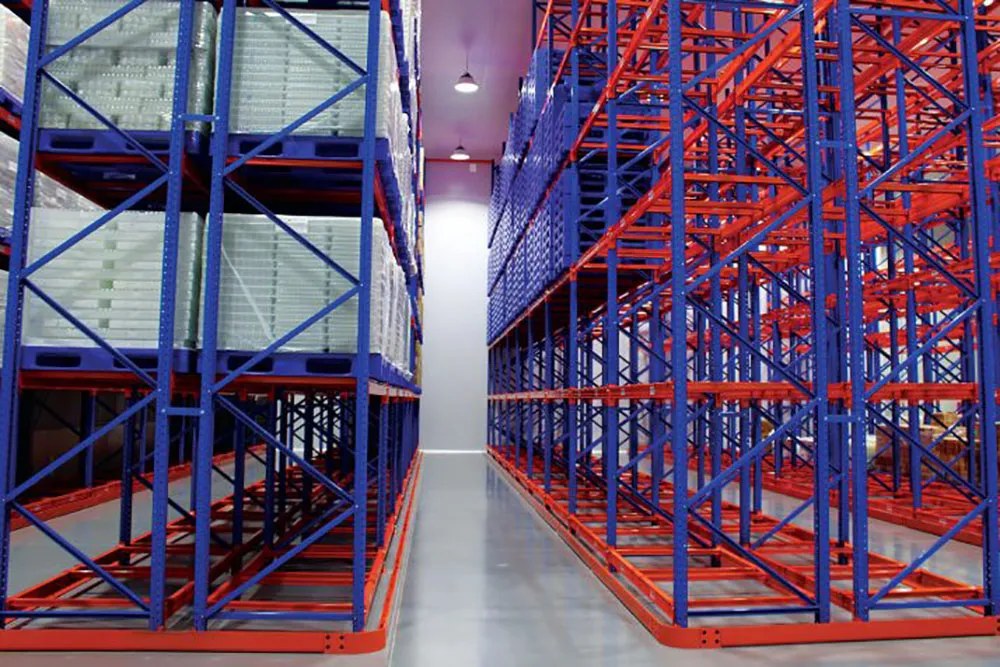
Many well-designed warehouses use both configurations rather than choosing one exclusively. A distribution center may use wide aisle in the receiving, staging, and shipping zones to support high forklift traffic, while using narrow aisle in the main storage zone to maximize density. A cold storage facility may use narrow aisle for the temperature-controlled zone (where every cubic meter carries refrigeration cost) and wide aisle for the ambient dock area. This hybrid approach captures the density benefits of narrow aisle where they matter most while preserving the throughput and flexibility of wide aisle where they add value.
Key Takeaways
- Wide aisle racking uses aisles of 3.0–3.5 meters and standard forklifts, providing the lowest capital cost but the lowest storage density.
- Narrow aisle racking uses aisles of 2.0–2.5 meters, achieving 25–30% higher density with dedicated reach trucks.
- VNA extends the narrow aisle principle to 1.5–2.0 meter aisles with turret or guided forklifts, delivering 40–50% density gain.
- Aisle width decisions affect forklift specification, floor flatness, building envelope, and long-term operating cost, not just rack layout.
- Wide aisle suits low-cost real estate, high-throughput, and mixed-fleet operations.
- Narrow aisle suits high-cost real estate, high-SKU distribution, and cold storage where cubic volume drives cost.
- Many modern warehouses combine both configurations within the same facility, applying each where its advantages are highest.
Frequently Asked Questions
1. What is the difference between wide aisle and narrow aisle racking?
The main difference is aisle width. Wide aisle uses 3.0–3.5 meter aisles with standard forklifts; narrow aisle uses 2.0–2.5 meter aisles with dedicated reach trucks. Narrow aisle achieves approximately 25–30% higher storage density at the cost of specialized forklift and floor requirements.
2. What forklifts are used in wide aisle vs narrow aisle racking?
Wide aisle accommodates counterbalance forklifts and standard reach trucks. Narrow aisle requires dedicated reach trucks with articulated forks or purpose-built narrow aisle forklifts. Very Narrow Aisle systems use turret trucks or guided VNA forklifts with wire, rail, or laser guidance.
3. How much storage density does narrow aisle racking provide?
Narrow aisle typically provides 25–30% more pallet positions in the same warehouse footprint compared to wide aisle. VNA extends this to 40–50%. Actual gains depend on ceiling height, building geometry, and how efficiently the aisles are utilized.
4. What floor flatness is required for narrow aisle racking?
Narrow aisle typically requires FM2 floor flatness or better, particularly at lift heights above 8 meters. VNA operations typically require FM1 or tighter. Standard warehouse floors often need surface grinding or resurfacing to meet these specifications.
5. Is narrow aisle racking suitable for small warehouses?
Narrow aisle is suitable for small warehouses when land cost or footprint constraints favor density over flexibility. However, the higher fixed cost of specialized forklifts and floor flatness upgrades may not be justified in facilities below approximately 2,000 pallet positions.
6. Can existing wide aisle warehouses be converted to narrow aisle?
Conversion is possible but requires reassessment of floor flatness, forklift fleet replacement, and often column protector and guide rail installation. Existing floors frequently need remediation to meet flatness requirements, adding cost that may reduce the economic case for conversion.
7. Does narrow aisle racking reduce throughput?
Not significantly in most operations. Forklift travel between pallet positions is slightly slower in narrow aisle configurations, but the reduced travel distance per pallet retrieved compensates in most cases. VNA can reduce individual lift throughput but is typically offset by higher position density.
8. What is the difference between narrow aisle and Very Narrow Aisle (VNA)?
Narrow aisle uses 2.0–2.5 meter aisles with reach trucks. VNA further reduces aisles to 1.5–2.0 meters using turret or guided forklifts. VNA delivers additional density but requires specialized equipment, tighter floor tolerances, and higher capital investment.
Conclusion
Wide aisle and narrow aisle racking represent two points on the same spectrum between flexibility and density. Wide aisle prioritizes forklift simplicity, low capital cost, and throughput per lift. Narrow aisle — and its VNA extension — prioritizes storage density, cubic space utilization, and long-term footprint efficiency. Neither configuration is universally superior; the right choice depends on land cost, throughput requirements, forklift fleet economics, floor flatness feasibility, and expected long-term scalability. In many modern warehouses, the most cost-effective outcome combines both configurations, applying each where its specific advantages produce the largest benefit.
For warehouse operators comparing wide aisle and narrow aisle configurations, rack geometry and forklift fleet compatibility must be resolved together during the design stage rather than in sequence. Mracking is one of the Chinese manufacturers producing pallet racking systems configured for wide aisle, narrow aisle, and VNA operations, with upright depth, beam length, column protector, and guide rail specifications engineered to match the intended forklift fleet, aisle width, and building envelope across distribution, cold storage, e-commerce, and industrial warehouse applications.