Logistics warehousing is the storage and handling stage of the supply chain, the point where goods are received, stored, picked, and dispatched on their way from supplier to customer. Unlike a simple storeroom, a logistics warehouse exists to move inventory, not just hold it. Distribution centers, e-commerce fulfillment hubs, and third-party logistics (3PL) facilities all share the same core mission: get the right goods out the door as fast, accurately, and cheaply as possible. For a closer comparison, see Smart Warehousing.
At the heart of that mission sits the warehouse racking. Racking determines how many pallets fit under the roof, how quickly orders can be picked, how easily the layout adapts to changing demand, and how ready the building is for automation. In logistics, the racking system is not background infrastructure. It is the lever that decides whether a warehouse is fast and profitable or slow and cramped.
This article looks at what logistics warehouses optimize for, then connects each of those goals to the racking systems built to deliver them. A related guide on Lead Time in Logistics gives more detail for this part of the planning work.
What a Logistics Warehouse Is Built to Do
A logistics warehouse is judged on flow, not just capacity. Four priorities shape almost every decision inside it, and each one points toward particular racking choices. This point also connects with Euro Pallet Size.
The first is space utilization. Industrial space is expensive and increasingly scarce, so operators are under pressure to store more within the same footprint rather than expand. High-bay racking, mobile racking systems, mezzanines, and vertical storage solutions let facilities increase capacity within the same footprint, and are especially effective when paired with automation.
The second is throughput and fulfillment speed. Orders have to move quickly, particularly in e-commerce. US retail e-commerce sales reached an estimated $326.7 billion in the first quarter of 2026, and that volume rewards warehouses designed for fast picking and replenishment.
The third is flexibility. SKU profiles and order patterns change, so layouts need to adapt. Modern warehouses increasingly use modular racking, movable shelving, and reconfigurable zones so storage, picking, returns, and light assembly can share the same footprint.
The fourth is cost and accuracy, which the racking layout influences directly by shortening travel, reducing errors, and lowering the cost to cool, light, and operate the space.
These priorities often pull against each other. Packing in more pallets can slow picking, and opening up access can waste space. The skill in logistics warehousing is finding the right balance for a given operation, and the racking system is the main tool for striking it.

Why Racking Is the Backbone of Logistics Warehousing
Once those priorities are clear, the central role of racking follows. Racking is the structural framework that turns an empty building into an organized, high-velocity operation.
The scale of this is reflected in the market itself. The global industrial racking system market is projected to grow from $19.2 billion in 2026 to $34.5 billion by 2033, with third-party logistics providers the dominant end users and e-commerce fulfillment the fastest-growing segment. Racking demand tracks logistics growth because the two are inseparable.
A well-chosen pallet racking layout sets the density of the building, defines the pick paths, and creates the addressable locations a warehouse management system needs to direct work. Get it right and goods flow; get it wrong and every order pays the price in extra steps and slower handling.
The real skill in logistics warehousing is balancing three competing goals, density, selectivity, and throughput, because no single system maximizes all three at once.
Matching Racking Systems to Logistics Priorities
Logistics warehouses almost always combine several racking types, assigning each to the products and tasks it suits best. The table below frames the trade-offs, with detail on each system following.
| Racking system | Density | Selectivity | Throughput fit | Best logistics use |
|---|---|---|---|---|
| Selective pallet racking | Low | High | Medium | Many SKUs, full access |
| Double-deep / VNA | Medium–high | Medium | Medium | Space-tight, mixed SKUs |
| Drive-in racking | High | Low | Low | Bulk, few SKUs |
| Push-back racking | Medium–high | Medium | Medium | LIFO buffering |
| Pallet flow racking | High | Low–medium | High | FIFO, high turnover |
| Pallet shuttle | Very high | Medium | High | High-volume, automation-ready |
| Mobile racking | Very high | High | Low–medium | Slow movers, dense storage |
| Pick modules / mezzanine | — | High | Very high | E-commerce piece picking |
Selective Pallet Racking
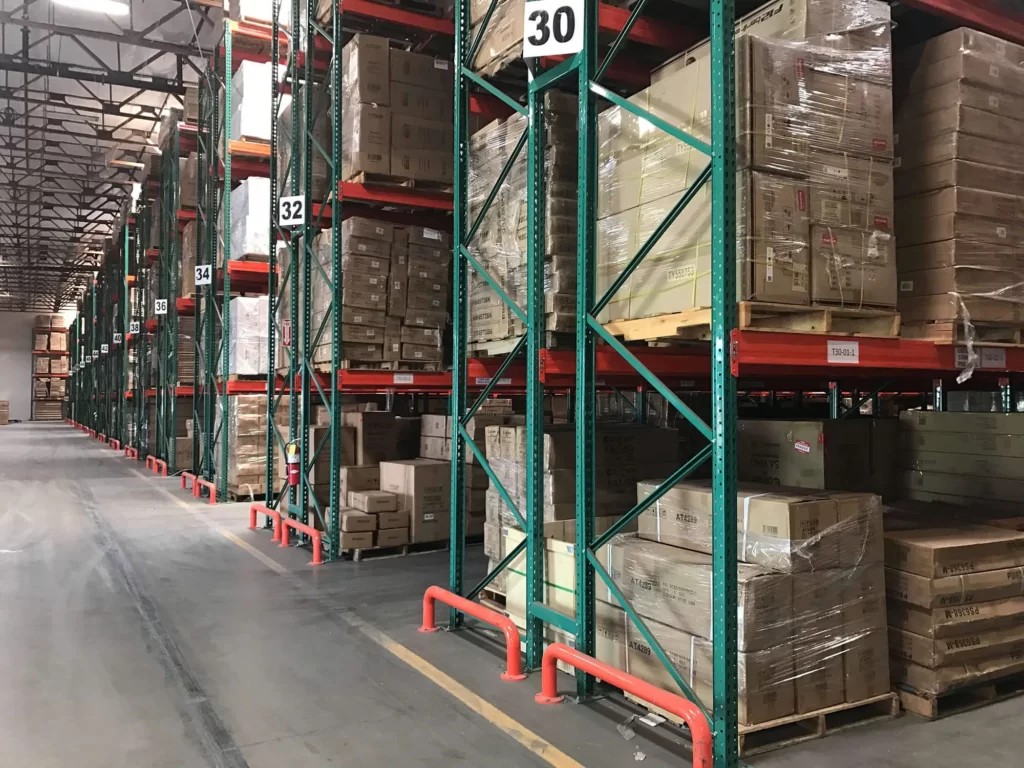
Selective racking is the default backbone of most logistics warehouses. It gives direct access to every pallet, which keeps picking simple and supports a wide SKU range, the norm in distribution and 3PL operations.
It trades density for accessibility, so it is the foundation operators build around, then supplement with denser systems where the SKU profile allows.

Double-Deep and Very Narrow Aisle Racking
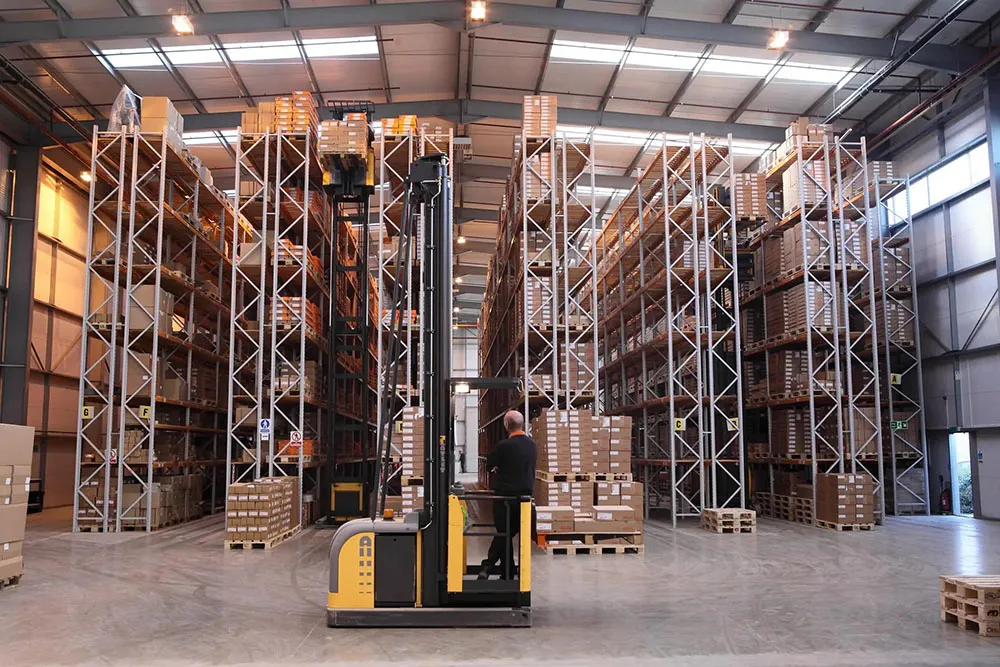
When space tightens but selectivity still matters, narrow aisle racking shrinks the aisles and lets specialized trucks reach more positions, recovering floor area without losing access. Double-deep racking stores pallets two deep with a reach truck, roughly doubling density for SKUs with more than one pallet on hand.
These systems are the practical middle ground for logistics buildings that need both reach and reasonable density.
Drive-In Racking
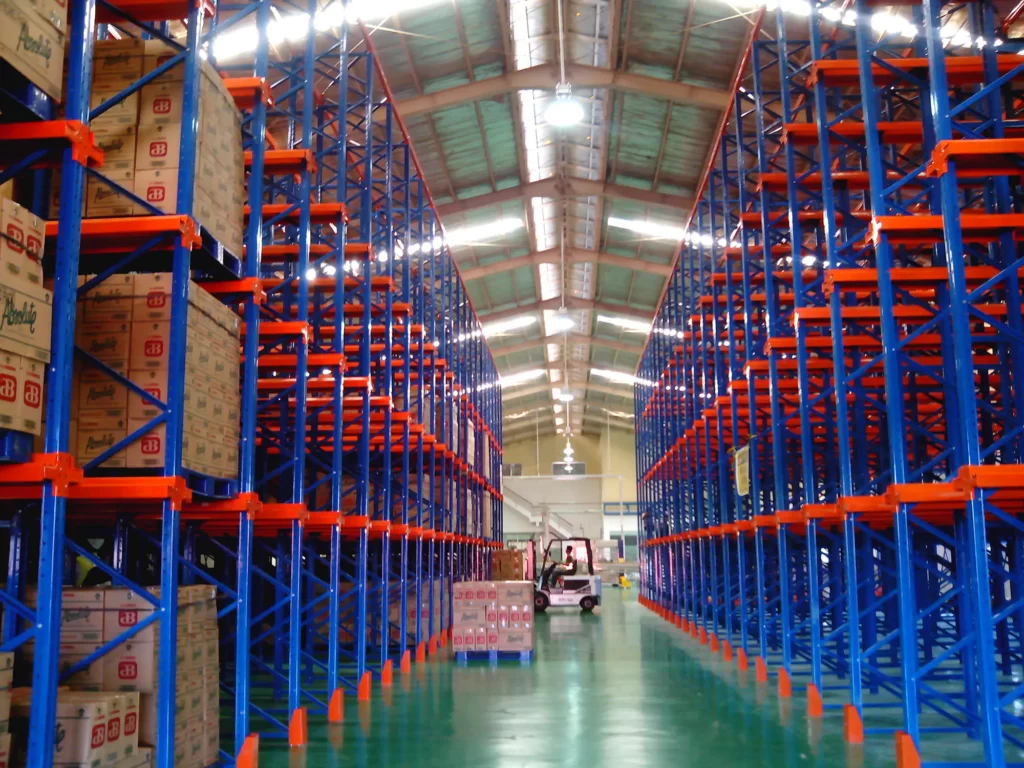
Drive-in racking packs pallets several positions deep into shared lanes, delivering high density for uniform, high-volume SKUs. It suits bulk storage and buffer stock where individual pallet access is not important.
The trade-off is low selectivity, so it works best for a limited range of fast-stable products.

Push-Back Racking
Push-back racking holds pallets several deep on inclined rails, working last-in, first-out. It offers a strong balance of density and access, letting one face serve many pallets while still handling multiple SKUs.
It is well suited to buffering and staging within a distribution flow, where deep storage helps but strict rotation is not essential.
Pallet Flow Racking
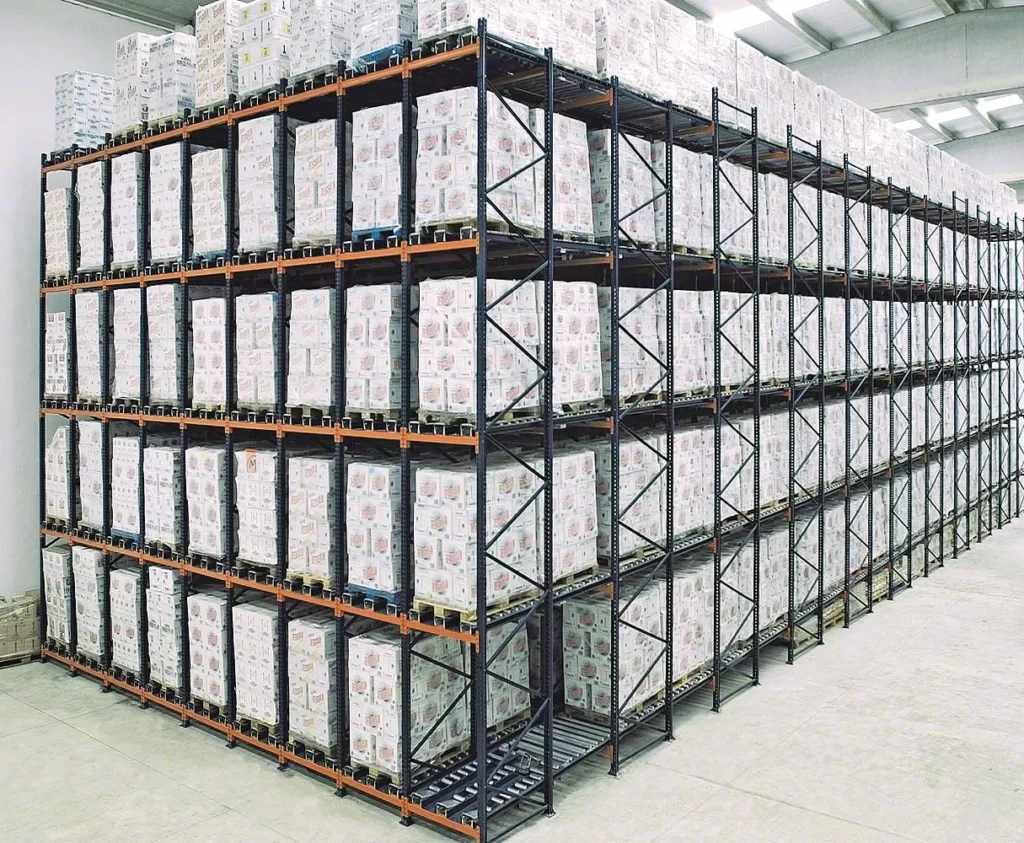
Pallet flow racking uses gravity rollers so pallets travel from the loading side to the pick face, enforcing first-in, first-out automatically. For high-turnover logistics operations it combines dense, deep-lane storage with fast, reliable rotation and minimal forklift movement.
This makes it a strong fit wherever throughput and stock rotation both matter, separating replenishment from picking on opposite sides of the rack.
Pallet Shuttle Systems
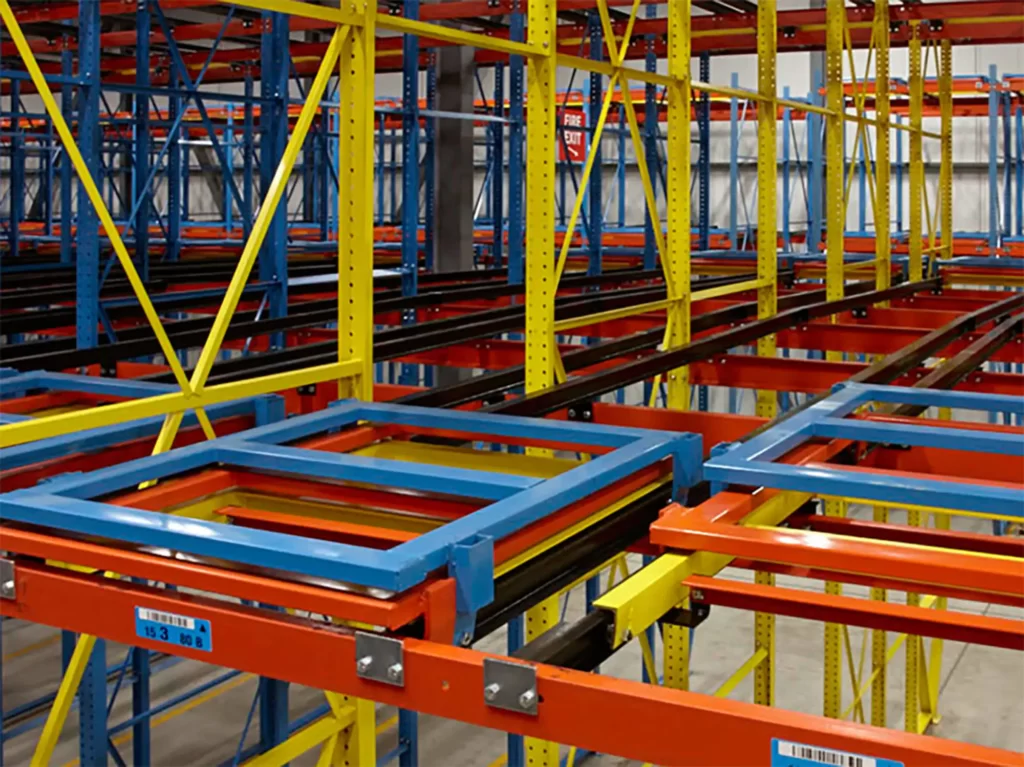
The radio shuttle racking is where high-density racking meets automation. A motorized shuttle carries pallets deep into lanes while the forklift stays at the aisle, lifting both density and throughput at once.
This category is growing quickly. Automation-integrated racking such as pallet shuttles and AI-enabled systems is transforming storage efficiency and throughput, and multidirectional shuttles that move between lanes and levels autonomously are gaining ground in high-throughput inbound and outbound operations.

Mobile Racking
Mobile racking mounts rows on powered bases that slide along tracks, eliminating fixed aisles and opening one only where work is happening. It delivers very high density while preserving access to every pallet, ideal for slower-moving inventory and space-constrained buildings.
Pick Modules, Mezzanines, and Shelving for Order Fulfillment
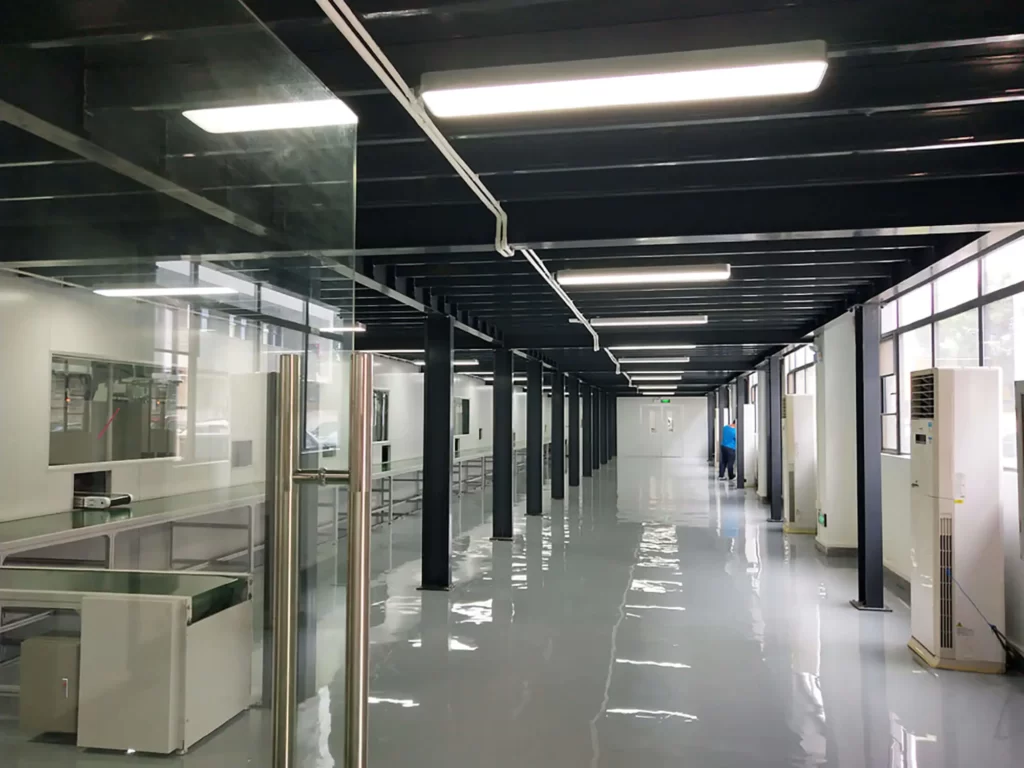
E-commerce and 3PL fulfillment rely on fast piece and case picking, not just pallet moves. Multi-tier pick modules built on a mezzanine floor stack several picking levels into the building height, while carton flow and longspan shelving present cases and small items at an ergonomic pick face.
This is the fastest-growing area of logistics storage, driven by online retail’s demand for high-density, accessible picking layouts.
Slotting and Layout: Turning Racking Into Speed
The right racking only pays off inside a layout that reflects how goods actually move. Logistics warehouses slot inventory by velocity, placing the fastest-moving SKUs in the most accessible positions near dispatch.
Modern systems take this further. Advanced warehouse management systems use predictive analytics to position fast-moving goods as close to packing stations as possible and adjust storage density based on forecast turnover.
A typical logistics layout zones the building by function: bulk reserve storage in dense racking, fast-pick faces fed by flow systems, returns and value-added areas in flexible zones, and staging or cross-dock space near the doors. Pairing dense bulk racking with accessible pick faces lets one building serve both storage and high-velocity fulfillment.
The principle that ties it together is simple: minimize the distance goods and people travel. A small number of fast-moving SKUs usually accounts for the bulk of order lines, so positioning those items closest to packing and dispatch cuts the most travel for the least effort. Slower lines move to denser, deeper storage where access is less frequent. Done well, this velocity-based slotting can lift picking productivity without buying a single extra rack.
Cross-docking adds another layer, moving goods straight from inbound to outbound with minimal storage. Even here, racking matters for the staging and overflow that keep the flow smooth.
The 3PL Factor: Racking for Multi-Client Warehousing
Third-party logistics providers deserve a section of their own, because they are now the largest single driver of racking demand. 3PLs run multi-client warehouses, storing goods for many different brands under one roof, which puts a premium on flexible, scalable racking that can be reconfigured as clients come and go.
The growth here is real. In some markets, 3PL operators account for roughly a third of warehouse leasing, with leasing activity rising sharply year over year. Every new contract can bring a different product profile, from palletized bulk to small-item e-commerce, so a 3PL cannot lock itself into one rigid system.
This is why adjustable, modular racking matters so much in logistics. Beam levels that re-set quickly, systems that mix pallet storage with pick faces, and layouts that can shift between clients let a 3PL re-slot a building in weeks rather than months. The racking becomes a flexible platform that the operator reconfigures repeatedly over the life of the facility, rather than a one-time fit-out.
Designing for Flexibility and Automation
Logistics demand is volatile, so the strongest warehouses build in room to change. Modular racking that can be reconfigured as SKU profiles and order volumes shift avoids costly redesigns when the business model evolves.
Automation readiness is now a core design factor. Growth in racking is driven less by adding square footage and more by demand for higher density, faster turnover, and smarter, automation-integrated systems, from pallet shuttles to automated storage and retrieval that move totes within the racking structure.
The practical takeaway is to specify racking that can accept automation later, even if the warehouse starts manual. Designing for shuttles, conveyors, or robotic picking from the outset protects the investment as volumes grow.
Sourcing Logistics Racking From a China Manufacturer
The systems described here, selective and narrow-aisle racking, drive-in, push-back, pallet flow, radio shuttle, mobile racking, and multi-tier pick modules, all perform best when engineered to the building and the flow. Sourcing from an established manufacturer in China is a practical route to that customization at a competitive cost, which matters in a sector where scale is large and margins are tight. For broader industry context, Rack Manufacturers Institute (RMI) is a useful reference.
This is also where much of the world’s racking is made. East Asia leads the global industrial racking market with around a third of total share, driven by strong manufacturing output and export logistics.
A capable manufacturer can supply a coordinated range across storage and fulfillment, engineered to work together and ready for automation. The standard international-sourcing points apply: plan for freight and lead times so racking arrives ahead of fit-out, and require proper engineering and load documentation that meets the standards at your site. Handled well, this combines lower equipment cost with a system designed for the density, throughput, and flexibility that logistics warehousing demands.
Final Thoughts
Logistics warehousing lives or dies on flow, and warehouse racking is what shapes that flow. The racking sets how densely a building stores, how fast it picks, how easily it adapts, and how ready it is for the automation reshaping the industry.
The best logistics operations match each task to the right system: selective racking for access, narrow-aisle and double-deep for space, drive-in and push-back for bulk, pallet flow and shuttle systems for high-velocity rotation, mobile racking for dense reserve, and pick modules on mezzanines for e-commerce fulfillment. They slot by velocity, design for change, and build with automation in mind. Specify the racking well, source it from a manufacturer who understands logistics, and the warehouse becomes not a cost center but a competitive edge in the supply chain. For product-level details, review Double Deep vs Selective Pallet Racking.