High-density storage solutions are increasingly adopted by warehouse operators, distribution centers, and cold storage facilities seeking to maximize cubic space utilization without expanding facility footprints. Rising real estate costs, growing SKU portfolios, and the expansion of e-commerce fulfillment have made storage density a central concern in modern warehouse design. Choosing between drive-in racking, push-back racking, pallet flow racking, radio shuttle systems, VNA racking, and mobile racking requires a clear understanding of how each system performs in terms of density, accessibility, throughput, and cost. A related guide on 4 Way Pallet Shuttle Racking System gives more detail for this part of the planning work.
What Are High-Density Storage Solutions?
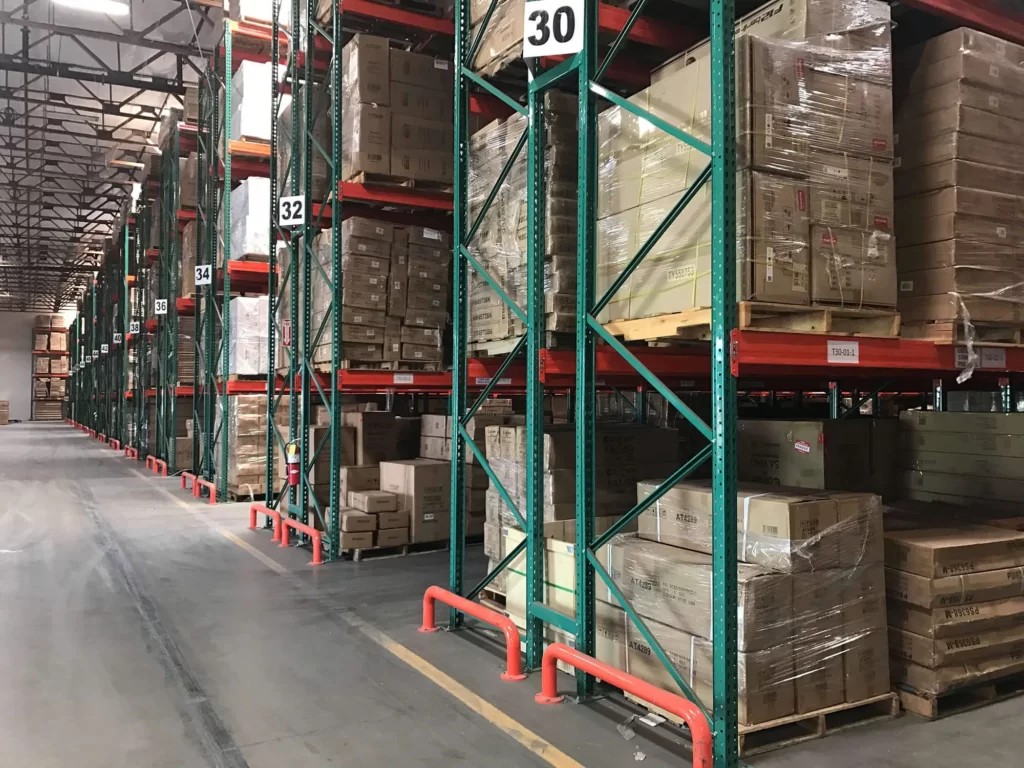
High-density storage solutions are warehouse racking systems engineered to maximize the volume of goods stored per square meter of floor space by reducing aisle area and increasing pallet depth, height, or both. Compared to standard selective pallet racking, which typically achieves 35–40% floor utilization, high-density systems can reach 60–85% utilization depending on configuration.
These systems are most commonly applied where storage cost per pallet position is a critical metric — such as cold storage facilities, third-party logistics (3PL) warehouses, beverage distribution centers, automotive parts storage, and FMCG distribution networks. Warehouse operators considering high-density solutions generally evaluate trade-offs between storage capacity, picking flexibility, throughput speed, and capital investment.
The most widely used high-density storage solutions include drive-in racking, push-back racking, pallet flow racking, radio shuttle racking, very narrow aisle (VNA) racking, and mobile pallet racking. Each system addresses different operational priorities and is suited to specific SKU profiles and warehouse layouts. For product-level details, review Drive in Racking.
Drive-In and Drive-Through Racking
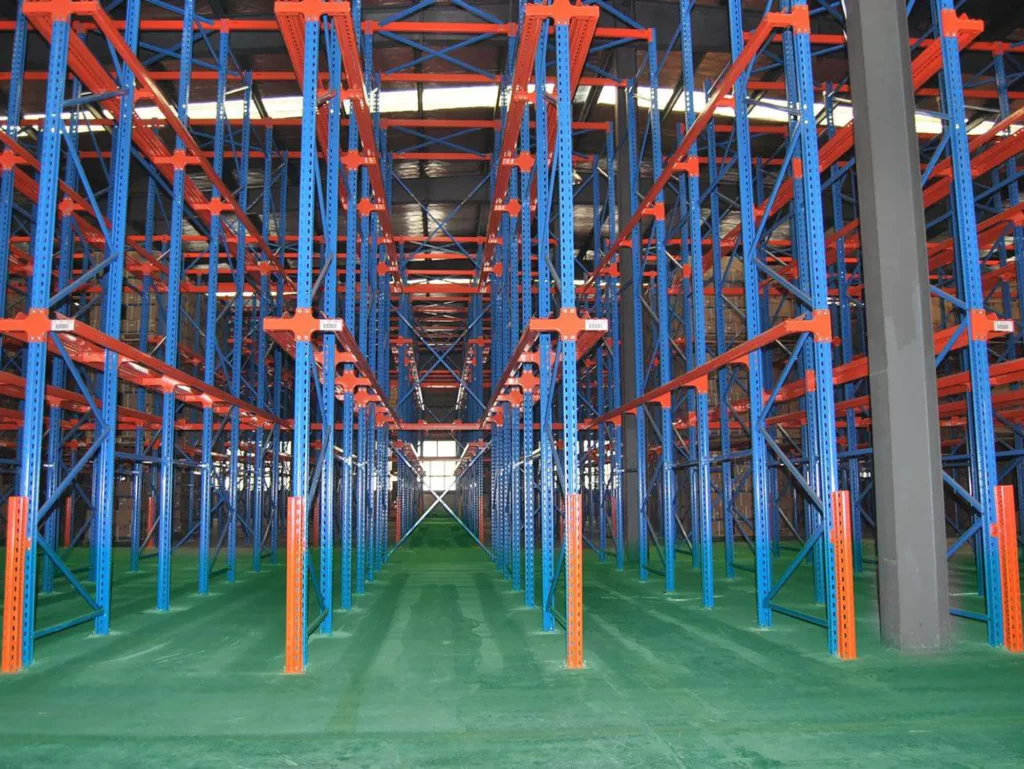
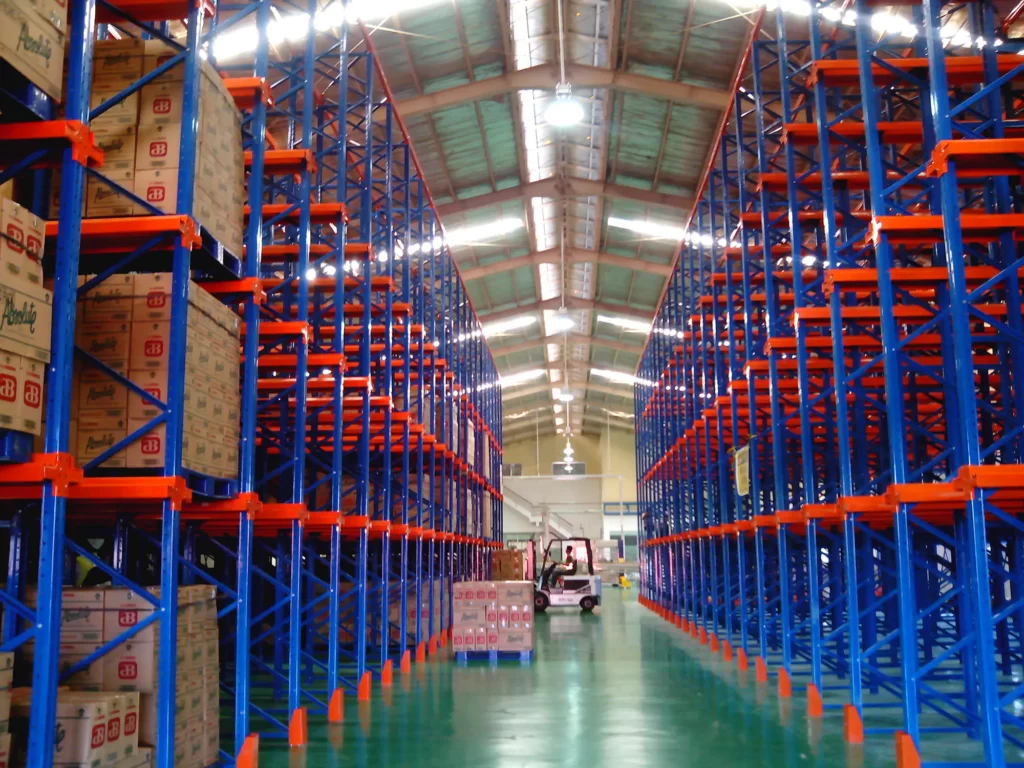
Drive-in racking is a high-density block storage system in which forklifts enter the rack structure through deep storage lanes to load and retrieve pallets. Pallets rest on support rails attached to upright frames, with no aisles between rack rows. Drive-in racking operates on a Last In, First Out (LIFO) basis, while drive-through racking — which provides access from both ends — supports First In, First Out (FIFO) rotation.
This system offers some of the highest static storage densities available, typically increasing pallet capacity by 60–75% compared to selective racking. It is particularly suited to warehouses storing large quantities of identical SKUs, such as cold storage operations, beverage warehouses, and seasonal goods distribution. Detailed structural specifications for drive-in pallet racking systems are typically documented by manufacturers based on lane depth, beam height, and load capacity per pallet position.
The main limitation is reduced selectivity. Each lane should contain a single SKU, and access to rear pallets requires the removal of forward pallets. Forklift operation inside the racking structure also demands skilled drivers and increases the risk of structural damage if not managed carefully.
Push-Back Racking
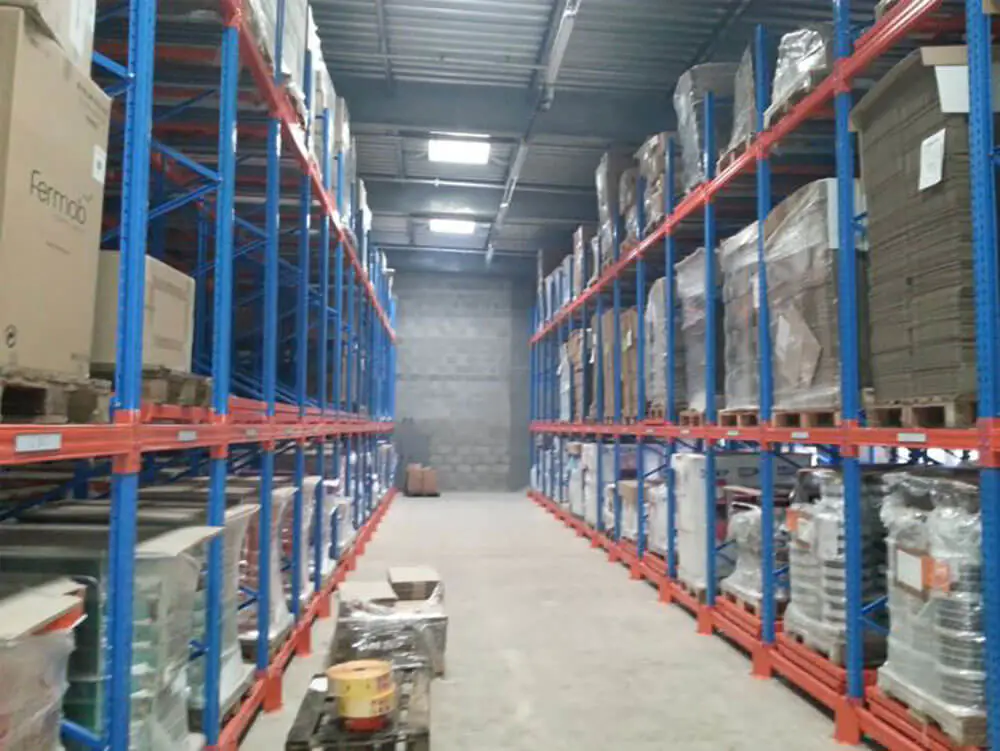
Push-back racking is a semi-dynamic high-density storage system that uses inclined rails and nested carts to store pallets up to six deep per lane. When a new pallet is loaded, it pushes the previous pallet backward along the rails. When a pallet is removed, the remaining pallets roll forward by gravity into the picking position.
The system operates on a LIFO basis but offers significantly better throughput than drive-in racking because forklifts do not enter the rack structure. This reduces handling time, minimizes rack damage, and improves operator safety. Push-back racking typically supports 2 to 6 pallets deep, making it well-suited to medium-density applications with moderate SKU variety.
Push-back is widely used in distribution centers handling fast-moving consumer goods, where each lane stores a single SKU but multiple SKUs are required across the warehouse. The trade-off is higher capital cost compared to drive-in racking and limited depth scalability beyond six pallets.
Pallet Flow Racking
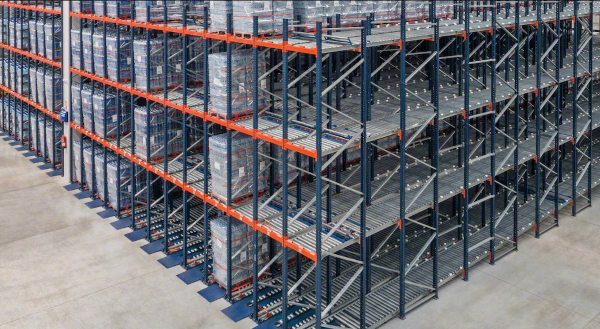
Pallet flow racking, also known as gravity flow racking, uses inclined gravity rollers or wheels to move pallets from the loading side to the picking side of the rack. Pallets are loaded at the higher end and flow downward under gravity, allowing strict First In, First Out (FIFO) rotation. Speed controllers regulate pallet movement to ensure safe travel through the lane.
This system is widely used in cold storage, food and beverage warehouses, and pharmaceutical distribution centers where FIFO rotation and expiration date control are critical. Pallet flow racking can store pallets up to 20 deep per lane and supports high throughput rates because loading and picking occur on separate aisles, eliminating cross-traffic.
The main limitations are higher capital investment, the need for consistent pallet quality to ensure smooth gravity flow, and limited flexibility when SKU mix changes frequently. Pallet flow systems also require careful structural engineering to handle dynamic loads and maintain safe pallet velocity.
Radio Shuttle Racking
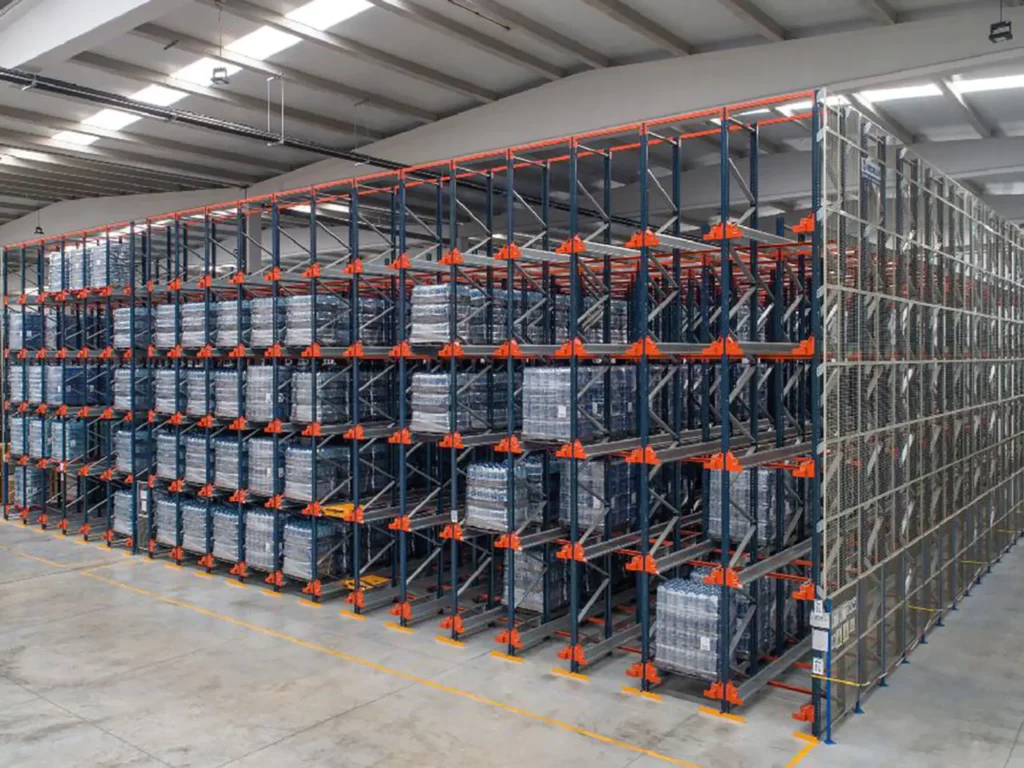
Radio shuttle racking is a semi-automated high-density storage system in which a battery-powered shuttle car moves pallets within the rack structure under wireless remote control. Forklifts place pallets at the lane entrance, and the shuttle transports them into the deep storage position. The system supports both FIFO and LIFO configurations depending on lane design.
Radio shuttle systems offer storage densities comparable to drive-in racking but with significantly higher throughput, lower forklift damage rates, and reduced labor demands. Lane depths of 20 to 40 pallets are common. Because forklifts do not enter the rack, the structural integrity of the system is preserved over longer service life. This point also connects with Do Drive-In Racking Systems Require a Dedicated Forklift?.
This solution is particularly attractive for cold storage operations, where labor costs and equipment damage in low-temperature environments are higher than in ambient warehouses. It is also widely deployed in beverage, dairy, and frozen food distribution centers. Reference configurations for radio shuttle racking systems typically specify shuttle payload capacity, battery autonomy, and lane depth limits. The primary trade-off is higher upfront investment, including shuttle units, charging infrastructure, and control systems.
Very Narrow Aisle (VNA) Racking
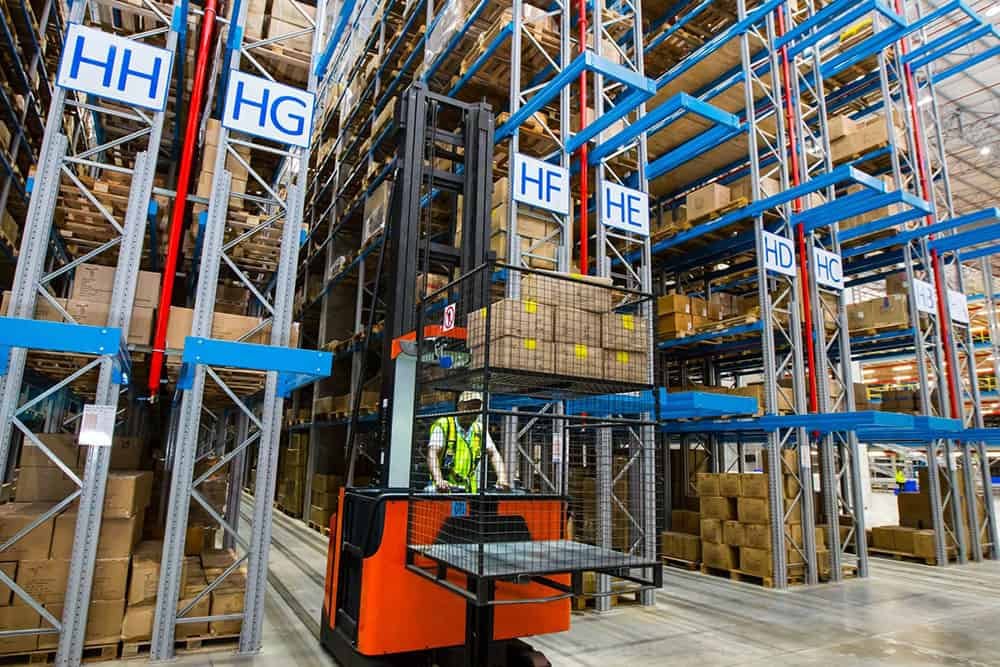
Very narrow aisle racking uses standard selective pallet racking configurations but with aisle widths reduced to between 1.5 and 1.8 meters — compared to 3.0 to 3.5 meters for conventional forklift operations. Specialized turret trucks or guided VNA forklifts operate within these narrow aisles, often using wire or rail guidance systems to maintain precise positioning.
The main advantage of VNA racking is that it combines high storage density with 100% pallet selectivity. Every pallet remains directly accessible, which is not possible in drive-in, push-back, or pallet flow systems. VNA configurations can increase storage capacity by 40–50% compared to wide-aisle selective racking on the same footprint.
VNA is widely used in distribution centers with high SKU variety and moderate-to-high pick frequency, including spare parts warehouses, e-commerce fulfillment centers, and industrial component distribution. Project planners typically reference manufacturer specifications for VNA pallet racking to confirm aisle width, upright spacing, and turret truck compatibility. Limitations include the requirement for very flat floors (typically FM2 or FM1 specification), dedicated guided forklift fleets, and higher initial capital investment for both racking and material handling equipment.
Mobile Pallet Racking
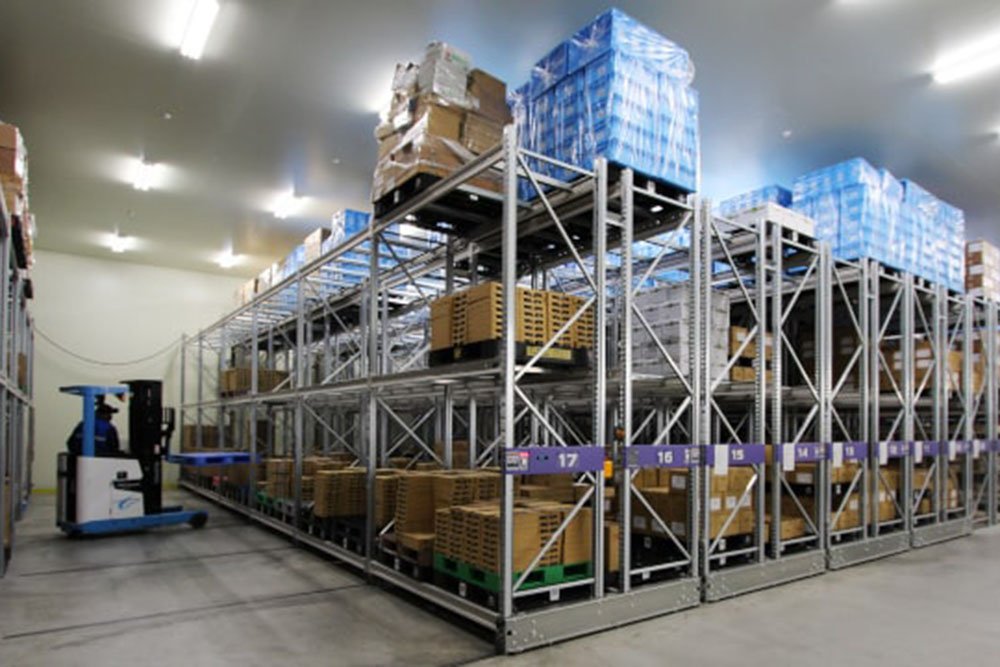
Mobile pallet racking consists of standard selective racking units mounted on motorized bases that travel along floor-embedded rails. Only one aisle is open at any given time; the entire row of racks shifts laterally to create access where needed. This design eliminates the need for permanent aisles between every rack row.
Mobile racking can increase storage density by 80–90% compared to conventional selective racking while maintaining full pallet selectivity. It is most commonly used in cold storage and freezer warehouses, where every cubic meter of refrigerated space carries a high operating cost. Pharmaceutical, archive, and high-value goods storage are additional common applications. Manufacturer documentation for mobile pallet racking systems typically specifies rail load capacity, drive motor configuration, and integrated safety systems such as light curtains and emergency stops.
The trade-offs include higher capital investment, slower throughput due to the time required to open aisles, the need for reinforced floors to support rail systems, and additional safety controls to protect operators inside the open aisle.
High-Density Storage Solutions: Comparison Table
The following table summarizes the key performance characteristics of the six high-density storage solutions discussed above. Comparisons are based on typical warehouse configurations and reflect general industry benchmarks rather than specific project values.
| System | Storage Density | Selectivity | Rotation | Throughput | Typical Lane Depth | Capital Cost |
|---|---|---|---|---|---|---|
| Drive-In Racking | Very High | Low | LIFO | Low | 6–10 pallets | Low |
| Drive-Through | Very High | Low | FIFO | Low | 6–10 pallets | Low–Medium |
| Push-Back Racking | High | Medium | LIFO | Medium | 2–6 pallets | Medium |
| Pallet Flow Racking | High | Medium | FIFO | High | Up to 20 pallets | High |
| Radio Shuttle | Very High | Medium | FIFO or LIFO | High | 20–40 pallets | Very High |
| VNA Racking | Medium–High | Very High | Flexible | High | 1 pallet | High |
| Mobile Racking | Very High | Very High | Flexible | Low–Medium | 1 pallet | Very High |
Operators should interpret these benchmarks as relative indicators rather than absolute specifications. Actual performance depends on SKU profile, pallet dimensions, building height, forklift capability, and warehouse management system configuration.
How to Choose the Right High-Density Storage Solution
Selecting the appropriate high-density storage solution involves balancing density, selectivity, rotation requirements, and total cost of ownership. The following step-by-step framework reflects the evaluation process commonly used by warehouse planners and storage system integrators.
Step 1: Analyze SKU Profile.
Determine how many SKUs the warehouse handles, how many pallets per SKU are stored on average, and how frequently each SKU is picked. Low SKU count with high pallet count per SKU favors drive-in or shuttle systems. High SKU count favors VNA or mobile racking.
Step 2: Define Rotation Requirements.
Identify whether goods require FIFO rotation (perishables, pharmaceuticals, expiration-dated products) or whether LIFO is acceptable (raw materials, non-perishable bulk goods). FIFO requirements eliminate drive-in and push-back as primary options.
Step 3: Calculate Pallet Positions and Throughput.
Estimate peak inbound and outbound pallet movements per hour. High-throughput operations benefit from radio shuttle or pallet flow systems, while lower-throughput, storage-focused operations can use drive-in or mobile racking.
Step 4: Evaluate Building Constraints.
Measure clear ceiling height, floor flatness, column spacing, and fire protection layout. VNA and mobile racking require strict floor flatness; high-bay shuttle systems benefit from tall buildings.
Step 5: Assess Forklift and Equipment Compatibility.
Confirm whether the existing forklift fleet can operate within the chosen system. VNA requires turret trucks; shuttle systems require compatible pallet quality; mobile racking requires guidance systems.
Step 6: Compare Total Cost of Ownership.
Include not only racking cost but also installation, forklift investment, maintenance, and labor productivity. Industry organizations such as the Material Handling Institute (MHI) publish reference data useful for benchmarking.
Step 7: Verify Safety and Compliance.
Ensure compliance with applicable rack design standards such as the Rack Manufacturers Institute (RMI) ANSI MH16.1 specification and workplace safety requirements published by OSHA.
Best Use Cases by Industry
Different industries gravitate toward different high-density storage solutions based on SKU characteristics and operational priorities:
- Cold Storage and Frozen Food. Radio shuttle, mobile racking, and pallet flow racking are dominant due to high real estate cost per cubic meter.
- Beverage and Dairy Distribution. Drive-in and pallet flow systems are widely used for high-volume single-SKU storage.
- Pharmaceutical Warehousing. Pallet flow and VNA racking support FIFO rotation and traceability requirements.
- Automotive Parts Distribution. VNA racking is preferred for high SKU variety with moderate pallet quantity per SKU.
- E-commerce Fulfillment. VNA and shuttle racking support broad SKU coverage with rapid retrieval.
- Bulk Raw Materials and Seasonal Goods. Drive-in and push-back racking provide cost-effective dense storage where rotation flexibility is not critical.
Key Takeaways
- High-density storage solutions can increase pallet capacity by 60–90% compared to conventional selective racking, depending on system type.
- Drive-in and push-back racking offer the lowest capital cost per pallet position but limit selectivity and rotation flexibility.
- Pallet flow and radio shuttle systems combine high density with FIFO capability, making them well-suited to perishable and regulated goods.
- VNA and mobile racking preserve full pallet selectivity, which is essential for warehouses with high SKU counts.
- System selection should be based on SKU profile, rotation requirements, throughput, building constraints, and total cost of ownership rather than density alone.
Frequently Asked Questions About High-Density Storage Solutions
1. What is the difference between high-density storage and selective pallet racking?
Selective pallet racking provides direct access to every pallet but uses 60–65% of warehouse space for aisles. High-density storage solutions reduce aisle area or increase pallet depth to store more goods in the same footprint, typically at the cost of reduced selectivity or slower retrieval.
2. Which high-density storage system has the highest capacity?
Radio shuttle racking and mobile racking generally offer the highest pallet capacity per square meter, often exceeding 80% floor utilization. Drive-in racking provides similar density at lower capital cost but with reduced throughput.
3. Is drive-in racking suitable for FIFO operations?
Standard drive-in racking operates on a LIFO basis and is not suitable for strict FIFO. Drive-through racking, which is accessible from both ends, supports FIFO but requires more floor space and is less commonly used.
4. What is the typical ROI period for high-density storage solutions?
Return on investment depends on land cost, throughput improvements, and labor savings. Simple systems such as drive-in racking can pay back within 2–4 years, while shuttle and mobile systems typically range from 4–7 years depending on operating conditions. For a closer comparison, see Shuttle Racking vs ASRS.
5. Can high-density storage solutions be retrofitted into existing warehouses?
Yes, most systems can be installed in existing buildings, but floor flatness, ceiling height, fire protection, and column spacing must be evaluated. VNA and mobile racking have the strictest building requirements.
6. Do high-density systems require specialized forklifts?
Drive-in and push-back systems use standard counterbalance or reach trucks. Radio shuttle systems require compatible shuttle cars. VNA requires turret trucks or man-up order pickers. Mobile racking uses standard forklifts but with controlled aisle access.
7. Are high-density storage solutions suitable for small warehouses?
Small warehouses can benefit from push-back or VNA racking. Very deep systems such as drive-in or shuttle racking are typically more cost-effective in warehouses with at least 2,000 to 3,000 pallet positions.
8. How does high-density storage affect warehouse safety?
Properly engineered high-density systems can improve safety by reducing forklift travel, minimizing aisle congestion, and limiting human entry into storage lanes. However, rack design must comply with RMI and local structural standards, and operator training is essential.
Conclusion
High-density storage solutions have become a strategic priority for warehouse operators facing rising real estate costs, expanding SKU portfolios, and increasing throughput demands. The optimal system depends on a careful evaluation of SKU profile, rotation requirements, throughput targets, building constraints, and capital availability. Drive-in, push-back, pallet flow, radio shuttle, VNA, and mobile racking each occupy distinct positions on the density-versus-selectivity spectrum, and few warehouses rely on a single solution. Most modern facilities combine two or more systems to balance bulk storage efficiency with operational flexibility.
Warehouse planning increasingly treats racking selection as part of an integrated design that includes material handling equipment, warehouse management software, and building infrastructure. Comprehensive evaluation against industry standards such as those published by FEM and the Rack Manufacturers Institute supports both safety and long-term performance.
Among the suppliers active in this segment, Mracking is one of the Chinese manufacturers producing the full range of high-density configurations discussed above, from drive-in and push-back systems to radio shuttle, VNA, and mobile pallet racking, with project specifications typically tailored to building dimensions, pallet standards, and rotation requirements.