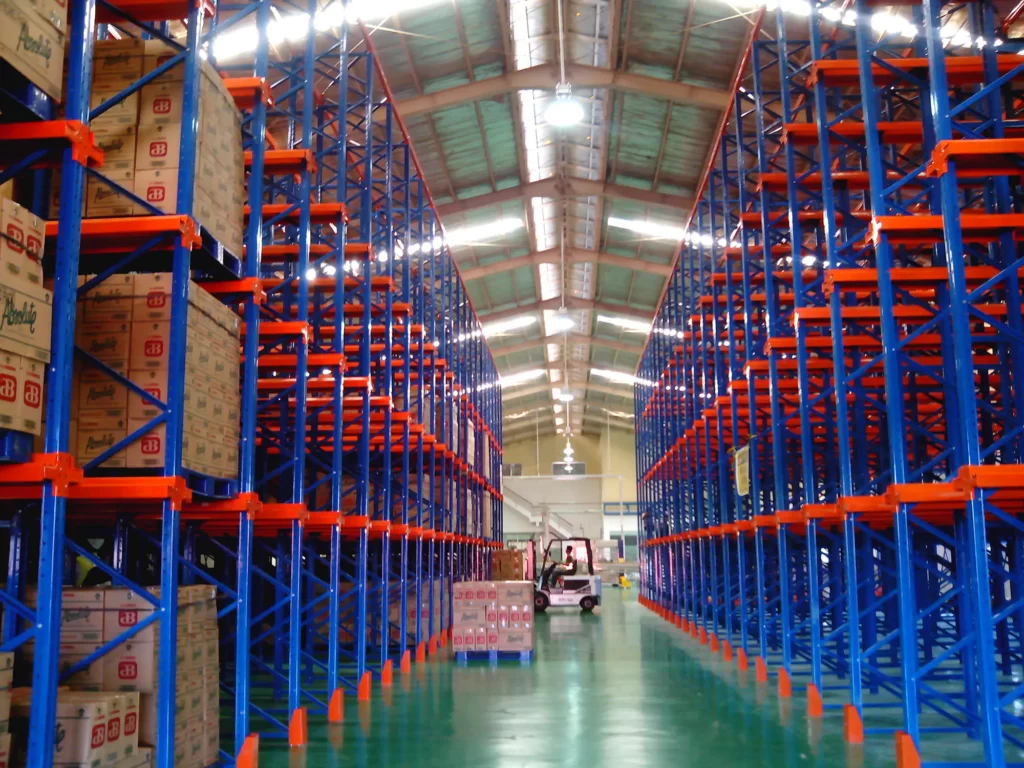
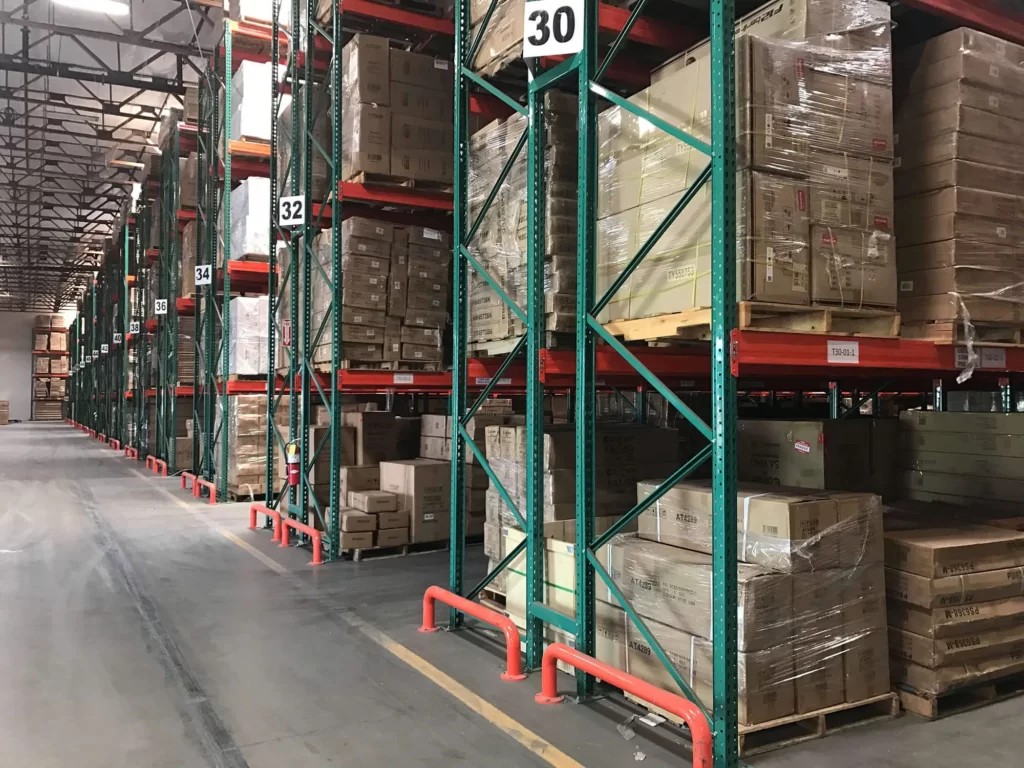
Drive-in pallet racking prices vary widely depending on specification, region, and supplier — often by a factor of two or three for systems that look outwardly similar. Warehouse operators comparing quotations frequently discover that the same nominal “drive-in racking” can differ significantly in steel gauge, upright profile, coating, engineering documentation, and included accessories, all of which shift the price. Understanding what actually drives drive-in pallet racking prices — and how to evaluate suppliers, particularly Chinese manufacturers who supply a large share of the global market — is essential for making a cost-effective purchasing decision without sacrificing safety or long-term performance.
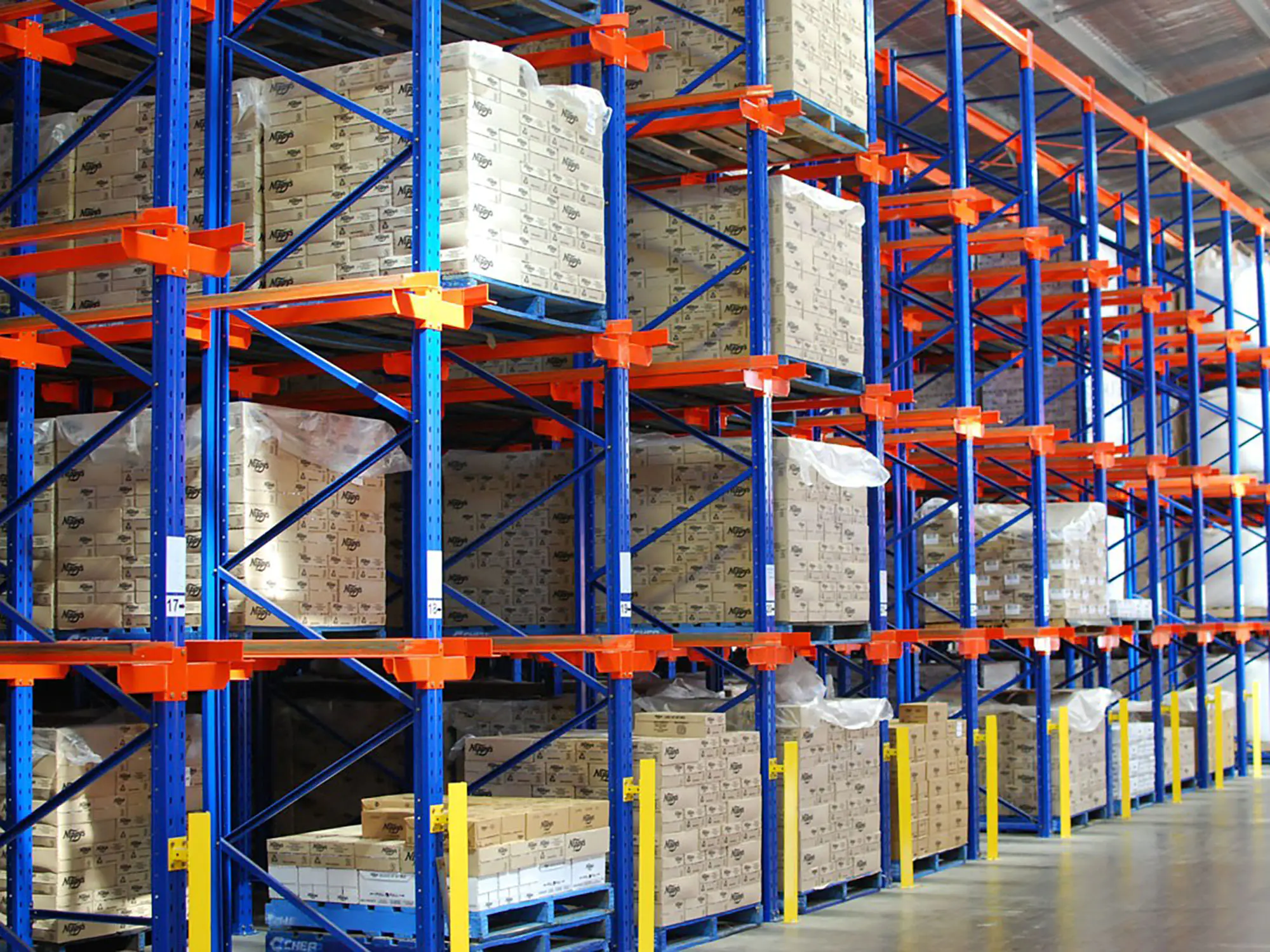
This article examines the main factors that affect drive-in pallet racking prices, outlines typical price ranges, compares regional cost differences, and explains how warehouse operators can source competitively from Chinese suppliers while maintaining engineering and quality standards.
What Determines Drive-In Pallet Racking Prices?
Drive-in pallet racking prices are determined by a combination of raw material cost (primarily structural steel), engineered specifications (upright profile, beam or rail dimensions, gauge, load rating), surface treatment, lane depth and system size, compliance with regional design standards, and the supplier’s manufacturing base and export logistics. Unlike commodity products with fixed catalog pricing, drive-in racking is quoted per project, meaning small differences in specification produce meaningful differences in final cost.
The most transparent way to compare drive-in pallet racking prices is on a per-pallet-position basis rather than per bay or per meter. Per-pallet-position pricing accounts for the fact that deeper lanes and higher tiers reduce cost per position, while heavy loads, cold storage finishes, or elevated seismic requirements increase it. Detailed technical guidance on the system itself is available in drive-in racking guide, which help buyers evaluate whether a quotation reflects the intended specification.
Key Factors That Affect Drive-In Pallet Racking Prices
Seven variables account for most of the variation in drive-in pallet racking prices.

Steel Cost and Gauge. Structural steel represents 60–75% of raw material cost. Prices for hot-rolled and cold-rolled steel fluctuate with global commodity markets, and gauge (material thickness) directly affects both cost and load capacity. Thicker uprights cost more per unit but provide higher stability and longer service life.
Upright Profile and Design. Roll-formed uprights are less expensive than hot-rolled structural profiles but generally offer lower impact resistance. Structural drive-in systems using C-channel or I-beam profiles cost significantly more but withstand forklift impact better — a decisive factor in high-traffic operations. Drive-in and drive-through racking systems are commonly available in both configurations.
Lane Depth and System Size. Cost per pallet position decreases as lane depth and system size increase, because fixed components (base plates, end frames, anchors) are amortized across more positions. A 4-pallet-deep system typically costs 15–25% more per position than a 10-pallet-deep system of the same specification.
Load Capacity per Pallet. Higher pallet weights require heavier rails, stronger uprights, and more extensive bracing. Systems rated for 1,000 kg pallets typically cost 30–40% less per position than systems engineered for 1,500 kg pallets.
Surface Treatment. Standard powder coating is the baseline finish. Hot-dip galvanization for cold storage or corrosive environments adds 15–30% to material cost. Specialized epoxy or polyester coatings for pharmaceutical or food-grade environments add further cost.
Accessories and Safety Components. Column protectors, guide rails, entry guards, safety pins, backstops, and rail-end stops are often quoted as separate line items. Full accessory packages can add 8–15% to base system cost but significantly reduce forklift impact damage and extend service life.
Regional Design Standards and Certification. Compliance with ANSI MH16.1 (North America), EN 15512 and EN 15620 (Europe), or AS 4084 (Australia) requires engineered documentation, load calculations, and often third-party certification. Certified engineered systems cost more than uncertified quotations but eliminate legal, insurance, and safety risks.
Typical Price Ranges for Drive-In Pallet Racking
Actual quotations vary by project, but the following ranges reflect general market benchmarks in mid-2020s conditions.
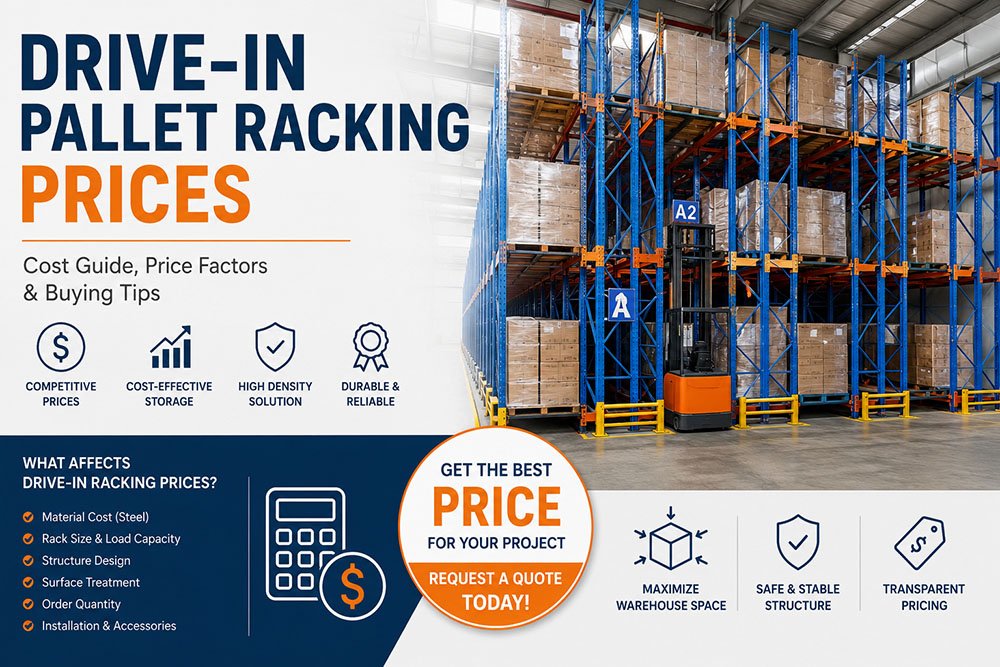
Roll-formed drive-in pallet racking sourced from Chinese manufacturers typically ranges from USD 45 to USD 90 per pallet position for standard configurations at moderate volumes. Structural drive-in systems generally range from USD 90 to USD 160 per pallet position. Cold storage finishes, seismic upgrades, and full accessory packages can add 20–40% on top of these base ranges. Additional cost data and market context are available in resources covering warehouse racking prices, which discuss both product cost and total installed cost drivers.
These figures represent ex-works or FOB pricing at the manufacturer’s port. Total delivered cost includes freight, insurance, import duty, inland transport, installation, and commissioning — factors that can add 30–70% to the ex-works price depending on destination and project scale.
Regional Price Differences: China vs Europe vs North America
Drive-in pallet racking prices differ significantly across manufacturing regions.
Chinese Manufacturers. China produces a large share of the global warehouse racking supply, benefiting from vertically integrated steel supply, high production volumes, and mature export logistics. Ex-works prices for equivalent specifications are typically 30–50% lower than European or North American manufacturers.
European Manufacturers. European producers focus on structural systems, strict certification, and integrated design services. Prices reflect higher labor, energy, and steel input costs, but also often include on-site engineering and installation supervision.
North American Manufacturers. North American drive-in racking is typically manufactured to ANSI MH16.1 with structural or heavy roll-formed profiles. Prices sit between European and Chinese levels, with shorter lead times for domestic buyers.
For buyers outside China, the cost advantage of Chinese sourcing narrows once freight, tariffs, and inland logistics are added, but often remains significant at project scale — particularly for medium and large systems where per-position cost differences accumulate.
How to Source Cost-Effective Drive-In Pallet Racking from China
Sourcing drive-in pallet racking from Chinese manufacturers can deliver meaningful cost savings, but success depends on structured supplier evaluation rather than reliance on headline unit price. The following practices reflect established international procurement approaches.

Request Engineered Quotations, Not Catalog Pricing.
Provide a detailed specification (pallet dimensions, load, height, lane depth, tier count, coating, applicable standard) and require the supplier to quote against it. Vague quotations often hide specification gaps that produce false price advantages.
Verify Design Standard Compliance.
Confirm that engineering documentation complies with the standard applicable in the destination country. Systems designed to Chinese domestic standards may not satisfy ANSI, EN, or AS requirements without modification.
Compare Steel Gauge and Upright Profile.
Two quotations at different prices often reflect different steel gauges. Request the exact steel grade, gauge, and upright section drawing to enable meaningful comparison. A 1.8 mm upright and a 2.5 mm upright are not interchangeable even if both are labeled “drive-in racking”.
Evaluate Coating Specification.
Confirm coating type (powder coat, hot-dip galvanization, epoxy), coating thickness in microns, and warranty against corrosion. Coating specification directly affects service life, particularly in cold storage or humid environments.
Assess Manufacturing Capacity and Quality Control.
Review the supplier’s production facilities, quality control procedures, and export history. Reputable Chinese manufacturers publish factory audit documentation and welcome pre-shipment inspection by third-party inspectors. Broader guidance on evaluating suppliers is available in resources on warehouse racking manufacturers in China.
Include Total Cost of Ownership in the Comparison.
Freight, duty, installation, spare parts availability, and long-term service should all factor into supplier selection. A 20% price advantage at ex-works can disappear if inland logistics or damaged shipments increase project cost.
Comparison Table: Drive-In Pallet Racking Price Drivers
| Cost Factor | Impact on Price | Key Consideration |
|---|---|---|
| Steel Gauge & Profile | High | Roll-formed vs structural, thickness in mm |
| Lane Depth & System Size | High | Cost per position drops with larger systems |
| Load Capacity | High | Heavier ratings require heavier steel |
| Surface Treatment | Medium | Powder coat, hot-dip galvanization, epoxy |
| Accessories & Safety | Medium | Column protectors, guide rails, backstops |
| Standards & Certification | Medium–High | ANSI MH16.1, EN 15512, AS 4084 compliance |
| Region of Manufacture | High | China vs Europe vs North America pricing |
| Freight & Import Costs | Medium–High | Ex-works vs delivered, tariffs and inland transit |
Reading a quotation without understanding these variables often leads buyers to select on price alone, only to discover that the low quotation excluded coating upgrades, certification documentation, or safety accessories that were assumed to be included.
Step-by-Step: How to Evaluate Drive-In Pallet Racking Suppliers
Step 1: Define the Full Specification Before Requesting Quotations.
Document pallet size, weight, height, throughput, cold or ambient environment, seismic zone, and applicable design standard.
Step 2: Solicit Multiple Quotations Against the Same Specification.
Request three to five quotations from different suppliers to establish market benchmarks and identify outliers in either direction.
Step 3: Compare Steel Gauge, Coating, and Accessories.
Line up quotations side by side and confirm that the underlying specifications match — not just the headline system description.
Step 4: Verify Engineering and Certification.
Request stamped or signed engineering calculations and confirm compliance with the applicable regional standard. Reference standards published by the Rack Manufacturers Institute (RMI) provide baseline design requirements.
Step 5: Audit the Manufacturer.
Conduct a factory audit or engage a third-party inspection service for facilities in unfamiliar regions. Review quality control procedures, welding standards, and export history.
Step 6: Calculate Total Landed Cost.
Add freight, insurance, customs duty, inland transport, installation, and commissioning to the ex-works quotation to compare true delivered cost per pallet position.
Step 7: Review Safety, Warranty, and Service Terms.
Confirm warranty duration, spare parts availability, damaged-shipment resolution process, and installation supervision. Workplace safety references from OSHA guide long-term operational compliance.
Common Pitfalls to Avoid
Buyers new to drive-in racking procurement — particularly cross-border sourcing — frequently encounter the following issues. Awareness of these pitfalls significantly improves outcomes.
Unspecified steel gauge in the quotation, allowing the supplier to substitute lighter material. Missing engineering documentation, leaving the buyer unable to prove compliance for insurance or building permit. Coating specification without micron thickness, resulting in premature corrosion. Excluded accessories that are essential for safe operation, creating change-order costs after installation. Freight terms that shift risk and cost to the buyer without clear communication. Lack of pre-shipment inspection, allowing manufacturing defects to reach the site. Poor packaging that causes transit damage on components with long lead times.
Key Takeaways
- Drive-in pallet racking prices are driven by steel gauge, upright profile, lane depth, load capacity, coating, accessories, and regional design standards.
- Typical ex-works prices from Chinese manufacturers range from USD 45 to USD 160 per pallet position depending on specification.
- Total delivered cost can add 30–70% to ex-works pricing once freight, duty, and installation are included.
- Chinese manufacturers offer significant price advantages but require structured supplier evaluation to ensure specification and compliance.
- Comparing quotations on a per-pallet-position basis and against identical specifications avoids most common procurement errors.
- Total cost of ownership — including service life, damage rates, and compliance — typically outweighs any short-term unit price advantage.
Frequently Asked Questions
1. How much does drive-in pallet racking typically cost per pallet position?
Roll-formed drive-in racking from Chinese manufacturers typically costs USD 45 to USD 90 per pallet position ex-works, while structural systems range from USD 90 to USD 160. Delivered cost including freight, duty, and installation can add 30–70% depending on destination.
2. Why do drive-in racking prices vary so much between suppliers?
Variation reflects differences in steel gauge, upright profile, coating, accessories, and engineering documentation. Two quotations at very different prices often reflect different underlying specifications rather than genuine supplier competitiveness.
3. Is it worth buying drive-in racking from China?
Chinese manufacturers offer competitive pricing due to vertically integrated steel supply and high production volumes. For medium and large projects, the cost advantage typically remains significant after freight and duty. Success depends on structured supplier evaluation and specification control.
4. What documentation should the supplier provide?
A complete quotation should include engineering drawings, load calculations, steel and coating specifications, compliance statement with the applicable regional standard, accessory list, and packaging and shipping details.
5. What is the difference between roll-formed and structural drive-in racking?
Roll-formed systems use cold-formed steel sections and are less expensive but generally offer lower impact resistance. Structural systems use hot-rolled C-channel or I-beam profiles, cost more, and withstand higher forklift impact — a common choice in cold storage and high-traffic operations.
6. How do I avoid low-quality drive-in racking?
Specify steel gauge in millimeters, coating thickness in microns, and applicable design standard in writing. Require engineering calculations and consider third-party inspection before shipment. Review the manufacturer’s export history and factory certifications.
7. Does drive-in racking require any special accessories?
Column protectors, entry guides, guide rails, backstops, and safety pins are strongly recommended in drive-in systems because forklifts enter the rack structure, increasing impact risk. Excluding accessories to reduce quoted price often leads to higher long-term damage costs.
8. How long does drive-in racking sourced from China typically take to deliver?
Manufacturing lead time is typically 30–60 days depending on system size and complexity. Ocean freight adds 25–45 days depending on destination. Total procurement timeline is usually 3–5 months from order to installation-ready delivery.
Conclusion
Drive-in pallet racking prices reflect a combination of steel cost, engineering specification, coating, accessories, and regional design standards — not a single fixed unit price. Buyers who understand these variables can compare quotations meaningfully, avoid common procurement pitfalls, and source cost-effectively from Chinese manufacturers who supply a significant portion of the global market. The most reliable approach is to define the full specification before requesting quotations, compare offers against identical inputs, and evaluate suppliers on engineering documentation and quality control rather than on headline price alone.
For warehouse operators sourcing drive-in pallet racking from Chinese manufacturers, price transparency and specification clarity are typically more decisive than unit cost alone. Mracking is one of the Chinese manufacturers producing drive-in and drive-through pallet racking systems, with pricing driven by the standard variables discussed in this article — steel gauge, upright profile, coating type, lane depth, tier count, and regional standard compliance — and available for evaluation against detailed project specifications during the quotation process.