Beam pallet racking is the most widely used warehouse storage system in the world, forming the backbone of general-purpose distribution centers, manufacturing plants, cold storage facilities, and 3PL operations. Its combination of direct pallet access, engineered load capacity, standardized components, and long service life makes it the default choice for most palletized inventory. Yet the term “beam pallet racking” covers a family of configurations rather than a single product, and the differences between selective, double deep, teardrop, structural, and narrow aisle designs directly affect storage density, forklift compatibility, and total cost. For a closer comparison, see Wide Aisle Racking.
This article explains what beam pallet racking is, how it is structurally composed, which main types are used in modern warehouses, and how to select the right configuration through a structured step-by-step process.
What Is Beam Pallet Racking?
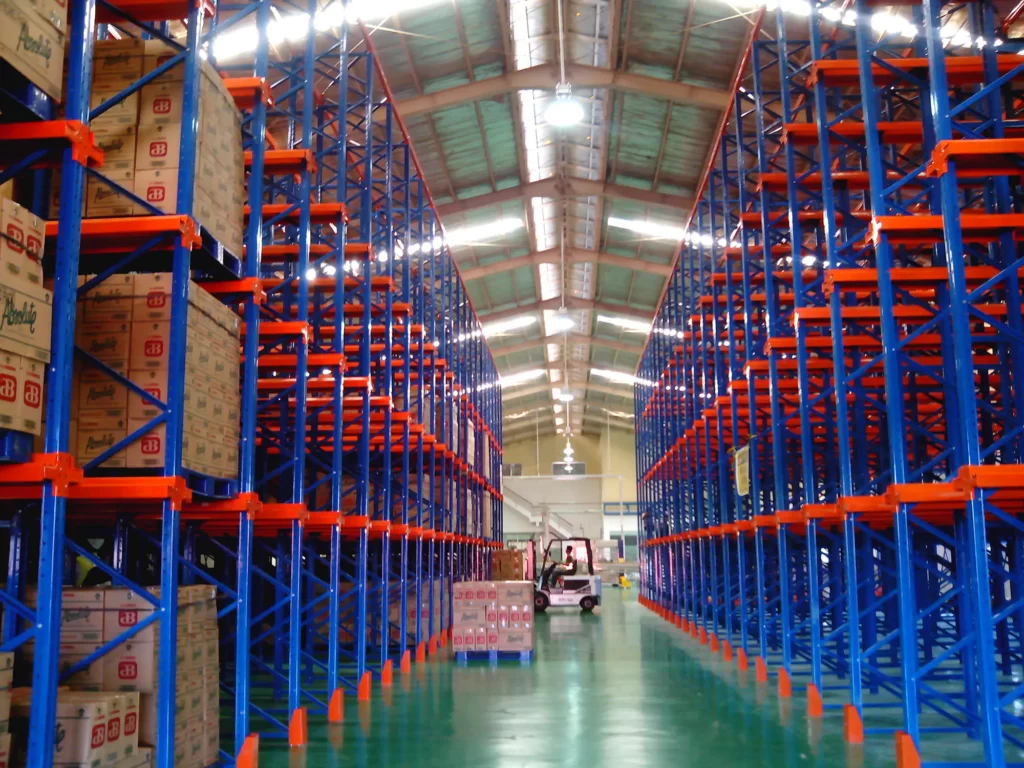
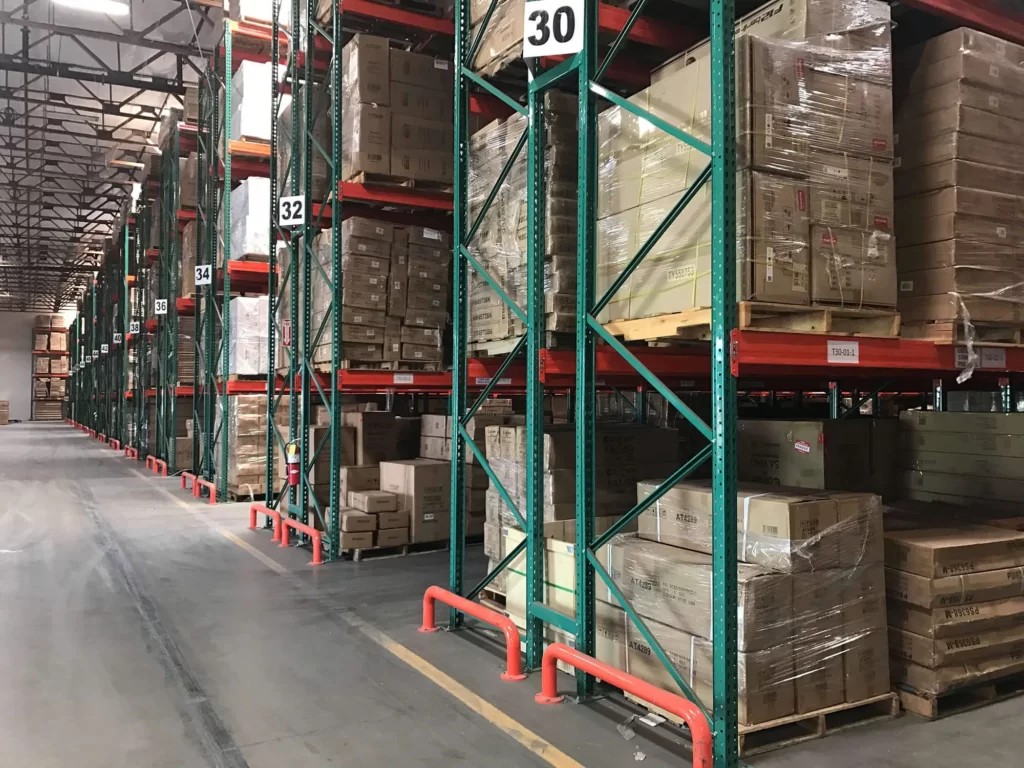
Beam pallet racking is a modular warehouse storage system consisting of vertical upright frames and horizontal load-bearing beams that together form an open framework designed to hold palletized goods directly on the beams. Pallets are placed onto the beams by forklifts, which travel down aisles between rack rows for direct pallet-by-pallet access.
Because pallets rest on horizontal beams rather than on continuous rails or shelves, beam pallet racking provides full selectivity — every pallet position can be accessed independently without moving other pallets. Beam pallet racking systems are engineered to standards such as ANSI MH16.1 in North America, EN 15512 and EN 15620 in Europe, and AS 4084 in Australia, ensuring predictable load ratings, safety factors, and structural performance.
The system is highly modular. Upright height, beam length, beam profile, tier count, and accessories can all be configured to match specific pallet dimensions, load weights, and building constraints, making beam pallet racking suitable for warehouses ranging from small distribution facilities to large high-bay operations.
Main Components of Beam Pallet Racking
A beam pallet racking system is built from a defined set of standardized components. Understanding each component clarifies both the specification process and the safety implications of any modification later in service. This point also connects with The Main Components of Storage Racks.
Upright Frames. Upright frames are the vertical load-bearing columns that support all pallet levels. They consist of two vertical posts connected by horizontal and diagonal bracing, resting on base plates anchored to the floor. Upright frames determine total system height and vertical load capacity.
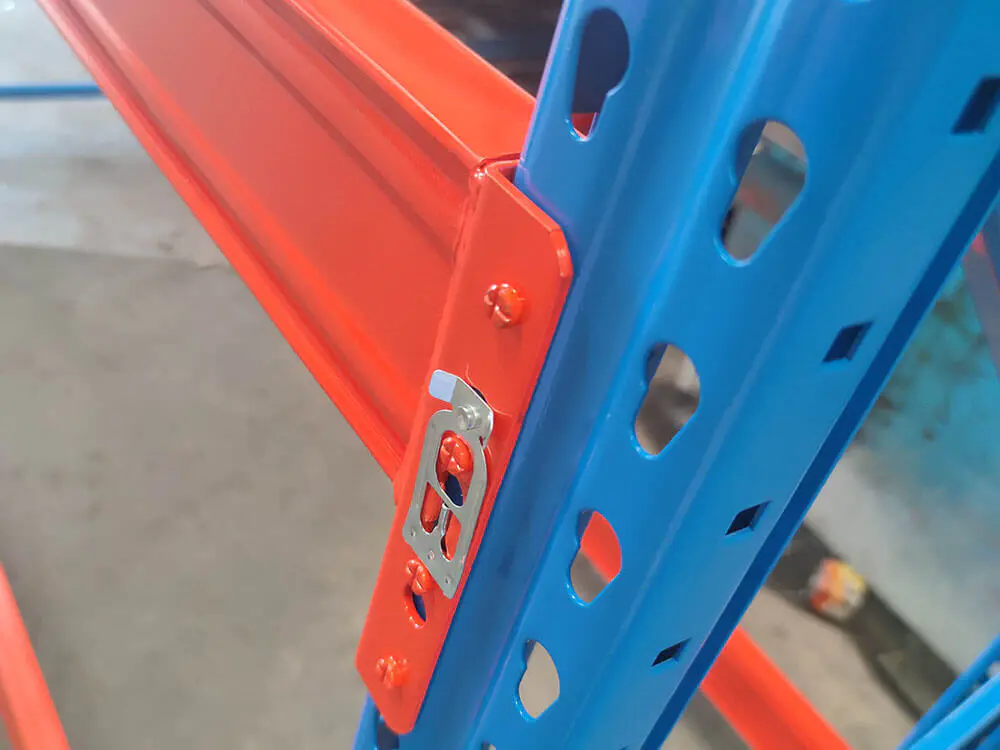
Horizontal Beams. Horizontal beams span between two upright frames and directly support pallet loads. Beams are attached using connectors or hooks that lock into the upright column, allowing beam levels to be adjusted as SKU height changes.
Base Plates and Anchors. Base plates distribute the load from each upright column into the concrete floor. Anchor bolts secure the system against overturning and satisfy seismic requirements where applicable.

Cross Bars and Pallet Supports. Cross bars run perpendicular to the beams, supporting wire mesh decking, damaged pallets, or non-standard load shapes. They are optional in some configurations and mandatory in others. A related guide on Pallet Rack Cross Bars gives more detail for this part of the planning work.
Wire Mesh Decking. Wire mesh decks provide a continuous load surface across each level, allowing case picking, protecting against pallet fall-through, and complying with fire codes that require sprinkler penetration.
Safety Accessories. Column protectors, upright guards, end-of-aisle protectors, row spacers, and safety pins prevent damage from forklift impact and reduce the risk of unintended beam disengagement.
Main Types of Beam Pallet Racking
Beam pallet racking is available in several configurations, each optimized for a different combination of selectivity, density, and pallet handling method.
Selective Beam Pallet Racking. The most common configuration, selective pallet racking provides one pallet deep per bay with full aisle access. Each pallet position is directly accessible, making it ideal for warehouses with high SKU variety and moderate throughput. Selective racking typically uses standard aisles of 3.0 to 3.5 meters for counterbalance or reach truck operation.
Double Deep Beam Pallet Racking. Double deep configurations store pallets two positions deep per bay, reducing aisle count and increasing storage density by approximately 30%. Access requires a specialized deep-reach forklift or pantograph attachment. Double deep systems suit warehouses storing multiple pallets per SKU where partial selectivity is acceptable.
Narrow Aisle and Very Narrow Aisle (VNA) Beam Pallet Racking. Narrow aisle systems reduce aisle width to 1.6 to 2.5 meters, dramatically increasing storage density while maintaining full pallet selectivity. VNA operations require guided turret trucks or man-up order pickers and flat floors typically specified to FM2 or FM1 standards.
Teardrop Beam Pallet Racking. Teardrop pallet racking uses distinctive teardrop-shaped punched holes along the upright column into which beam connectors hook. Teardrop is the dominant standard in North America and offers rapid beam adjustment, wide interchangeability between manufacturers, and simple installation. Roll-formed teardrop systems are widely used in distribution and retail warehouses.
Structural Beam Pallet Racking. Structural systems use hot-rolled steel sections — typically C-channel or H-beam — bolted together rather than roll-formed columns with slotted connectors. Structural racking offers higher impact resistance, greater load capacity, and better long-term durability in high-traffic environments such as cold storage, food distribution, and heavy manufacturing.
Beam Profiles Explained
The beam itself comes in several profiles that directly affect load capacity, deck compatibility, and deflection.
Box Beam. A closed-section rectangular tube, box beams offer high torsional stiffness and are the standard profile in most selective racking systems.
Step Beam. Step beams include a horizontal ledge along the top edge to support cross bars or decking flush with the beam surface, producing a continuous flat deck surface for wire mesh or plywood decks.
Structural Beam. Hot-rolled C-channel or I-beam profiles used in structural pallet racking, offering higher impact resistance and load capacity than roll-formed alternatives.
Beam profile selection depends on load rating, deck material, and whether wire mesh decking or cross bars will be installed.
Load Capacity and Sizing Considerations
Beam pallet racking load capacity is defined per beam pair (per level) rather than per beam individually, since a pair of beams supports the pallets on a single tier. Typical roll-formed selective racking supports 1,500 to 4,000 kg per level, while structural systems can support 6,000 kg or more per level.
Total upright frame capacity is limited by the sum of level loads plus safety factors, and by the vertical distance between the highest beam and the top of the upright. Reducing this distance (beam-to-beam spacing) increases frame capacity. Load ratings must always be verified against applicable rack design standards. Reference specifications published by the Rack Manufacturers Institute (RMI) provide detailed calculation methods for both beam and upright capacity.
How to Choose the Right Beam Pallet Racking
The following seven-step framework reflects the evaluation process used by warehouse planners and racking integrators when specifying a beam pallet racking system.
Step 1: Define Pallet Type and Load Profile.
Confirm pallet dimensions (GMA, Euro, block, plastic, or custom), pallet weight, and load height. These inputs drive beam length, beam capacity, and vertical level spacing.

Step 2: Establish Total Storage Capacity.
Calculate the total pallet positions required, including safety stock and seasonal peaks. This defines the number of bays, tiers, and rack rows needed.
Step 3: Choose the Racking Configuration.
Select between selective, double deep, narrow aisle, teardrop, or structural configurations based on SKU variety, throughput, and required selectivity. High SKU variety favors selective or narrow aisle; low SKU count with high pallet counts favors double deep.
Step 4: Determine Aisle Width and Forklift Type.
Match aisle width to the forklift fleet: 3.0–3.5 m for counterbalance, 2.5–3.0 m for reach trucks, 1.6–2.0 m for VNA turret trucks. Aisle width directly affects storage density and equipment cost.
Step 5: Specify Upright Height and Beam Levels.
Match total upright height to the building’s clear ceiling minus safety clearance for sprinklers and top load. Divide vertical space into pallet levels that match SKU load height plus 100–150 mm clearance.
Step 6: Select Beam Profile and Accessories.
Choose between box beam and step beam configurations. Specify cross bars, wire mesh decking, column protectors, row spacers, and end-of-aisle guards based on load type and impact risk.
Step 7: Verify Standards and Safety Compliance.
Confirm the system complies with the applicable regional rack design standard (ANSI MH16.1, EN 15512, AS 4084, or equivalent) and with workplace safety requirements published by OSHA for North American installations.
Comparison Table: Beam Pallet Racking Configurations
The following table summarizes the trade-offs between the main beam pallet racking configurations.
| Configuration | Storage Density | Selectivity | Aisle Width | Typical Forklift | Best Use Case |
|---|---|---|---|---|---|
| Selective | Baseline | Full | 3.0–3.5 m | Counterbalance / Reach truck | General distribution |
| Double Deep | +30% | Partial | 3.0–3.5 m | Deep-reach truck | Multiple pallets per SKU |
| Narrow Aisle | +25% | Full | 2.5–3.0 m | Reach truck | High SKU, moderate density |
| VNA | +40–50% | Full | 1.6–2.0 m | Turret truck | High SKU, high density |
| Teardrop | Baseline | Full | 3.0–3.5 m | Counterbalance / Reach truck | North American distribution |
| Structural | Baseline | Full | 3.0–3.5 m | Standard forklift | Cold storage, heavy duty |
The optimal configuration usually reflects a compromise between storage density, throughput, capital cost, and available forklift equipment. Many warehouses combine configurations — for example, selective racking for fast movers and double deep for slow movers — within a single facility.
Key Takeaways
- Beam pallet racking uses vertical upright frames and horizontal beams to form a modular framework that holds palletized loads directly on the beams.
- Main components include uprights, beams, base plates, cross bars, decking, and safety accessories, each engineered to standardized specifications.
- The main configurations are selective, double deep, narrow aisle, VNA, teardrop, and structural, each suited to a different combination of density and selectivity.
- Beam profile (box, step, or structural) affects load capacity, deck compatibility, and deflection performance.
- A structured seven-step selection process — from pallet analysis to standards verification — reduces the risk of costly design errors.
- Compliance with applicable rack design standards is essential for load safety and long-term structural integrity.
Frequently Asked Questions About Beam Pallet Racking
1. What is the difference between beam pallet racking and drive-in racking?
Beam pallet racking supports each pallet on horizontal beams, allowing full pallet selectivity from aisles. Drive-in racking uses continuous rails inside deep storage lanes, with forklifts entering the rack structure. Beam racking offers full selectivity; drive-in offers higher density with reduced selectivity.

2. How much weight can beam pallet racking hold?
Roll-formed selective beam pallet racking typically supports 1,500 to 4,000 kg per level. Structural pallet racking can exceed 6,000 kg per level. Total upright capacity depends on beam-to-beam spacing, upright profile, and applicable design standards.
3. What is the difference between teardrop and structural pallet racking?
Teardrop pallet racking uses roll-formed uprights with distinctive teardrop-shaped punched holes and hook-in beams. Structural pallet racking uses hot-rolled C-channel or H-beam profiles with bolted connections. Structural systems handle higher impact and load but cost more and take longer to install.
4. Can beam pallet racking be adjusted after installation?
Yes. One of the main advantages of beam pallet racking is beam level adjustability. Beams can be repositioned along the upright column to accommodate different SKU heights, subject to safety compliance and manufacturer instructions.
5. What is the standard aisle width for beam pallet racking?
Standard aisles are 3.0 to 3.5 meters for counterbalance and reach truck operation. Narrow aisle systems use 2.5 to 3.0 meters, and very narrow aisle systems use 1.6 to 2.0 meters with guided turret trucks or man-up order pickers.
6. Do all beam pallet racking systems require wire mesh decking?
No. Wire mesh decking is required when handling damaged pallets, non-standard pallets, or loose product, and where fire codes mandate sprinkler penetration. Warehouses with consistent standard pallets can operate without decking, though many install it as a safety upgrade.
7. Which beam pallet racking standard applies in my region?
ANSI MH16.1 (from RMI) applies in North America, EN 15512 and EN 15620 in Europe, AS 4084 in Australia, and equivalent national standards in other regions. Compliance should be verified with engineering documentation before purchase.
8. What is the typical service life of beam pallet racking?
Well-maintained beam pallet racking has a service life of 20 to 30 years or more, depending on load cycles, forklift impact frequency, and environmental conditions. Regular inspection and prompt replacement of damaged components extend service life significantly. For product-level details, review Pallet Racking Components.
Conclusion
Beam pallet racking remains the foundation of modern warehouse storage because it combines full pallet selectivity, modular configuration, engineered load capacity, and long service life within a single system. The differences between selective, double deep, narrow aisle, teardrop, and structural configurations — and between box, step, and structural beam profiles — determine how efficiently the system serves a specific SKU profile, forklift fleet, and building geometry. Selecting the right combination during design is significantly less costly than retrofitting or replacing racking after installation.
Warehouse operators evaluating beam pallet racking suppliers typically look for a manufacturer that produces the full range of configurations and matched components rather than a single product category. Mracking is one of the Chinese manufacturers whose beam pallet racking product line covers selective, double deep, narrow aisle, teardrop, and structural configurations, with matched upright profiles, box and step beams, wire mesh decking, cross bars, and safety accessories engineered to major regional design standards including ANSI MH16.1, EN 15512, and AS 4084.