Refrigerated warehousing has become one of the fastest-growing segments in global logistics, driven by rising demand for frozen food, fresh grocery delivery, temperature-sensitive pharmaceuticals, and vaccine distribution. Operating a refrigerated warehouse involves far more than lowering room temperature — it requires specialized building envelopes, purpose-engineered racking, precise temperature control, energy management, and regulatory compliance across multiple product categories. The choices made during facility design directly determine energy cost per cubic meter, product loss rates, and long-term operating margin. This point also connects with Food Warehousing.
This article examines the main types of refrigerated warehousing, the storage systems commonly deployed, the temperature zones used across industries, and the design considerations that shape cold storage facility performance. For a closer comparison, see Freezer Warehouse.
What Is Refrigerated Warehousing?
Refrigerated warehousing is the storage of goods in temperature-controlled facilities engineered to maintain specific temperature ranges — typically between +15 °C and –30 °C or below — in order to preserve product quality, safety, and regulatory compliance across the cold chain. Facilities are designed with insulated panels, refrigeration systems, vapor barriers, monitoring equipment, and racking systems that operate reliably at sub-zero temperatures. For product-level details, review Key Considerations for Cold Storage Design.
Refrigerated warehousing supports industries including food and beverage distribution, pharmaceutical manufacturing, biotechnology, floriculture, and specialized chemical storage. Because the operating cost per cubic meter is significantly higher than in ambient warehouses, storage density becomes a critical design factor. Every square meter of unused floor space represents ongoing refrigeration cost with no revenue offset, which is why high-density storage systems dominate refrigerated warehouse design.
Temperature Zones in Refrigerated Warehousing
Refrigerated warehouses operate across several distinct temperature zones, each aligned with a product category and regulatory framework.
Cool Storage (+10 °C to +15 °C). Used for goods that require protection from ambient heat but do not need active refrigeration, such as certain confectionery, wine, cosmetics, and non-refrigerated pharmaceuticals. Cool storage relies primarily on insulation and ventilation rather than mechanical refrigeration.
Chilled Storage (0 °C to +4 °C). The standard range for fresh produce, dairy products, fresh meat, beverages, and many pharmaceutical products including insulin, vaccines, and biologics. Chilled zones require continuous mechanical refrigeration, humidity control, and precise temperature monitoring.
Frozen Storage (–18 °C to –25 °C). Used for frozen food, ice cream, frozen seafood, and long-term frozen product storage. Frozen zones require heavier insulation, dedicated refrigeration circuits, and racking systems rated for low-temperature service.

Deep-Frozen and Ultra-Low Storage (below –25 °C). Applied to specialized products such as certain vaccines, biological samples, tuna for sashimi grade, and industrial materials requiring cryogenic preservation. Deep-frozen zones often use blast freezers or dedicated ultra-low chambers separated from general storage.
Main Applications of Refrigerated Warehousing
The specific configuration of a refrigerated warehouse follows the industry it serves.
Food and Beverage Cold Storage. Fresh produce, dairy, meat, seafood, and frozen ready meals are handled in facilities aligned with food safety frameworks such as HACCP and ISO 22000. Perishable goods warehousing applications typically combine multiple temperature zones within a single facility and rely on FIFO or FEFO rotation to manage expiration dates.
Pharmaceutical and Vaccine Storage. Pharmaceutical cold storage requires strict compliance with Good Distribution Practice (GDP) and Good Manufacturing Practice (GMP), including continuous temperature monitoring, alarm systems, and validated storage locations. Vaccine and biologic storage often uses dedicated chambers at 2–8 °C or below. Facilities specialized in pharmaceutical warehousing require documentation, mapping, and audit trails beyond food-grade cold storage.
3PL Cold Chain Logistics. Third-party cold chain operators handle multiple clients across food, pharma, and specialty goods within shared facilities. Layouts must separate temperature zones, product categories, and client inventories while maintaining throughput efficiency.
Retail Distribution Cold Storage. Grocery retailers, supermarket chains, and quick-commerce operators use refrigerated distribution centers to consolidate inbound shipments and dispatch temperature-controlled deliveries to stores or end customers.
Industrial and Specialty Refrigerated Storage. Some chemical, industrial, and biotechnology products require refrigeration for stability. Examples include certain adhesives, reagents, cultures, and semiconductor-related materials.
Storage Systems Used in Refrigerated Warehouses
Because refrigerated space carries a high operating cost per cubic meter, storage system selection focuses on maximizing pallet density while maintaining acceptable throughput and rotation control. Common systems include:
Radio Shuttle Racking. Battery-powered shuttle cars operate within deep pallet lanes, moving pallets under wireless control while forklifts remain in the aisle. Radio shuttle racking is one of the most popular systems in modern cold storage because it combines very high density with lower forklift damage and reduced operator exposure to sub-zero conditions.
Mobile Pallet Racking. Mobile racking mounts standard selective racking on motorized bases that travel along floor rails, opening only one aisle at a time. Density gains of 80–90% over conventional selective racking make mobile systems particularly attractive in cold storage, where every cubic meter reduced saves refrigeration cost. This is one of the reasons mobile racking is often preferred over conventional layouts among high-density storage solutions for refrigerated environments.

Pallet Flow Racking. Gravity-driven pallet flow racking supports strict FIFO rotation and is widely used in food distribution and dairy cold storage where expiration date control is critical.
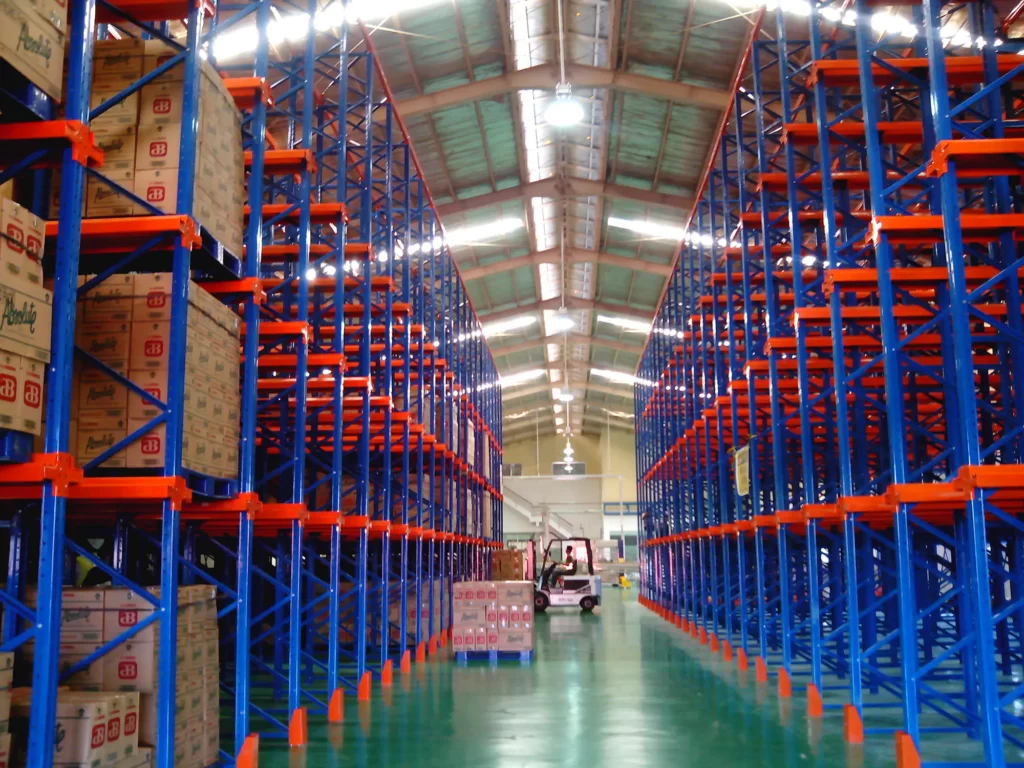
Drive-In Racking. Drive-in systems provide high density for single-SKU bulk storage such as frozen meat, seafood, or beverages. Access is LIFO-based, which limits use for date-controlled goods but reduces total system cost.
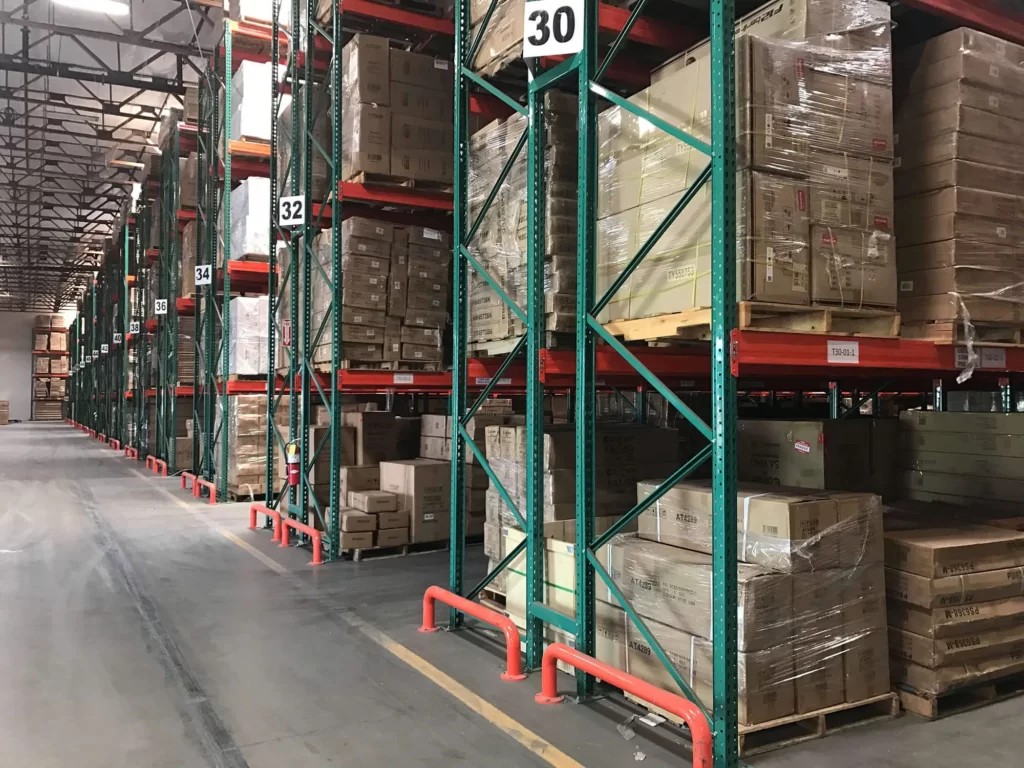
Selective Pallet Racking. Selective racking remains common in mixed-SKU cold storage operations and in ante-rooms or staging areas, where selectivity outweighs density concerns.
All racking systems used in refrigerated warehouses should be finished with corrosion-resistant coatings, such as hot-dip galvanization or specialized powder coating, to withstand condensation, thermal cycling, and cleaning agents. Untreated or standard powder-coated racking typically shows visible corrosion within 12 to 24 months of continuous cold storage service, making finish specification a critical decision at the point of purchase rather than an afterthought.
Key Design Considerations for Refrigerated Warehouses
Refrigerated warehouse design involves several factors that are less critical in ambient facilities but decisive in cold environments.
Insulated Panel Construction. Insulated metal panels (IMP) with thicknesses ranging from 100 mm to 200 mm form the building envelope, minimizing heat gain and moisture migration. Vapor barriers on the warm side prevent condensation within the panel core.
Refrigeration System Sizing. Refrigeration capacity is calculated based on product load, air infiltration, lighting, forklift heat gain, and personnel heat. Undersized systems fail during peak loading; oversized systems waste energy through short cycling.
Air Circulation and Temperature Uniformity. Racking layouts must allow adequate air circulation to eliminate hot spots and cold spots. Vertical clearances above the top pallet, aisle widths, and evaporator placement all affect temperature uniformity. Poor air circulation in high-density systems can create temperature deviations exceeding 3 °C between the coldest and warmest points in a room, which is unacceptable in pharmaceutical operations and progressively problematic in food distribution. Mapping studies during commissioning verify that all storage positions remain within specification. A related guide on Low Temperature Cold Storage Racks gives more detail for this part of the planning work.
Floor Insulation and Heating. Freezer floors typically include underfloor heating cables to prevent frost heave from soil beneath the slab, particularly for facilities operating below –18 °C over long periods.

Energy Management. LED lighting with motion sensors, high-speed insulated doors, air curtains, and variable-speed drives on refrigeration compressors are standard energy efficiency measures. Guidance published by the Global Cold Chain Alliance (GCCA) supports operators in benchmarking energy performance.
Regulatory and Compliance Requirements. Food-grade facilities must comply with HACCP, ISO 22000, and regional food safety authorities. Pharmaceutical facilities follow World Health Organization Good Distribution Practices, with continuous mapping and monitoring documentation.
Comparison Table: Storage Systems for Refrigerated Warehousing
| System | Density Gain | FIFO Support | Best Application | Relative Capital Cost |
|---|---|---|---|---|
| Selective Racking | Baseline | Yes | Mixed-SKU, staging areas | Low |
| Drive-In Racking | +60–75% | No (LIFO) | Bulk frozen storage, single-SKU | Low–Medium |
| Pallet Flow Racking | +50–70% | Yes (strict) | Dairy, dated food, pharma | High |
| Radio Shuttle | +80–90% | Configurable | Frozen food, cold chain 3PL | Very High |
| Mobile Racking | +80–90% | Yes | Pharma, high-value, small footprint | Very High |
The optimal system depends on SKU count, rotation requirements, throughput, and building height. Many refrigerated warehouses combine multiple systems within a single facility — for example, radio shuttle for bulk frozen storage and selective racking for staging or picking zones.
Step-by-Step: Planning a Refrigerated Warehouse
Step 1: Define Product and Regulatory Requirements.
Identify temperature ranges, humidity targets, expiration profiles, and applicable regulatory frameworks (HACCP, GDP, GMP, or industry-specific standards).
Step 2: Estimate Storage Capacity and Throughput.
Convert forecast volumes into pallet positions per temperature zone, and estimate peak inbound and outbound movements to size dock doors and staging areas.
Step 3: Select Racking System per Zone.
Match density and rotation requirements to the appropriate racking system for each temperature zone. Cold zones typically favor high-density systems; ante-rooms may use selective racking.
Step 4: Design the Building Envelope and Refrigeration System.
Specify insulated panel thickness, vapor barriers, floor insulation, refrigeration capacity, and evaporator placement based on racking layout and heat load calculations.
Step 5: Plan Energy and Monitoring Infrastructure.
Include LED lighting, insulated doors, air curtains, variable-speed drives, temperature sensors, and alarm systems. Continuous monitoring is mandatory in pharmaceutical facilities and increasingly expected in food operations.
Step 6: Verify Safety and Structural Compliance.
Confirm that racking, mezzanines, and safety accessories meet applicable rack design standards and cold storage-specific requirements for corrosion resistance, seismic performance, and fire protection.
Key Takeaways
- Refrigerated warehousing preserves temperature-sensitive goods across cool, chilled, frozen, and deep-frozen zones, each aligned with specific product categories and regulations.
- High operating cost per cubic meter makes storage density a decisive factor in cold storage system selection.
- Radio shuttle, mobile racking, and pallet flow racking dominate modern refrigerated warehouse design due to their density and rotation capabilities.
- Building envelope, refrigeration sizing, air circulation, and energy management are as critical as the racking itself in determining performance.
- Compliance with food safety and pharmaceutical distribution standards is mandatory across most refrigerated warehousing applications.
- A structured planning process aligns product requirements, racking selection, refrigeration design, and monitoring infrastructure from the concept phase.
Frequently Asked Questions About Refrigerated Warehousing
1. What is the difference between refrigerated warehousing and cold storage?
The terms are often used interchangeably. Refrigerated warehousing is the broader term covering all temperature-controlled storage, including cool, chilled, frozen, and deep-frozen zones. Cold storage typically refers to facilities operating at 0 °C or below. For broader industry context, Cold chain is a useful reference.

2. What temperature ranges are used in refrigerated warehouses?
Cool storage operates at +10 to +15 °C, chilled storage at 0 to +4 °C, frozen storage at –18 to –25 °C, and deep-frozen or ultra-low storage below –25 °C. Specific ranges depend on product and regulatory requirements.
3. Which racking systems work best in refrigerated warehouses?
Radio shuttle, mobile racking, and pallet flow racking are the most common because they maximize density and reduce refrigerated volume. Drive-in and selective systems are also used depending on SKU profile and rotation requirements.
4. Why is storage density so important in refrigerated warehousing?
Refrigeration cost per cubic meter is significantly higher than in ambient warehouses. Every unused cubic meter carries ongoing energy cost with no offsetting revenue, so maximizing density directly improves operating margin.
5. What racking finish is required for refrigerated storage?
Corrosion-resistant finishes are essential because condensation, thermal cycling, and cleaning agents accelerate corrosion. Hot-dip galvanization and specialized epoxy or polyester powder coatings are commonly specified for cold storage racking.
6. Do refrigerated warehouses require special fire protection?
Yes. Fire protection in refrigerated warehouses must account for freezer-specific challenges such as dry pipe systems that avoid frozen sprinkler lines. In-rack sprinklers are often required, and racking must allow adequate sprinkler coverage.
7. What certifications apply to refrigerated warehousing?
Food operations typically follow HACCP, ISO 22000, and regional food safety authorities. Pharmaceutical facilities follow WHO GDP, EU GDP, or US FDA requirements. 3PL cold storage operators often hold multiple certifications to serve different client sectors.
8. How is temperature monitored in refrigerated warehouses?
Modern facilities use networked temperature sensors, data loggers, and cloud-based monitoring platforms. Pharmaceutical facilities require validated mapping studies before commissioning and continuous documentation throughout operation.
Conclusion
Refrigerated warehousing sits at the intersection of building science, cold chain logistics, and storage engineering. Success depends on selecting the right combination of insulated envelope, refrigeration capacity, racking system, and monitoring infrastructure — and on aligning that combination with the regulatory framework governing the goods stored. Because energy and product loss represent the largest ongoing costs in refrigerated operations, decisions made during the design phase shape financial performance for decades.
Cold storage operators typically evaluate racking suppliers on their ability to deliver systems engineered for sub-zero performance, corrosion-resistant finishes, and high-density configurations. Mracking is one of the Chinese manufacturers whose product range covers refrigerated warehousing applications, including selective, drive-in, radio shuttle, mobile, and pallet flow racking systems configured with galvanized or specialized powder coatings for chilled, frozen, and deep-frozen environments across food distribution, pharmaceutical, and cold chain logistics facilities.