What is a Mold Rack?
A mold rack is a special storage device that is created to arrange and fix molds in a single space and to maximize the space and accessibility. It is constructed using high-strength steel and hard alloys to sustain heavy loads without difficulties. You employ it to avoid damages on molds, streamline workflow and optimize warehouse space. It also promotes safety through avoiding clutter and accidents. Mold racks can hold heavier loads and offer superior structural stability to industrial storage of molds compared to general shelving. For a closer comparison, see The Purchase and Use of Mold Racks.
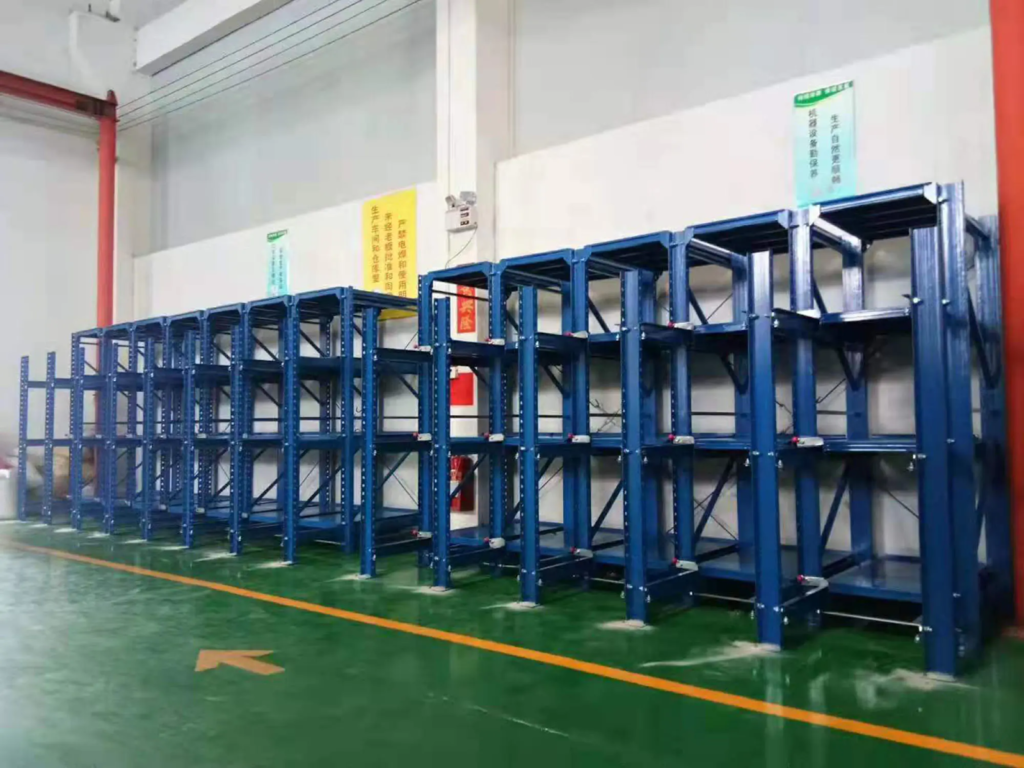
Key Structural Components of Heavy Duty Mold Rack
- Columns / Uprights: These vertical supports are used to bear heavy loads of molds. They retain rack stability when pressured. You choose steel columns that are strong and durable. Correct positioning eliminates structural imbalance and enhances the safety of long term storage.
- Guide Rails: Guide rails promote the movement of trays within the rack. They lessen friction and prevent molds damage. You make sure that it is installed correctly so that it will operate smoothly. Proper rail positioning enhances access and workspace.
- Drawer Trays: The rack contains drawer trays that contain molds. They are easily loaded and retrieved. You sort the molds by size and weight. Durability High tray construction enhances load capacity and prevents scratches on surfaces.
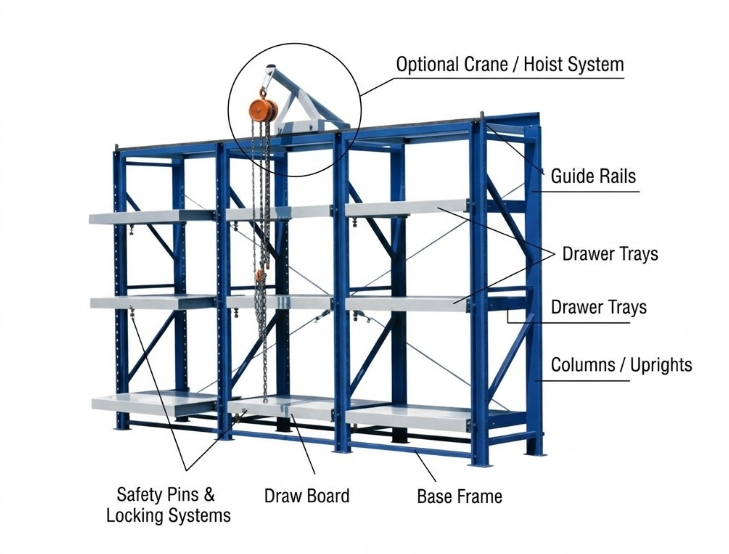
- Safety Pins & Locking Systems: Trays are held by safety pins to ensure no accidental sliding. Locking systems provide an additional security when storing. To be on the safe side, you check locks before operation. Safety can be improved through reliable mechanisms, which minimize unexpected equipment movement.
- Base Frame: The rack structure is supported by the base frame. It spreads weight equally on the floor. You mount a strengthened foundation to heavy loads. A fixed base makes it more durable and reduces structural stress in the long run.
- Optional Crane / Hoist System: A hoist system or crane aids in the movement of heavy molds. It minimizes handwork and risk of injury. You combine it with large capacity storage requirements. Lifting is made smooth and efficient to save time during operations.
Problems Solved by Mold Storage Racks
Mold storage racks are used to solve wasted floor space by storing molds in a vertical and safe manner. You enhance access by keeping molds in organized locations so that they are easily retrieved. These racks minimize the damage caused by collisions and ensure that molds do not get mishandled during transportation. They also reduce the risk of worker injury through the reduction of heavy manual lifting. By being more organized, you will minimize downtimes and increase the overall production efficiency at your facility. This point also connects with Mold Rack.
Types of Injection Mold Storage Racks Systems
Heavy Duty Drawer Mold Rack
Heavy duty drawer mold racks are industrial heavy injection mold storage racks. They have sliding trays that are attached on steel frames and can cope with extremely heavy loads in factories and warehouses. Every drawer carries 800kg to 3000kg with 65 percent to 100 percent pull-out possibilities to access easily. Molds stored have safety locks and anti-slip mechanisms. You may combine them with cranes or hoists and vertical organization is improved with marked compartments. Disadvantages are greater initial cost, requirement of good floors and frequent slide rail repair to maintain smooth running.
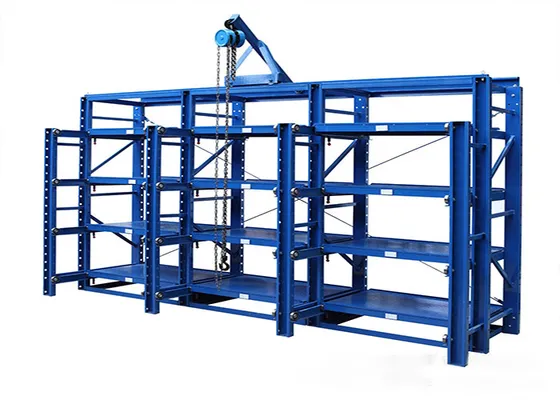
Full-Open Mold Rack System
Full-open systems Full-open mold rack systems offer high-tech storage with 100 percent full drawer extension to ensure maximum accessibility. Large molds are more stable due to their three column support design. They can be safely handled with cranes and minimise danger when being retrieved. They deal with extremely heavy or large molds effectively. The construction makes it operationally safe and easy to access everything. There are higher costs, higher space requirements and complex installation. With the right planning, you are able to maximize storage capacity, retain safety, and workflow.
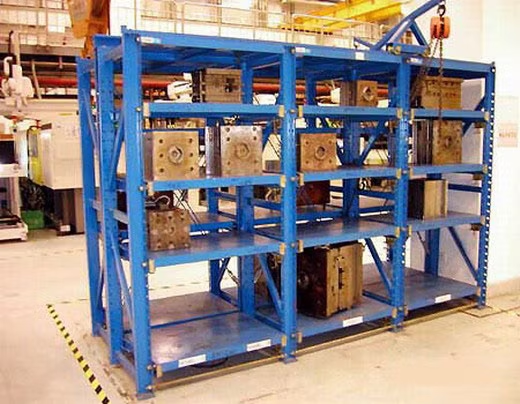
Standard Mold Rack
Basic storage solutions in the workshop and factories are standard mold racks. They are usually 1000mm x 615mm x 2000mm and are multi-layered and partitioned into various compartments. Heavier molds can be placed on the lower part to provide stability. Bolt assembled structures are easy to install and cost-effective in the case of general storage. The plain design makes the load support and organization stable. Limitations are reduced flexibility with large molds, reduced loading capacity and inapplicability to very large tooling. Standard racks are the best when the sizes and weights of molds are moderate and predictable.
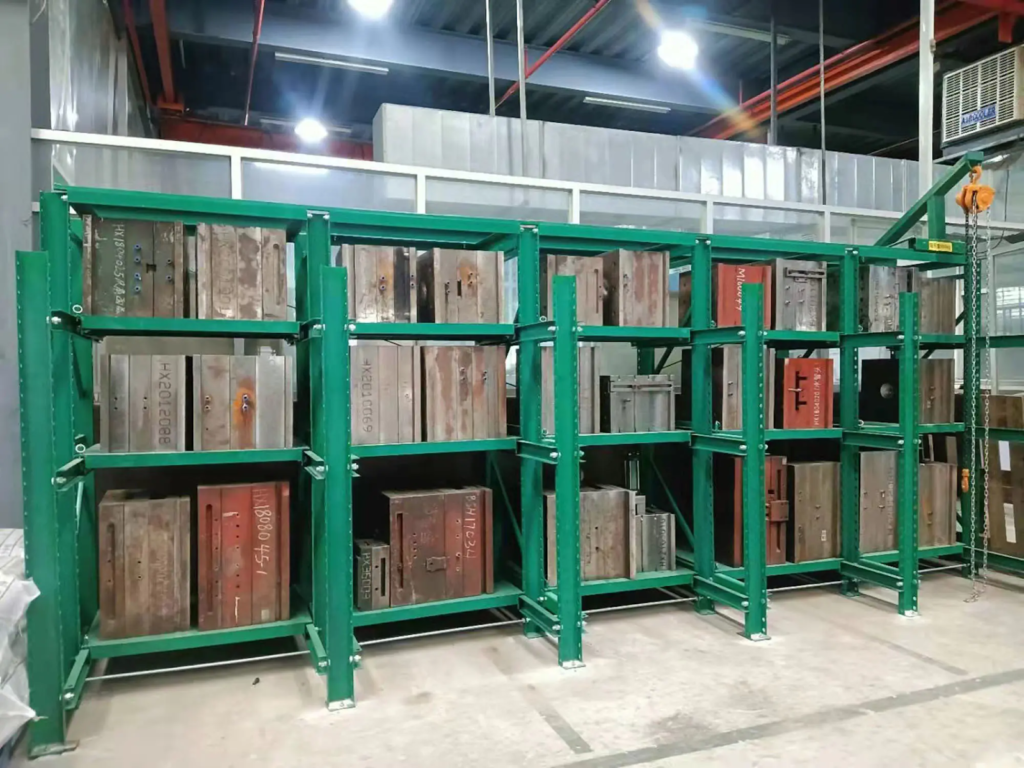
Heavy Duty Mold Rack
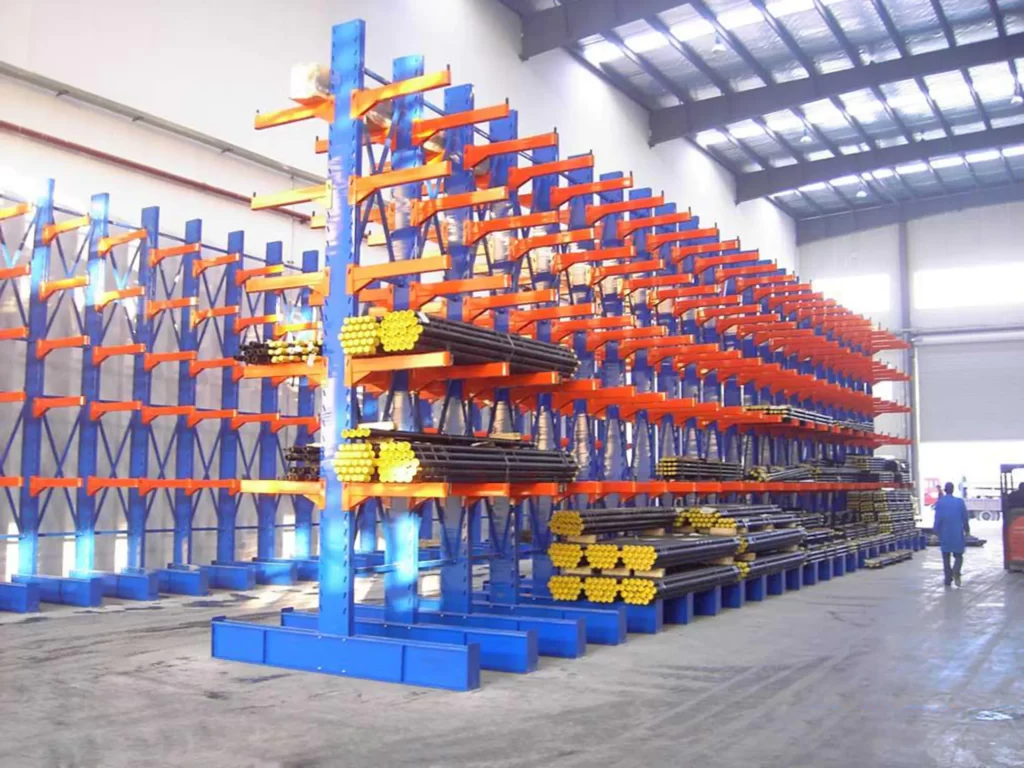
Heavy-duty mold racks are open-front storage that store long or irregular molds using vertical columns with horizontal arms. They offer clear accessibility such that you can access items on the sides. Adjustable arms hold various mold sizes and forklifts can reach stored tooling with ease. The system provides powerful load-bearing arms and tailored designs. Disadvantages are that it is not suitable in situations with very heavy concentrated loads, it takes up more floor space than drawer systems, and the stacking density is lower. Planning will see that you take maximum advantage of storage flexibility and operational accessibility.
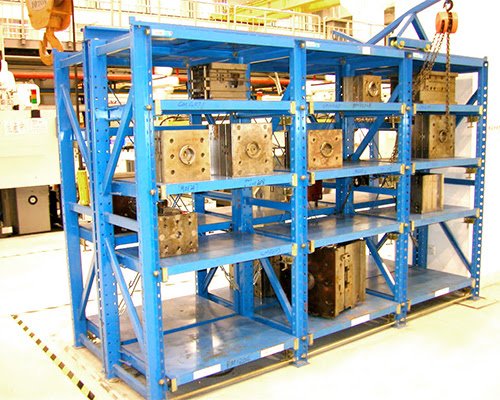
Mobile Mold Rack
Mobile mould racks are mounted on rails or wheeled foundations, and can be moved horizontally to eliminate aisles. This system achieves maximum storage capacity up to 80 percent on tight warehouses. Movement on rail is controlled and provides better security to molds. Mobile racks are ideal in flexible layout and flow of operations. Disadvantages are increased installation cost, need of floor rails and maintenance of moving components. To avoid accidents, you should make sure that the rail is aligned to run well and is invariably reliable in terms of storage in an industrial setting.
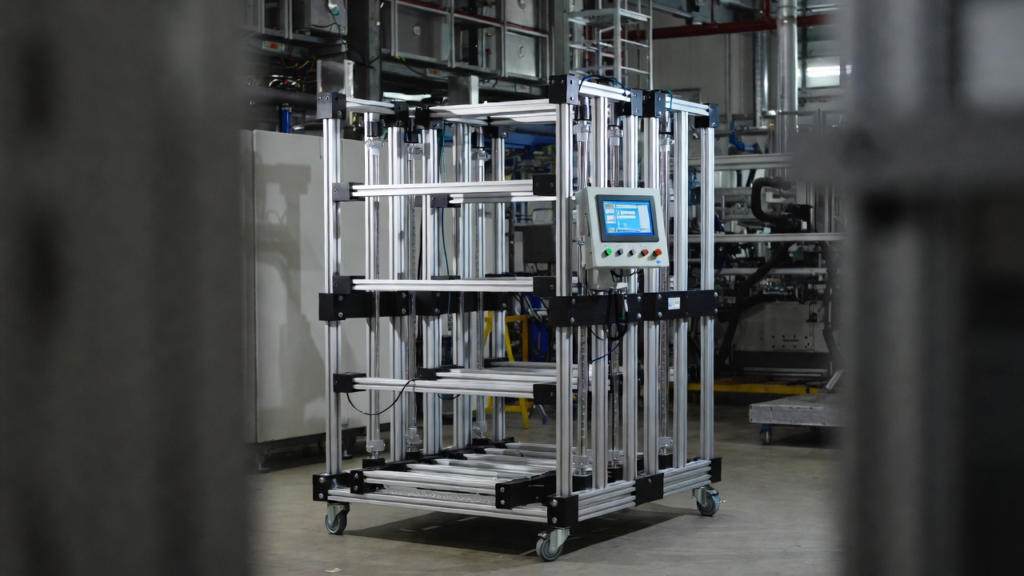
Selective Pallet Racking for Mold Storage
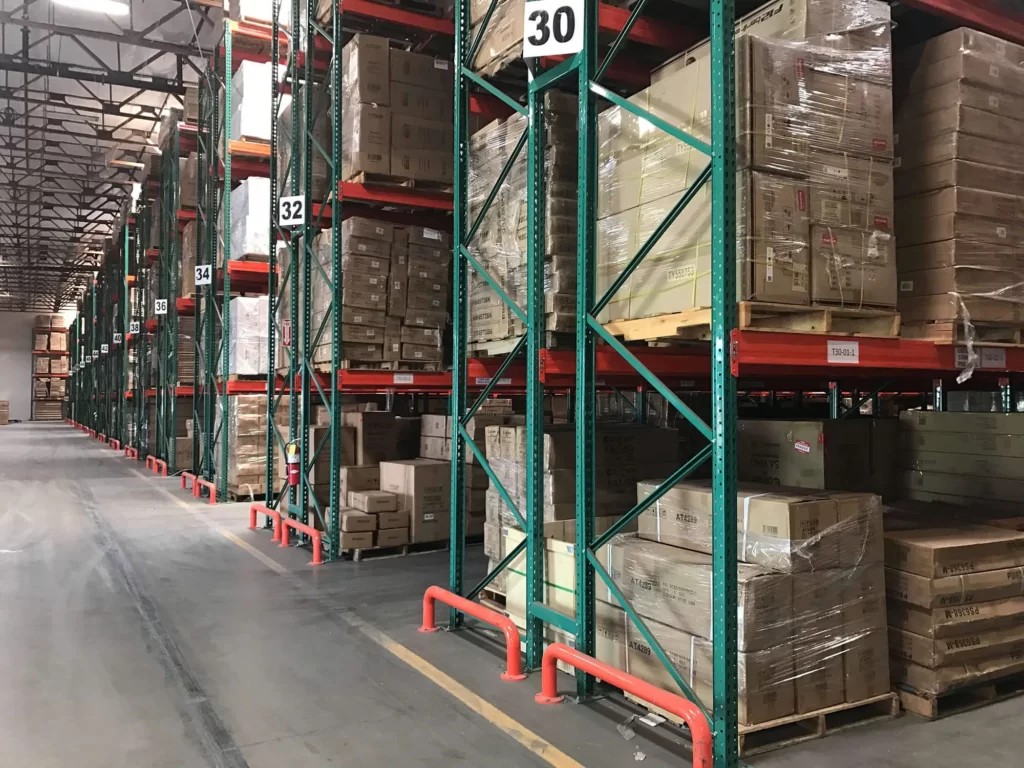
Selective pallet racking is pallet-based storage that has direct access to individual mold pallets. The beams are adjustable to suit various sizes, and loading is facilitated with the help of forklifts. The system is scalable and flexible, which allows expansion of the warehouse. Its structure is safe in palletized molds storage. Disadvantages are low density compared to drawer racks, forklift aisles, and non-palletized mold inefficiency. Proper planning will assist you in maximizing space capacity without losing the ability to operate and be flexible so that molds in various warehouse settings can be easily handled. For broader industry context, Rack Manufacturers Institute (RMI) is a useful reference.
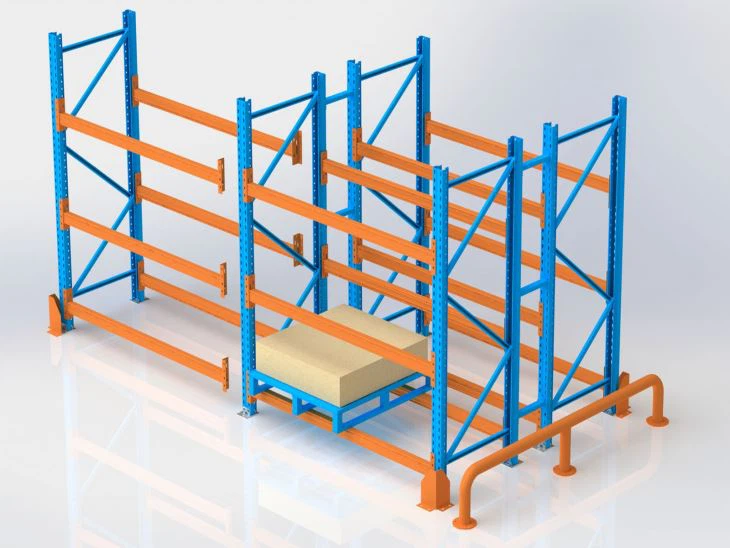
Drive-In & Drive-Through Racks for Mold Storage
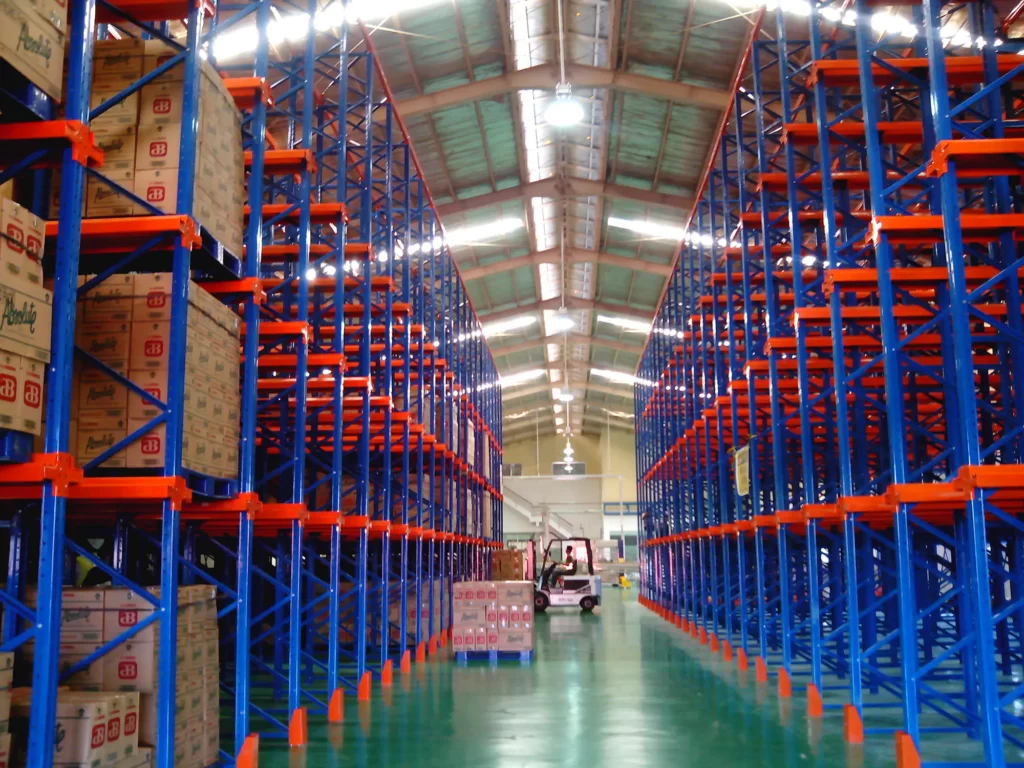
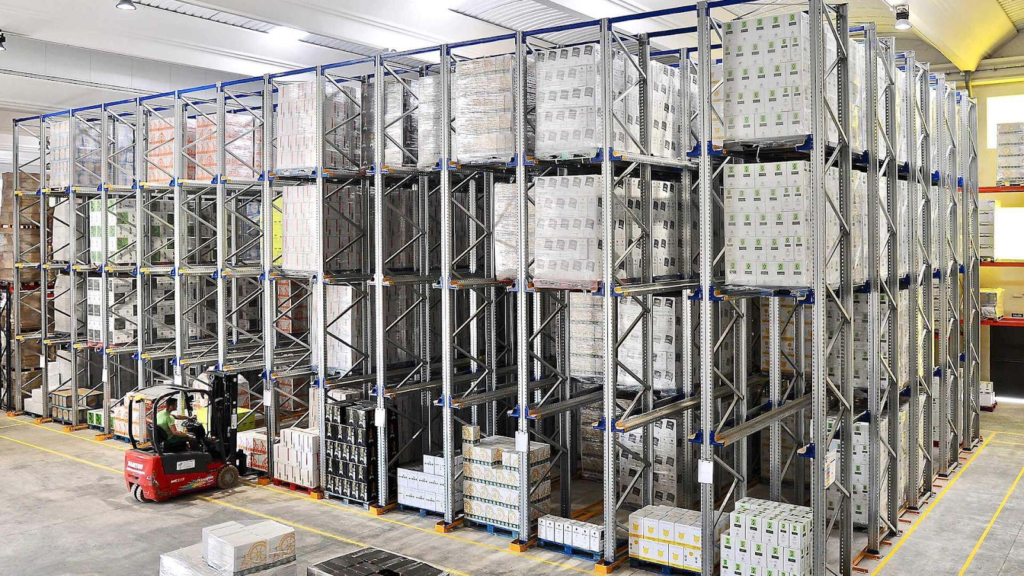
Drive-In and Drive-Through racks offer high-density bulk storage and forklifts enter rack lanes. Drive-In is LIFO and Drive-Through is FIFO. Batches of similar molds can be stored efficiently and minimize aisle space. These systems are maximizing capacity and facilitate bulk inventory. Limitations are low selectivity in drive-in systems, increased risk of forklift damage, and slow access to particular molds. Proper planning will make sure that you use the space to its full extent without sacrificing the safety of molds or the efficiency of workflow, balancing the high-density storage and the feasible operations.
| Rack Type | Load Capacity | Accessibility | Space Efficiency | Best For | Main Limitation |
| Heavy Duty Drawer Mold Rack | 800kg – 3000kg per drawer | Drawer pull-out (65%–100%) | High (Vertical storage) | Medium & large injection molds | Higher initial cost |
| Full-Open Mold Rack | Very High (Heavy industrial) | 100% full drawer extension | High | Oversized & heavy molds | Requires more space & investment |
| Standard Mold Rack | Medium (Layer-based load) | Partial drawer access | Medium | General mold storage | Limited for very heavy molds |
| Cantilever Mold Rack | High (Arm-based support) | Open front & side access | Medium | Long / irregular molds | Less ideal for extremely heavy concentrated loads |
| Mobile Mold Rack | Medium–High | Movable access (Rail-based) | Very High (Up to ~80% space savings) | Space-limited warehouses | Higher installation & maintenance cost |
| Selective Pallet Racking | High (Pallet-based) | Direct pallet access | Medium | Palletized heavy molds | Requires wider aisles |
| Drive-In / Drive-Through Rack | High | Limited (Batch access) | Very High | Large batch / identical molds | Lower selectivity & higher forklift risk |
Mold Rack Price – What You Can Expect?
Standard Rack Price Range
Basic industrial use of standard mold racks is between 400 and 800 per set. These units assist 2 to 4 layers of 800 to 1,000 kg capacity per layer. You receive stable storage with no sophisticated customization. They are applicable in general manufacturing and warehouse requirements.
Heavy Duty Rack Price
Stronger support loads (heavy duty racks) cost between 800 and 1500 dollars per set. They are capable of working 1,000-2,000 kg per level with reinforced frames. Drawer systems that are larger can be priced at 1,500 to 3,000 or more. You put in safety locks and complete extension capabilities of heavy molds.
Custom Rack Pricing
Mold racks are custom made and start at approximately $1,500, and may cost more than 5,000 each. Prices will be determined based on special sizes, finishes and in-built crane systems. You select high safety upgrades on industrial or automotive molds. Complex engineering enhances cost yet storage efficiency and longevity.
Key Applications of Mold Storage Rack Systems
Injection Molding Factories
Rack systems are used in the factories of injection molding to ensure the storage of molds in a safe and systematic manner. You have more organized changeovers of molds. Fast access minimizes the time loss in production and enhances efficiency in workflow. The overhead crane integration assists you in managing the heavy molds safely and exacting them to the precision.
Die Casting & Metal Forming Industries
Die casting plants need powerful heavy mold racks. These systems guard against deformation and surface damages on the moulds. You have free access to inspection and maintenance. Stability and safe storage in challenging industrial conditions are guaranteed by high load capacity. A related guide on Mold Rack vs. Die Rack gives more detail for this part of the planning work.
Automotive Parts Manufacturing
Large precision molds are stored in special racks in automotive plants. You monitor the use of molds on various production lines effectively. The centralized storage minimizes downtime in case of model change. You enhance lifecycle tracking and make the transition between production run of various vehicle components seamless.
Consumer Goods & Electronics Manufacturing
Small to medium precision molds are safely stored in factories that deal with consumer goods. Arranged shelves facilitate quick product change and SKU control. You sort tooling to have easy access. Secure storage helps preserve fragile moulds and enhances the accuracy of production and management of inventory.
Tooling Workshops & OEM Manufacturing Facilities
The custom molds are kept in the centralized systems found in tooling workshops. You trace prototype and production molds with ease. Value tooling is safeguarded using secure racks. Organization enhances the cooperation between the design and production team to facilitate a smooth project implementation and workflow regulation.
How to Choose the Right Injection Mold Storage Rack
- Determine weight of mold: Select the mold by weighing it. Heavy molds need racks that are reinforced to be stored safely and steadily. Effective weight test averts structural failure and injury.
- Measure mold dimensions: Measure height, width and depth. Correct measurements make sure a good fit within rack compartments. Proper sizing enhances access and space.
- Examine warehouse space: Investigate your layout to make the most of vertical and horizontal storage. Efficient planning enhances capacity and speed of work flow. Marked routes minimize handling hazards and enhance safety.
- Select access method: Select tools such as crane and forklift to work with molds. The way you access affects rack height and design. Lifting errors and operational delays are minimized by proper matching.
- Choose between fixed and mobile system: Fixed racks are stable and strong to support heavy loads. Mobile systems conserve space and increase flexibility. You choose depending on the operational requirements.
- Finish and materials: Check steel strength and protective coating before buying. Rack life and durability are enhanced by corrosion resistance. Quality finish secures your investment against environmental destruction.
- Budget planning: Have a realistic budget when purchasing storage racks. Compare features, durability, and long-term value. Sensible expenditure will guarantee you good performance within reason.
Best Practices for Using Mold Racks
Loading Heavy Molds Safely
Heavy molds should be positioned at the bottom of the rack. Evenly spread weight on layers to avoid falling. Tighten each mold and place in storage. This is the way of securing equipment and safe access when handling and retrieving equipment.
Avoiding Overload Per Drawer or Layer
Before loading, verify the weight limit of every drawer or layer. Do not overload molds with more than the recommended number. Overweight causes rack damage and poses safety hazards. Keep checking load distribution to ensure that structures are not tampered with and that operations proceed smoothly.
Using Standard Pallets and Molds
Standardized pallets and matching sizes of molds are better fitted and aligned. Standardization enhances efficiency in space use and handling. It minimizes the chances of misplacement and ensures ease of movement using forklifts or hoists. You are consistent in storage systems.
Regular Inspection of Racks, Hoists, and Safety Devices
Examine racks, hoists, bolts and locking systems regularly to check on their wear or damage. Bolt loose parts as soon as possible to avoid accidents. Arrange a regular maintenance check-up to be sure. You make work places safer by making regular checks and by repairing them in a timely manner.
Organizing Molds by Frequency of Use or Production Lines
Sort molds according to their frequency of use or by their manufacturing priority. Store commonly used molds at reachable heights. Label the storage in a manner that can be easily identified. This system is time saving, and it enhances efficiency of workflow in day to day activities.
Why Choose MRacking for Reliable and Qualitative Mold Racks?
Mracking is a reputable China pallet racking and warehouse storage mezzanine manufacturer who has 16+ years of experience in the industry. It offers actual factory prices on trusted and individualized storage solutions. Having a 20,000+ sqm production area, 85 talented workers, high-level CAD design assistance, and having more than 1,000 successful projects in 40-plus countries, you receive quality, customization, and cost-effectiveness in a single package. They also provide a one-stop service including production, packaging, shipping and installation, to make sure that your mold rack project has smooth and efficient running.
Conclusion
The selection of the correct mold rack guarantees efficient and safe storage of molds in your facility in an organized way. Both types have their own advantages in terms of weight, access, and optimization of space. By choosing racks that fit your molds and warehouse plan, you can enhance workflow, minimize damage, and secure workers. MRacking offers quality storage of moulds with customization options, high quality and durability in material and professional services. By investing in the right racks, MRacking, you are improving your productivity, storage efficiency, and ensuring that your molds have been secured to be used in the long term in the industrial operations.