In today’s fast-moving logistics and warehousing industry in China, choosing the right mobile storage solution can directly impact productivity, safety, space utilization, and operational costs. Two of the most widely used wire-mesh units are the wire container and the roll container. While both are made from strong steel wire mesh and serve storage and transport needs, they are fundamentally different in design, function, and ideal applications.
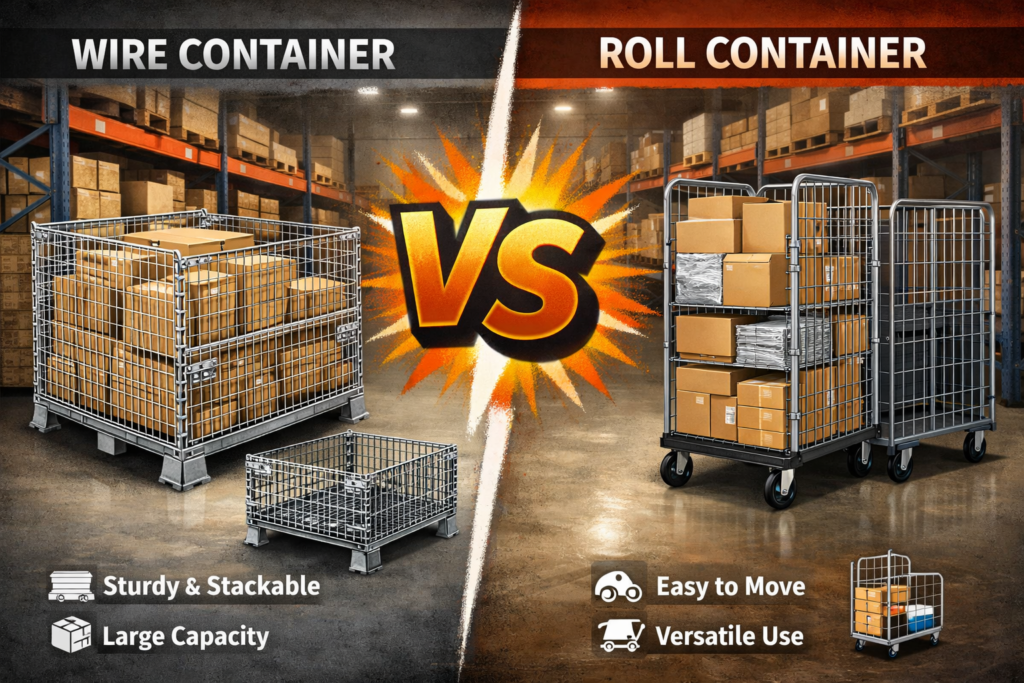
The short, sturdy wire container is a fixed-base, high-capacity box designed for heavy-duty bulk storage and forklift handling. The taller, multi-shelf roll container is a wheeled trolley with adjustable shelves, built for mobility, order picking, retail display, and easy manual movement.
At Mracking, we supply premium versions of both wire container and roll container alongside our full range of smart racking systems. This comprehensive 4500+ word guide compares the two in every detail — construction, load capacity, mobility, applications, cost, maintenance, stacking ability, and real-world performance in Chinese warehouses. By the end, you will know exactly which solution fits your operation in 2026.
What Is a Wire Container?
The wire container is a robust, four-sided wire-mesh storage box mounted on fixed legs or small feet. It is engineered for heavy, bulk storage and internal transport of goods that do not require frequent individual picking.
Typical specifications (standard sizes popular in China):
- Dimensions: 800×600×640 mm, 1000×800×840 mm, or 1200×1000×890 mm
- Height: Usually 640–850 mm (short and stable for stacking)
- Mesh size: 50×50 mm or 50×100 mm for excellent ventilation and visibility
- Load capacity: 800–1500 kg per unit (stackable 4–5 high when loaded)
- Material: High-tensile steel wire (4–6 mm diameter), hot-dip galvanized or powder-coated
- Base: Reinforced steel plate or mesh bottom with standard forklift pockets on all four sides
The wire container is built for durability and stacking strength. Its rigid welded structure allows safe stacking without deformation, making it perfect for long-term storage in warehouses or factories. The open wire mesh provides 360° visibility, good airflow (important for food, pharmaceuticals, and wet goods), and easy cleaning. Because it has no wheels, it remains stable when stacked and is ideal for integration with selective pallet racking, drive-in racking, or mezzanine systems supplied by Mracking.
In Chinese logistics, the wire container is the go-to solution for automotive parts warehouses, hardware factories, cold-chain facilities, and raw material storage. Its fixed legs and high load capacity make it the preferred choice when goods are heavy and need to be stored compactly for weeks or months.
What Is a Roll Container?
The roll container (also called roll cage or cage trolley) is a tall, narrow, wheeled wire-mesh unit that can be configured with 2–4 adjustable shelves. It is designed for mobility, order picking, retail display, and short-distance internal transport.
Typical specifications:
- Dimensions: 800×600×1700 mm or 720×450×1800 mm
- Height: 1600–1850 mm (tall and slim for easy pushing)
- Shelves: 2–4 adjustable wire shelves with locking brackets
- Wheels: 4 swivel casters (usually 100–150 mm diameter), 2 with brakes
- Load capacity: 300–500 kg total (evenly distributed across shelves)
- Material: Electro-galvanized or stainless steel wire for hygiene
- Features: Removable or foldable sides, security locks, and nestable design when empty
The roll container is all about movement and accessibility. Its four heavy-duty wheels allow one person to push it easily through narrow aisles, elevators, or retail floors. The multi-layer design makes it perfect for sorting different SKUs on the same unit — for example, one shelf for small parts, another for documents, another for tools. Many models have foldable or removable sides so they can be nested when empty, saving up to 70% space during return transport or storage.
In China, roll containers are standard equipment in supermarket chains, e-commerce fulfillment centers, hospitals, hotels, and garment factories. Their tall, narrow profile fits perfectly in narrow aisles and works beautifully alongside mezzanine racking or selective racking from Mracking.
Key Differences Between Wire Container and Roll Container
To help you decide quickly, here is a detailed side-by-side comparison:
Mobility and Wheels
- Wire container: No wheels — fixed legs or forklift pockets only. Moved by forklift or manual lifting.
- Roll container: 4 swivel casters with brakes. Can be pushed by hand anywhere in the facility.
Height and Shelf Configuration
- Wire container: Short (under 900 mm), single compartment, no internal shelves.
- Roll container: Tall (1600–1850 mm), 2–4 adjustable shelves for layered storage and easy picking.
Load Capacity and Stacking
- Wire container: 800–1500 kg per unit, stackable 4–5 high when loaded.
- Roll container: 300–500 kg total, not designed for stacking (wheels and height make it unstable).
Primary Purpose
- Wire container: Bulk storage, heavy parts, long-term holding, forklift transport.
- Roll container: Order picking, retail display, short-distance transport, multi-SKU sorting.
Space Efficiency
- Wire container: High when stacked, but takes more floor space when not stacked.
- Roll container: Excellent vertical utilization; can be nested when empty to save 70% space.
Ventilation and Visibility
Both offer excellent wire-mesh ventilation, but the roll container’s multiple shelves provide better visibility and access to every item.
Security and Locking
Both can have optional locks, but roll containers often include side gates or security panels for retail use.
Typical Lifespan
Both last 8–15 years with proper care, but wire containers are more durable under heavy stacking loads.
Construction and Materials Comparison
Both products are made from high-tensile steel wire, but the manufacturing focus differs:
Wire Container Construction
- Heavy-gauge wire (4–6 mm diameter) welded into rigid panels.
- Reinforced corner posts and base plate for stacking strength.
- Hot-dip galvanizing (80–100 μm) or powder coating for corrosion resistance.
- Forklift pockets and stacking feet as standard.
Roll Container Construction
- Lighter wire (3–4 mm) for easier pushing.
- Reinforced vertical frames with swivel caster mounts.
- Adjustable shelf brackets that lock securely at any height.
- Electro-galvanized finish or stainless steel for food/pharma use.
- Optional foldable sides and security doors.
At Mracking, we source both types from ISO-certified factories and test every batch for load capacity, weld strength, and coating thickness to ensure long service life in China’s humid and variable climate.
Applications and Real-World Use Cases in China
Wire Container Best Applications
- Automotive parts storage (heavy engine components)
- Hardware and fastener warehouses
- Cold-chain bulk food storage
- Raw material holding in manufacturing plants
- Integration with drive-in or selective racking systems
Roll Container Best Applications
- E-commerce order picking and sorting
- Supermarket backroom to shelf replenishment
- Hospital linen and equipment transport
- Retail display and promotional goods movement
- Hotel housekeeping and laundry transport
Many Chinese 3PL companies use a combination: wire containers for bulk incoming goods and roll containers for outbound order fulfillment.
Advantages and Disadvantages
Wire Container Advantages
- Extremely high load capacity and stacking strength
- Low maintenance
- Excellent for heavy, bulky items
- Cost-effective for long-term storage
Wire Container Disadvantages
- No wheels — requires forklift or manual lifting
- Single compartment only
- Less flexible for small-item picking
Roll Container Advantages
- Highly mobile and easy to push
- Multiple shelves for organized picking
- Nestable when empty
- Perfect for retail and display use
Roll Container Disadvantages
- Lower total load capacity
- Not suitable for very heavy items
- Wheels can wear on rough floors
Cost Analysis 2026 (China Market)
Wire Container
- Standard 800×600×640 mm: 680–880 RMB per unit
- Bulk purchase (100+ units): 650–800 RMB
- Stackable 4-high configuration saves floor space dramatically.
Roll Container
- 4-shelf 800×600×1700 mm: 820–1250 RMB per unit
- Bulk purchase (100+ units): 780–1180 RMB
- Nestable design reduces return transport costs by 60–70%.
When paired with our storage racking systems at Mracking, both containers deliver excellent ROI through better space utilization and faster material flow.
Maintenance and Longevity Tips
Wire Container Maintenance
- Inspect welds and feet annually
- Touch up powder coating if scratched
- Lubricate forklift pockets if needed
Roll Container Maintenance
- Check and replace worn casters every 2–3 years
- Tighten shelf brackets periodically
- Clean wheels to prevent floor damage
Both types are designed for 8–15 years of service when properly maintained.
How to Choose Between Wire Container and Roll Container
Ask yourself these questions:
- Do I need heavy bulk storage or frequent picking/display?
- Will the unit be moved by hand or by forklift?
- Do I need multiple layers for different SKUs?
- Is stacking important for space saving?
- What is my budget per unit?
For heavy storage and stacking → choose wire container. For mobility, picking, and retail → choose roll container.
At Mracking, our experts can help you combine the right containers with our smart racking systems for a complete, optimized solution.
Conclusion: Choose the Right Container for Your Operation
The wire container and roll container are both excellent tools, but they serve completely different roles in modern logistics. The short, sturdy wire container excels at heavy bulk storage and stacking, while the tall, wheeled roll container is the champion of mobility, order picking, and retail display.
At Mracking, we supply both types in premium quality, along with full ranges of smart racking, mezzanine systems, and cantilever racking. Our team offers free consultations, custom sizing, and nationwide delivery across China.
Ready to upgrade your storage and transport efficiency? Contact us today — we will help you select the perfect combination of wire container, roll container, and racking to meet your exact needs and budget.