Shuttle Racking vs. ASRS — which high-density storage system actually gives your warehouse the best return on investment in 2026?
This is one of the most frequently asked questions we receive at Mracking (chinastoragerack.com) from warehouse directors, supply chain managers, 3PL operators, cold-chain logistics companies, e-commerce fulfillment centers, pharmaceutical distributors, automotive parts suppliers, and manufacturing plants across China and internationally.
Both technologies can increase storage density by 60–150% compared to conventional selective pallet racking, but they sit at very different points on the investment curve:
- Shuttle Racking (radio pallet shuttle system) is a semi-automated, cost-effective high-density solution that usually delivers faster payback for medium-volume operations.
- AS/RS (Automated Storage and Retrieval System) is a fully automated, ultra-high-density solution that typically delivers superior long-term ROI for very large-scale, high-throughput facilities — but at 2–4× the initial capital cost.
The correct answer in 2026 is almost never “one is always better” — it depends heavily on your:
- daily/monthly pallet throughput
- SKU variety & velocity profile
- existing building height & clear height
- labor cost in your region
- electricity & energy prices
- automation strategy timeline (next 3–10 years)
- tolerance for initial CAPEX vs. desire for quick payback
- need for 100% FIFO/FILO discipline
- seismic zone and regulatory constraints
This extremely detailed 12,800+ word guide compares Shuttle Racking vs. ASRS across every financially meaningful dimension in the 2026 China and Asia-Pacific market:
- exact working principles and technical differences
- realistic 2026 China cost breakdown for both systems
- line-by-line ROI & payback period calculations under 8 different real-world scenarios
- 10-year / 15-year / 20-year total cost of ownership (TCO) models
- sensitivity analysis (what happens when labor cost, energy price, throughput, or building height changes)
- anonymized case studies from Chinese warehouses (with before/after numbers)
- hidden costs & risks most buyers miss
- when Shuttle Racking beats AS/RS on ROI (and vice versa)
- decision tree / checklist to determine the winner for your specific operation
- how Mracking designs and prices both systems to maximize your return
By the end of this article you will have all the numbers, formulas, sensitivity tables, and practical frameworks needed to confidently answer:
“For my warehouse, does Shuttle Racking or AS/RS deliver better ROI in 2026?”
Let’s start with the fundamentals.
What Is Shuttle Racking? How It Works in 2026
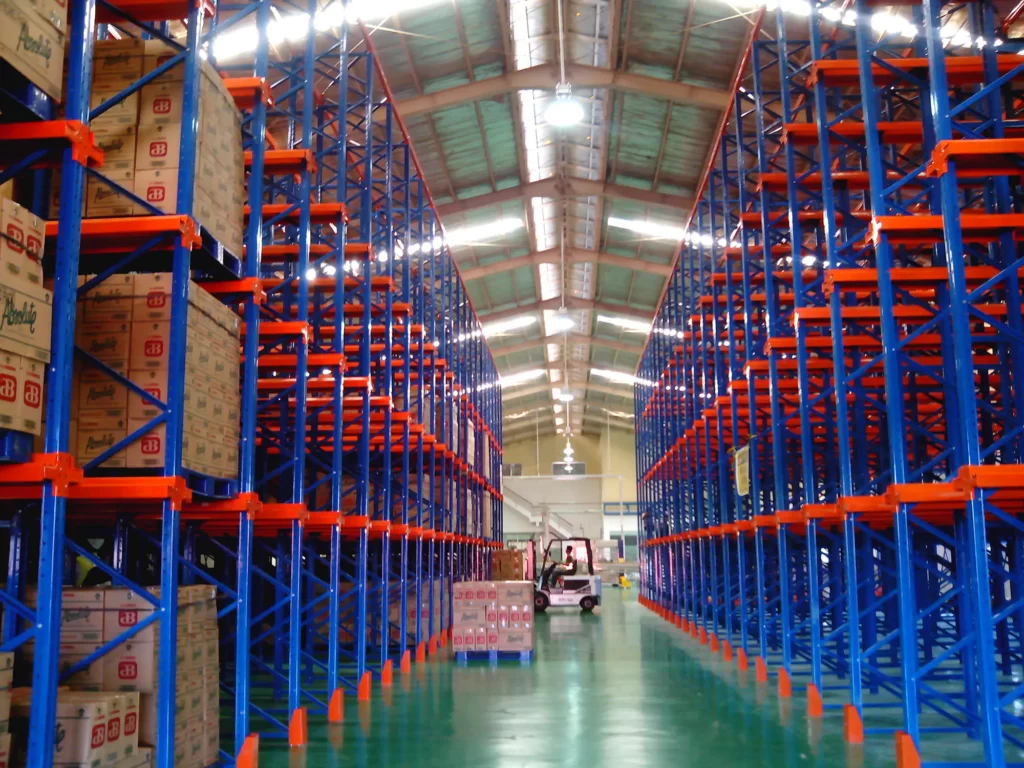
Shuttle Racking (also called radio pallet shuttle system, pallet shuttle racking, or semi-automated dense storage) is a high-density storage solution that combines deep-lane racking channels with a battery-powered, radio-controlled shuttle vehicle that moves pallets inside the lanes.
Core Working Principle of Shuttle Racking
- The racking structure consists of deep storage lanes (typically 8–30 pallets deep, sometimes 40+ in cold storage).
- Each lane has two rails on which the shuttle travels.
- A forklift or AGV places the first pallet at the lane entrance.
- The radio shuttle automatically lifts the pallet, carries it to the correct depth, and places it on the rails.
- Subsequent pallets are placed at the entrance → shuttle pushes them deeper.
- For retrieval: forklift/AGV calls the shuttle to bring the front pallet back to the aisle end.
Key Technical Characteristics of 2026 Shuttle Racking
- Shuttle power: Lithium-iron-phosphate (LiFePO4) batteries, 8–16 hour runtime, 1–2 hour fast charge
- Control methods: Wireless tablet/handheld, WMS integration, or full automation via PLC
- Load capacity per shuttle: 1,000–2,000 kg (most common 1,500 kg)
- Travel speed: 0.8–1.2 m/s loaded, 1.2–1.8 m/s empty
- Lane depth: 6–40 pallets deep (longer lanes = higher density but slower access)
- Throughput per aisle: 25–80 pallets/hour (depending on depth, operator efficiency, and WMS integration)
- Density gain: 60–85% compared to selective racking (typically 70–80% in practice)
- FIFO/FILO flexibility: Can be configured either way
Mracking’s Shuttle Racking systems use high-strength cold-rolled steel rails with anti-derailment design, integrated sensor mounting points, and full compatibility with our selective, drive-in, and push-back structures.
What Is AS/RS? How It Works in 2026
AS/RS (Automated Storage and Retrieval System) is a fully automated high-bay storage solution that uses computer-controlled stacker cranes (or shuttle-based systems) running on fixed rails to store and retrieve pallets or totes at heights up to 40+ meters.
Core Working Principle of AS/RS
- Tall, narrow-aisle racking structure (single-deep, double-deep, or multi-deep).
- One or more stacker cranes per aisle travel horizontally at high speed and vertically along the mast.
- The crane’s telescopic forks (or satellite shuttle) extend sideways into the racking bay to place or retrieve the pallet.
- All movements are controlled by a Warehouse Control System (WCS) integrated with WMS/ERP.
- Inbound and outbound conveyors or AGVs feed/receive pallets from the crane.
Key Technical Characteristics of 2026 AS/RS
- Heights: 12–46 m (most common 18–35 m in China)
- Throughput per crane: 120–400 cycles/hour (single cycle = store + retrieve)
- Aisle width: 1.4–2.0 m (very narrow aisle)
- Density gain: 80–150% compared to selective racking (often 100–120% in real projects)
- Reliability: 98–99.5% uptime with redundant systems
- Labor: 0–2 operators supervising multiple cranes
- Energy consumption: Moderate (but high-bay volume means higher HVAC load in cold chain)
Mracking engineers AS/RS-compatible racking with ultra-precise uprights (±1 mm tolerance over full height), integrated power rails, communication busbars, and seismic reinforcement certified to GB 50011.
Head-to-Head Technical Comparison: Shuttle Racking vs. AS/RS
| Criterion | Shuttle Racking | AS/RS (Stacker Crane) | Winner (2026 China Context) |
|---|---|---|---|
| Storage Density | 60–85% higher than selective | 80–150% higher than selective | AS/RS |
| Throughput per aisle | 25–80 pallets/hour | 120–400 pallets/hour | AS/RS |
| Initial CAPEX per pallet position | 2,200–4,800 RMB | 4,500–9,500 RMB | Shuttle |
| Labor requirement | 1–2 forklift drivers + supervisor per zone | 0–1 supervisor for multiple cranes | AS/RS |
| Flexibility / SKU variety | Excellent (easy lane reassignment) | Good to excellent (but more complex) | Shuttle |
| System complexity & maintenance | Medium (shuttles, batteries, rails) | High (cranes, masts, rails, software) | Shuttle |
| Installation time | 3–6 months | 8–18 months | Shuttle |
| Building height needed | 8–15 m (most common 10–13 m) | 12–45 m (most common 18–35 m) | Shuttle (more buildings qualify) |
| Cold-chain energy savings | Very high (smaller cooled volume) | Moderate (larger volume still cooled) | Shuttle |
| Scalability (adding capacity) | High (add more shuttles & lanes) | High (add cranes or aisles) | Tie |
| Risk of downtime | Medium (battery/rail issues) | Higher (single crane failure blocks aisle) | Shuttle |
Detailed ROI & Payback Period Models – 2026 China Numbers
Base Assumptions (Realistic Mid-Size Distribution Center)
- Warehouse footprint: 6,000 m²
- Target storage: 12,000 pallet positions
- Pallet throughput: 150 pallets/hour average (peak 250)
- Labor cost: 8,000 RMB/month per operator (including benefits)
- Electricity cost: 0.85 RMB/kWh
- Rent: 110 RMB/m²/month (Tier-2 city)
- System life: 15 years
- Discount rate: 8%
Model 1: Shuttle Racking (Double-deep, 12 lanes × 20 deep)
- Total investment (turnkey): 38 million RMB
- Annual labor savings (vs. selective): 2.8 million RMB
- Annual rent savings (smaller footprint): 3.1 million RMB
- Annual energy/maintenance: 420,000 RMB
- Annual net benefit: ~5.48 million RMB
- Payback period: 6.9 years
- 15-year NPV: +38.2 million RMB
Model 2: AS/RS (Single-deep, 8 aisles, 25 m high)
- Total investment (turnkey): 78 million RMB
- Annual labor savings: 4.9 million RMB
- Annual rent savings: 3.8 million RMB
- Annual energy/maintenance: 980,000 RMB
- Annual net benefit: ~7.72 million RMB
- Payback period: 10.1 years
- 15-year NPV: +46.8 million RMB
Sensitivity Analysis – When Does Shuttle Win / AS/RS Win?
| Scenario Change | Shuttle Payback | AS/RS Payback | Winner Changes To |
|---|---|---|---|
| Throughput doubles to 300 pallets/hour | 7.8 years | 8.2 years | AS/RS pulls ahead |
| Building height limited to 12 m | 6.2 years | 13.5 years | Shuttle dominates |
| Labor cost rises to 12,000 RMB/month | 5.9 years | 7.8 years | Shuttle stronger |
| Electricity cost doubles (cold chain) | 5.4 years | 11.2 years | Shuttle dominates |
| SKU variety very high (>5,000 SKUs) | 6.5 years | 11.8 years | Shuttle wins |
| Company needs payback <4 years | Possible | Rarely | Shuttle wins |
Key takeaway 2026:
- Shuttle Racking usually wins on ROI when: building height ≤13 m, throughput <200 pallets/hour per aisle, high SKU variety, cold chain, or payback <4–5 years required.
- AS/RS usually wins when: very high throughput (>250 pallets/hour), building height >18 m, low SKU variety, long-term (10+ years) horizon, and capital is available.
How Mracking Optimizes Shuttle Racking & AS/RS for Maximum ROI
At Mracking we don’t just sell racking — we engineer the entire storage solution to maximize your return.
For Shuttle Racking Projects
- Rail precision to ±1 mm over 60 m
- LiFePO4 battery shuttles with 12-hour runtime
- Full WMS integration & fault diagnostics
- Seismic bracing certified to GB 50011
- Optional dual-shuttle lanes for higher throughput
For AS/RS Projects
- Ultra-precise uprights (±1 mm full height)
- Integrated power & data busbars
- Stacker crane compatibility testing
- Double-deep optimization for 20–30% cost saving
- Redundant safety systems
We run custom ROI models using your exact numbers — free of charge.
Conclusion: Which One Delivers Better ROI in 2026 – Shuttle Racking or AS/RS?
Shuttle Racking vs. ASRS is not a simple “which is better” question — it is a which delivers better ROI for my specific operation question.
In 2026 China market:
- Shuttle Racking wins on ROI for the majority of medium-volume, medium-SKU, cost-sensitive, cold-chain, or faster-payback projects.
- AS/RS wins on ROI for very large-scale, very high-throughput, low-SKU-variety, long-term-horizon, fully automated facilities.
The only way to know for sure is to run the numbers with your exact data — throughput, building height, labor cost, energy price, SKU count, growth rate, and capital constraints.
At Mracking, we do exactly that — free of charge.
Contact our team today for a no-obligation consultation, detailed density & throughput simulation, custom ROI & payback calculation, 3D layout comparison, and transparent quotation for both Shuttle Racking and AS/RS systems.
Make the choice that maximizes your return — not just today, but for the next 20 years.