Pharmaceutical warehousing is one of the most highly regulated, technically complex, and mission-critical areas of modern supply chain management. Unlike general-purpose warehousing, pharmaceutical warehousing must ensure uninterrupted temperature control, prevent any possibility of cross-contamination, maintain complete batch-level traceability from receipt to dispatch, comply with stringent GMP (Good Manufacturing Practice), GDP (Good Distribution Practice), and NMPA regulations in China, and protect high-value, sensitive, temperature-sensitive, or life-saving products from even the smallest environmental deviation that could compromise potency, stability, sterility, or patient safety.
In 2026, China’s pharmaceutical industry continues to expand at double-digit rates, driven by biologics, vaccines, cell & gene therapies, biosimilars, traditional Chinese medicine modernization, and the rapid growth of cold-chain logistics. At the same time, regulatory scrutiny from the National Medical Products Administration (NMPA), coupled with international alignment toward WHO GDP, EU GDP 2013/C 343/01, and US FDA 21 CFR Part 211/820 standards, has made pharmaceutical warehousing one of the most demanding and capital-intensive warehouse types in existence. For a closer comparison, see Freezer Warehouse. For broader industry context, Cold chain is a useful reference.
At Mracking, we have designed, manufactured, and installed specialized racking systems for dozens of pharmaceutical manufacturing sites, distribution centers, 3PL cold-chain operators, hospital pharmacies, clinical trial depots, and research institutions across China. Our pharmaceutical warehousing racking solutions are engineered to meet or exceed NMPA GMP Annex 1 (sterile products), Annex 15 (validation), GDP guidelines, GB 50011 seismic requirements, and international cleanroom compatibility standards while maximizing cubic storage density and supporting full automation readiness. This point also connects with Hot vs Cold Rolled Steel.
This exhaustive guide is the most comprehensive single resource available on pharmaceutical warehousing in 2026. We cover every critical topic in detail: regulatory framework in China and globally, temperature zones and cold-chain logistics requirements, contamination control and hygiene standards, traceability & data integrity (ALCOA+), suitable racking types for pharma (selective, cantilever, mobile, mezzanine, AS/RS), validation and qualification of racking systems, seismic & structural safety design, energy efficiency and sustainability, cost analysis & ROI calculations, common pitfalls that lead to non-compliance, future trends (AI predictive monitoring, blockchain traceability, robotic picking), and how Mracking’s pharmaceutical-grade racking systems help companies achieve compliance, efficiency, and long-term cost savings. A related guide on Low Temperature Cold Storage Racks gives more detail for this part of the planning work.
By the end of this article, you will have a complete, self-contained understanding of how to design, equip, validate, and operate a fully compliant and highly efficient pharmaceutical warehousing facility — no additional research required.
Why Pharmaceutical Warehousing Is Fundamentally Different from General Warehousing
Pharmaceutical warehousing is not “just another warehouse.” The products stored — finished medicines, vaccines, biologics, APIs, medical devices, clinical trial materials, investigational medicinal products (IMPs) — are not ordinary commodities. Any excursion in temperature, humidity, cleanliness, pest control, or documentation can render an entire batch ineffective, unsafe, or unusable, with potential consequences ranging from product recalls and financial loss to patient harm and regulatory sanctions.

Key Differences from General Warehousing
- Temperature & Humidity Sensitivity Most pharmaceutical products require strict environmental control: 2–8°C (refrigerated), 15–25°C (controlled room temperature), -20°C / -40°C / -80°C (frozen/ultra-low), or even ambient with tight ±2°C tolerance. Even short excursions outside validated ranges can degrade active ingredients, reduce shelf life, or cause complete loss of potency.
- Contamination & Cross-Contamination Risk Dust, microbes, allergens, or residues from one product can contaminate another. This requires physical segregation, dedicated zones, validated cleaning protocols, and restricted access.
- Full Traceability & Data Integrity Every movement, environmental reading, and handling step must be recorded and auditable (ALCOA+ principles: Attributable, Legible, Contemporaneous, Original, Accurate, Complete, Consistent, Enduring, Available).
- Regulatory Oversight China NMPA, GMP (2010 version), GDP, WHO guidelines, EU GDP, US FDA 21 CFR Part 211/820, and ICH Q9/Q10 standards all impose strict requirements on facilities, equipment, processes, and documentation.
- High Product Value & Safety Stakes A single pallet of biologics or vaccines can be worth millions of RMB. A quality issue can lead to product recalls, reputational damage, and legal liability.
- Validation Requirement Every critical system — including racking — must undergo Installation Qualification (IQ), Operational Qualification (OQ), and Performance Qualification (PQ).
These unique requirements make pharmaceutical warehousing one of the most demanding warehouse types, and the storage racking system is the physical backbone that must support all these controls without introducing risk.
China & Global Regulatory Framework for Pharmaceutical Warehousing
Understanding the regulatory landscape is essential before designing any pharmaceutical warehousing facility.
China NMPA & GMP/GDP Requirements
- GMP (Good Manufacturing Practice) — Annex 1 (sterile medicinal products), Annex 15 (qualification and validation)
- GDP (Good Distribution Practice) — Temperature mapping, qualified vehicles, validated storage, deviation management
- Data Integrity — ALCOA+ principles mandatory for electronic records
- Seismic Design — GB 50011-2010 (mandatory for all racking in pharma facilities)
- Cold Chain — Specific guidelines for 2–8°C and frozen products
International Alignment
- WHO GDP Guidelines (2010, updated 2021)
- EU GDP 2013/C 343/01
- US FDA 21 CFR Part 211 (cGMP for finished pharmaceuticals), Part 820 (medical devices)
- ICH Q9 (Quality Risk Management), Q10 (Pharmaceutical Quality System)
Mracking racking systems are designed to support full validation and compliance with all these frameworks.
Temperature-Controlled Pharmaceutical Warehousing: The #1 Critical Factor
Temperature is the single most regulated and monitored parameter in pharmaceutical warehousing.
2–8°C Refrigerated (Cold Chain) Storage
Vaccines, insulin, monoclonal antibodies, blood products, and many injectables require strict 2–8°C storage with ±2°C tolerance. Excursions outside this range can cause irreversible degradation.
Racking considerations:
- Increased airflow channels between pallets to prevent hot/cold spots
- Compatibility with large-scale refrigerated HVAC and air circulation systems
- Special coatings resistant to condensation and corrosion
- Integrated temperature sensor mounting points on every level
- Open-front design to allow uniform air distribution
15–25°C Controlled Room Temperature (CRT)
Most tablets, capsules, oral solids, and non-sterile liquids fall into this category.
Racking considerations:

- Uniform air circulation to avoid localized hot spots
- Easy cleaning and sanitization of surfaces
- Compatibility with continuous monitoring data loggers
Frozen & Ultra-Low Temperature Storage (-20°C to -80°C)
Cell & gene therapies, some APIs, and certain vaccines require ultra-low temperatures.
Racking considerations:
- Materials and coatings that withstand extreme cold without becoming brittle
- Reduced thermal bridging to minimize energy loss
- Special reinforcement for low-temperature contraction
Mracking has developed specific pharmaceutical warehousing racking solutions for all three temperature zones, with proven performance in NMPA-inspected facilities.
Contamination Control, Hygiene & Cleaning in Pharmaceutical Warehousing
Preventing contamination and cross-contamination is a core GMP requirement.
Design Features for Cleanability
- Smooth, non-porous surfaces with no crevices
- Rounded corners where possible
- Elevated base plates (minimum 100 mm) to allow floor cleaning underneath
- Stainless steel or special epoxy coatings in high-risk areas
- No open threads or gaps that trap dust
Zoning and Physical Segregation
Mracking helps design dedicated, clearly separated zones for:
- Quarantine (incoming materials awaiting release)
- Released goods (approved for distribution)
- Returns (suspect or customer returns)
- Rejected materials (non-conforming products)
- Highly potent or cytotoxic APIs (contained areas)
- Highly active or allergenic products (dedicated racking lines)
Pest Control & Environmental Monitoring
Racking designs include easy access for pest control bait stations and integrated mounting for continuous temperature/humidity/particle monitoring.
Cleaning Validation
All pharmaceutical warehousing racking from Mracking supports validated cleaning protocols (detergent, disinfectant rotation, rinse verification).
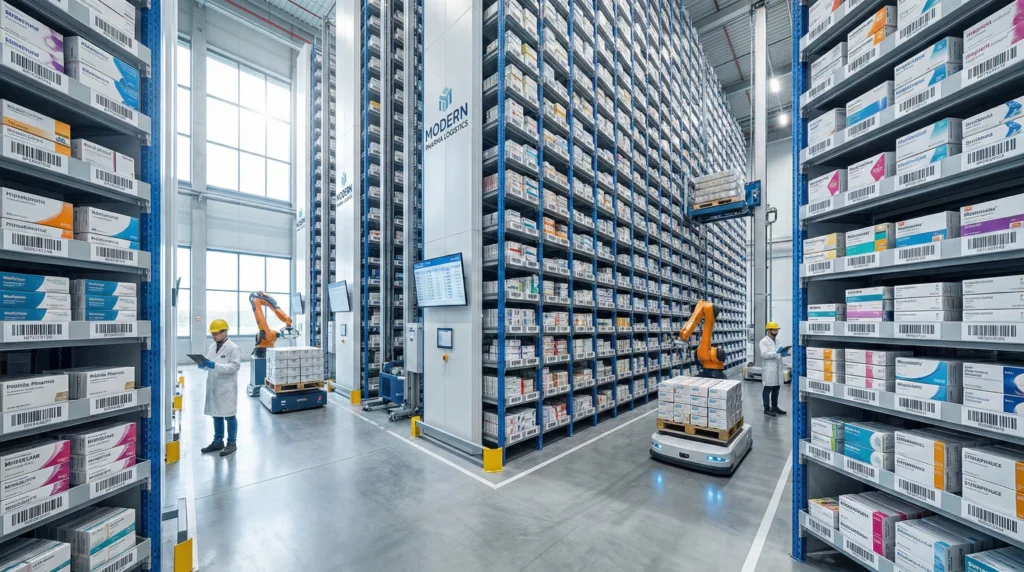
Full Traceability & Data Integrity in Pharmaceutical Warehousing
Traceability from receipt to dispatch is mandatory under NMPA and international GDP.
Mracking racking systems support:
- RFID and 2D barcode mounting channels on every beam level
- Clear, durable location addressing (e.g., A-03-05-B system)
- Integration with WMS/ERP for electronic batch records and audit trails
- Real-time inventory visibility and temperature history logging
This ensures complete ALCOA+ compliance (Attributable, Legible, Contemporaneous, Original, Accurate, Complete, Consistent, Enduring, Available).
Safety, Seismic Design & Structural Integrity in Pharmaceutical Warehousing
Pharmaceutical facilities often store high-value or hazardous materials, making safety and structural integrity paramount.
Seismic Design Requirements
All racking in China must comply with GB 50011-2010 seismic code. Mracking systems include:
- Cross-bracing and base plate anchoring
- Earthquake-resistant beam connectors
- Seismic load calculations provided for every project
Load Management & Overload Prevention
- Clear load plaques on every beam level (mandatory)
- Optional real-time load sensors for high-value or critical products
- Safety locks to prevent accidental beam dislodgement
Collision Protection
- Upright protectors
- Aisle protection rails
- Column guards
- Overhead netting for upper levels
Fire Safety & Sprinkler Clearance
Racking designs maintain adequate clearance for sprinklers and allow easy access for fire suppression systems.
Cost Analysis & ROI of Pharmaceutical Warehousing Racking
Pharmaceutical warehousing racking investments are higher than general warehousing due to regulatory and environmental requirements.
Typical Cost Ranges (China 2026, installed)
- Selective pallet racking (standard): 800–1,800 RMB per pallet position
- Selective racking with pharma-grade coatings & validation support: 1,200–2,800 RMB per position
- Mobile pallet racking (high-density cold chain): 2,500–5,000 RMB per position
- Mezzanine systems for secondary packaging: 1,200–2,200 RMB per m²
- AS/RS racking for large-scale distribution: 3,500–8,000 RMB per position
Major ROI Drivers
- Energy Savings in Cold Chain — Mobile racking reduces cooled volume by 50–70%, saving millions in electricity annually.
- Reduced Product Loss — Better temperature uniformity and traceability minimize excursions and write-offs.
- Faster Recall & Audit Response — Organized racking + full traceability shortens recall time and audit duration.
- Labor Efficiency — Optimized slotting and automation-ready design reduce picking labor by 30–50%.
- Extended Product Shelf Life — Stable conditions increase remaining shelf life, reducing waste.
Most Mracking pharmaceutical clients achieve payback in 2–4 years, with ongoing savings of 20–40% on energy, labor, and product loss thereafter.
Future Trends in Pharmaceutical Warehousing 2026–2030
- Increased adoption of AS/RS and robotic picking for sterile and high-value products
- AI-driven predictive temperature control and deviation prevention
- Blockchain and digital twins for end-to-end traceability
- Sustainable materials (recycled steel, low-VOC coatings) to meet carbon goals
- Modular, reconfigurable racking for rapid response to new product launches
Mracking is already developing next-generation systems to support these trends.
How Mracking Supports Pharmaceutical Warehousing Projects
At Mracking, we offer specialized services for pharmaceutical warehousing:
- GMP/GDP-compliant racking design
- Full IQ/OQ/PQ validation support documentation
- Temperature mapping and airflow study assistance
- Seismic and structural certification packages
- Stainless steel and special coating options
- Nationwide installation and after-sales service
Our team has successfully completed numerous pharmaceutical warehousing projects across China, helping clients pass NMPA inspections and achieve operational excellence.
Conclusion: Build a Compliant, Efficient & Future-Ready Pharmaceutical Warehousing Facility
Pharmaceutical warehousing demands zero tolerance for error. The storage racking system is the physical foundation that must support temperature control, contamination prevention, traceability, safety, and regulatory compliance without introducing any risk.
At Mracking, we specialize in designing and manufacturing pharmaceutical warehousing racking solutions that meet or exceed NMPA, GMP, GDP, WHO, and international standards while delivering maximum storage density, energy efficiency, and long-term cost savings.
Ready to build or upgrade your pharmaceutical warehousing facility? Contact the Mracking team today for a free consultation, detailed 3D design, load calculations, validation support, and competitive quotation. For product-level details, review Cold Storage Warehouse Cost.
Let us help you create a compliant, efficient, and future-ready pharmaceutical storage solution that protects product quality, patient safety, and your brand reputation.