


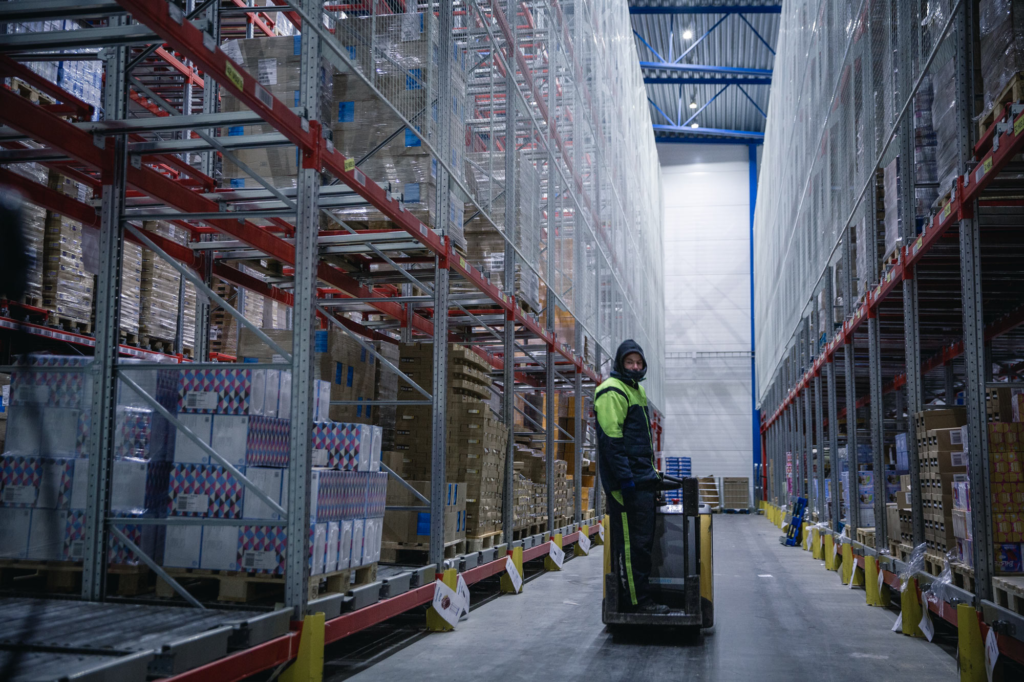
Fast-moving consumer goods are the products that quietly run our daily lives: the bottled drinks, packaged snacks, shampoo, detergent, and over-the-counter remedies that fly off retail shelves and need constant replenishing. Behind that endless flow sits a highly specialized engine — the FMCG warehouse. It is the point where bulk shipments from manufacturers are received, stored briefly, and then dispatched as a steady stream of precise orders to retailers and, increasingly, to online shoppers.
FMCG warehousing is a discipline of its own. Unlike a general storage facility where goods may rest for months, an FMCG distribution center is built for relentless movement, tight stock rotation, and high-volume order fulfillment. Every decision — the layout, the pallet racking, the rotation method, the technology — is shaped by one demand: keep fast-moving products flowing toward the consumer without spoilage, stockouts, or wasted space.
This guide walks through everything you need to understand FMCG warehousing, from definitions and product types to layout design, storage systems, FIFO and FEFO rotation, and where the industry is heading in 2026 and beyond. A related guide on Comparison of FEFO and FIFO Inventory Management gives more detail for this part of the planning work.
What Is FMCG Warehousing?
FMCG warehousing is the storage, handling, and distribution of fast-moving consumer goods — high-turnover, relatively low-cost products that sell in large volumes and often carry short shelf lives. The warehouse functions as a buffer and orchestration point between production and retail. It absorbs large inbound deliveries, holds inventory for a short window, and converts that stock into frequent, accurate outbound shipments. For product-level details, review Industrial Mezzanine Design.
The defining trait of FMCG warehousing is velocity. A traditional industrial warehouse might turn its inventory only a handful of times a year, but a well-run FMCG operation can turn over its stock 15, 20, or even 30 times annually. Perishable categories like dairy and bakery may cycle through in a matter of days. As a result, the warehouse behaves less like a storage vault and more like a flow-through hub where product is almost always in motion. For a closer comparison, see Drive in Racking vs Drive Through Racking.

Where the FMCG Warehouse Sits in the Supply Chain
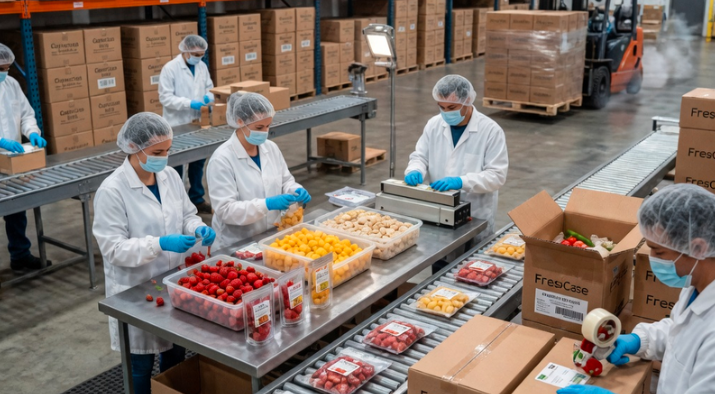
After goods leave a manufacturer or import terminal, they usually move into a regional or national distribution center. From there they are sorted, consolidated, and routed onward to smaller depots, retail outlets, or directly to consumers. This makes the FMCG warehouse a strategic lever rather than a passive cost center. A facility that processes orders quickly and accurately allows retailers to hold leaner store-level inventory, which reduces waste and frees up working capital throughout the chain. A slow or error-prone warehouse, on the other hand, forces everyone downstream to carry extra safety stock and raises the risk of expiry and spoilage.
Types of FMCG Products Stored in Warehouses
FMCG is a broad umbrella, and each product category brings distinct storage requirements. The product mix ultimately dictates the racking, the climate zones, the rotation method, and the handling equipment a warehouse needs.
Food and Beverages
This is the largest and most demanding category. It spans shelf-stable dry goods such as rice, pasta, canned products, and snacks; heavy, high-volume bottled and canned drinks; and a wide range of perishables. Beverages are dense and well suited to pallet racking and high-density storage, while fresh foods require strict expiry control and often chilled or frozen environments. A single food warehouse frequently has to manage the full spectrum from multi-year shelf life to a few days.
Personal Care and Cosmetics
Shampoo, soap, skincare, deodorant, and cosmetics are generally lighter and less perishable than food but bring their own challenges. Many are temperature-sensitive, and most are sold in retail-ready packaging that must arrive undamaged. These goods commonly sit on selective pallet racking for reserve stock and on shelving or carton flow racks for piece-level picking of fast movers.
Household and Cleaning Products
Detergents, surface cleaners, paper goods, and similar consumables form another major group. Cleaning chemicals may be classified as hazardous and require segregation from food, while paper products are bulky and light, consuming significant cubic space relative to their weight — a key factor in racking height and aisle planning. This point also connects with Food Warehousing.
Health and Impulse Goods
Over-the-counter health items like vitamins and pain relievers move quickly but carry strict batch-tracking and expiry requirements, pushing warehouses toward rigorous FEFO rotation. High-value impulse goods such as confectionery and tobacco are small, valuable, and theft-prone, often calling for secure storage and compact, high-speed picking systems like carton flow racking.
FMCG Warehousing vs Traditional Warehousing
It is easy to assume all warehouses are alike, but FMCG warehousing differs from traditional storage in fundamental ways. The table below summarizes the contrast, followed by the key distinctions explained.
| Factor | FMCG Warehousing | Traditional Warehousing |
|---|---|---|
| Inventory turnover | Very high (15–30+ times/year) | Low to moderate (a few times/year) |
| Primary design goal | Speed, accessibility, throughput | Storage density, long-term holding |
| Shelf life | Often short; expiry-critical | Usually long or non-perishable |
| Stock rotation | Strict FIFO / FEFO required | Often random or convenience-based |
| Order profile | Frequent, small, mixed-SKU orders | Fewer, larger, full-pallet orders |
| Picking intensity | High; case and piece picking | Lower; mostly pallet picking |
| Demand pattern | Volatile (promotions, seasons) | Relatively stable and predictable |
| Technology reliance | High (WMS, automation, tracking) | Moderate |
Velocity and Turnover
The biggest difference is velocity. Traditional warehouses are optimized to store; goods can sit for weeks or months, so density and cost-per-pallet-position dominate the design. FMCG warehouses are optimized to move, so the priority shifts toward accessibility and throughput. A racking layout that maximizes density but slows down picking is often the wrong choice for fast-moving goods.
Shelf Life and Rotation
Traditional goods rarely expire, so storage order matters little. FMCG goods frequently carry best-before or use-by dates, and even non-perishable products lose value once a promotional window closes. This makes disciplined FIFO and FEFO rotation and batch-level tracking essential — a requirement that shapes nearly every storage decision.
Order Profile and Throughput
Traditional orders tend to be larger and less frequent. FMCG orders are the reverse: a high frequency of smaller, mixed-SKU orders picked at the case or piece level. This makes picking the most labor-intensive and error-prone part of the operation, which is why speed-optimized systems and high transaction volumes per square meter define FMCG facilities.
Key Characteristics of FMCG Warehouse Operations
High-performing FMCG warehouses share a recognizable operational profile that flows directly from the demands of fast-moving goods.
High Inventory Turnover and Rapid Fulfillment
Stock should never linger. The entire operation — dock scheduling, slotting, replenishment — is tuned to keep goods flowing toward the customer. At the same time, retailers expect fast, accurate, and complete deliveries, because a single missing or incorrect item disrupts store merchandising. FMCG warehouses therefore invest heavily in order fulfillment accuracy through barcode scanning, pick-to-light, voice picking, and warehouse management systems, treating speed and accuracy as simultaneous goals rather than trade-offs.
Disciplined Stock Rotation and Traceability
Because so many products are date-sensitive, stock rotation is non-negotiable, and the storage systems must physically support it. Many categories — food, beverages, health products — also fall under food-safety and traceability regulations, meaning operators must be able to trace any batch back to its source and forward to its destination quickly in the event of a recall.
Efficient Space Use and Scalability
FMCG warehouses must still use expensive real estate efficiently, balancing density against the accessibility that fast-moving goods demand. They also need to scale, because FMCG demand swings sharply with promotions and seasonality. A facility that runs smoothly at average volume but collapses during a promotional peak is a liability, so flexibility — modular racking, adaptable slotting, flexible labor — is built in from the start.
FMCG Warehouse Layout Design
Layout is where strategy becomes physical. A well-designed FMCG warehouse layout minimizes travel distance, supports smooth product flow, and adapts to changing demand. Poor layout locks in inefficiency that no technology can fully overcome.
Product Flow and Functional Zones
Most FMCG warehouses follow either a U-shaped flow, where receiving and shipping share one side of the building with storage between, or a through-flow (I-shaped) layout, where goods enter at one end and exit at the other in a straight, unidirectional path well suited to very high-volume operations.
Within that flow, the building is divided into clearly defined zones. The receiving zone checks and prepares inbound goods. The storage zone holds reserve inventory on pallet racking. The picking zone, usually a forward pick face replenished from reserve, is engineered for speed. The packing and consolidation zone checks and assembles shipments, and the shipping zone stages completed orders for dispatch. Separating these zones keeps activities from interfering with one another and lets each be optimized independently.
ABC Slotting
One of the most powerful layout principles is ABC slotting, or velocity-based placement. Because a small share of SKUs typically generates the majority of picks, the fastest-moving “A” items are placed in the most accessible, lowest-travel locations near packing and shipping, while slower “C” items occupy more distant or higher positions. Done well, this dramatically reduces travel time and labor cost. Slotting is not a one-time task: velocity shifts with promotions and seasons, so leading operations re-slot regularly using WMS data.
Storage Systems Used in FMCG Warehousing
Storage systems are the backbone of any FMCG warehouse, and the right combination is one of the most consequential decisions an operator makes. Because FMCG goods span a wide range of velocities, sizes, and rotation needs, no single system fits everything — effective warehouses blend several. Here is how the main warehouse storage systems compare.
| Storage System | Density | Selectivity | Rotation | Best For in FMCG |
|---|---|---|---|---|
| Selective pallet racking | Low–Medium | Very high | Any (FIFO/FEFO) | Wide SKU range, frequent picking |
| Drive-in racking | Very high | Low | LIFO | High-volume, non-perishable SKUs |
| Pallet flow racking | High | Medium | FIFO (automatic) | Perishable, date-sensitive high movers |
| Push-back racking | High | Medium | LIFO | Medium-velocity SKUs needing density |
| Carton flow racking | High (pick face) | High | FIFO | Fast small items, case/piece picking |
| Mezzanine / multi-tier | Adds floor area | High | Any | Many small-item SKUs, tall buildings |
| Shelving / bin storage | Low | High | Any | Slow-moving “C” items, broken-case picking |
Selective Pallet Racking
Selective pallet racking is the most widely used system in the world because it gives direct access to every pallet, supports any rotation method, and adapts easily to changing inventory. Its trade-off is lower density, since every pallet needs an access aisle, but for most FMCG warehouses the flexibility makes it the default choice for the bulk of storage.

Pallet Flow and Push-Back Racking
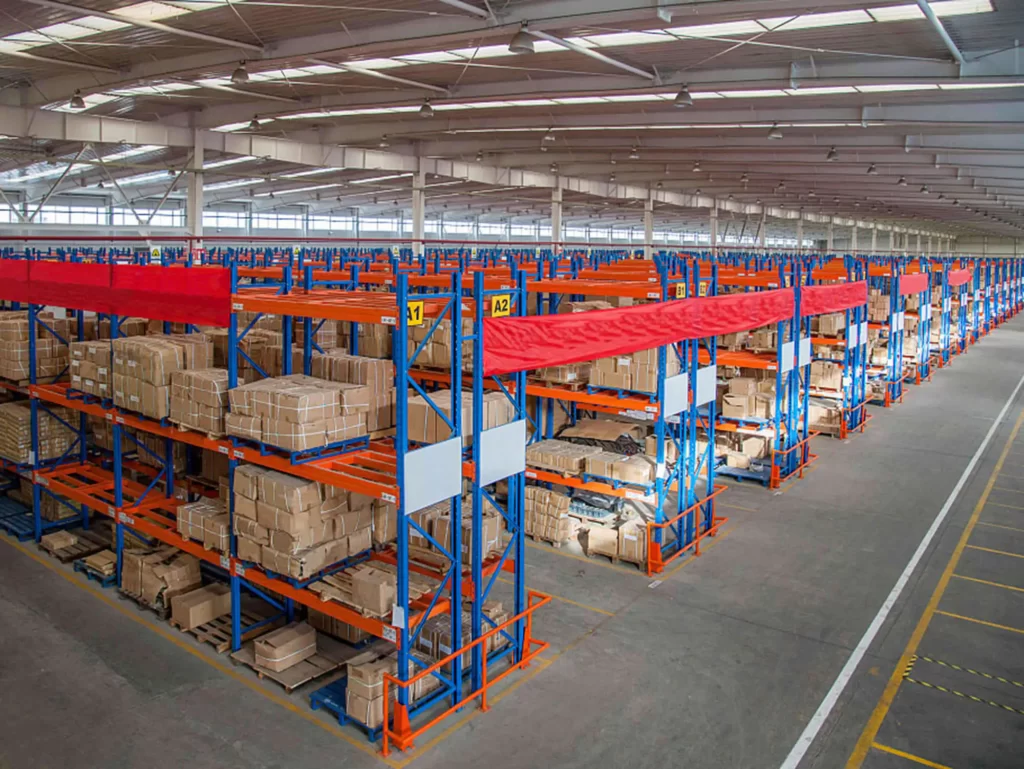
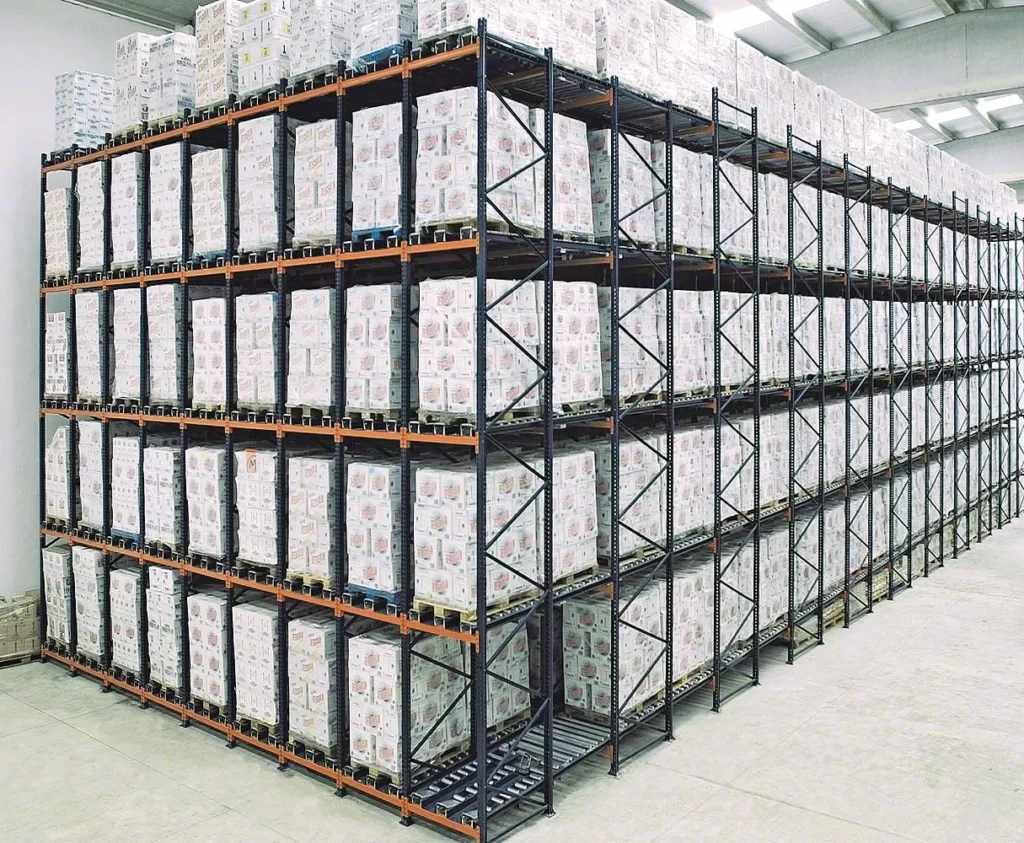
Pallet flow racking is one of the most valuable systems in FMCG because it combines high density with automatic FIFO rotation. Pallets load at the back of an inclined lane and roll forward on gravity rollers; as one is removed, the next slides into place, physically guaranteeing that the oldest stock ships first. That makes it ideal for perishable goods. Push-back racking offers high density with better selectivity than drive-in systems, operating on a LIFO basis that suits medium-velocity SKUs.

Carton Flow and Drive-In Racking
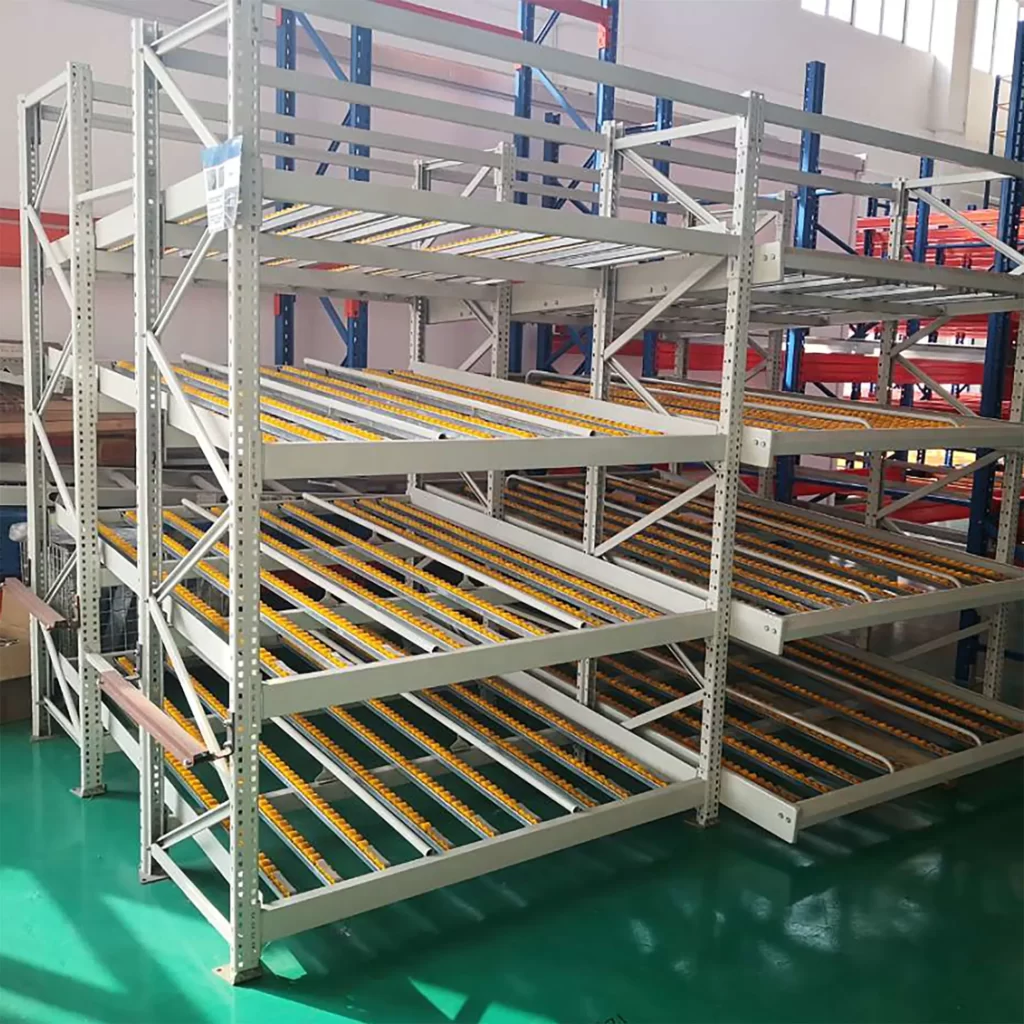
For piece and case picking of fast-moving small items, carton flow racking is exceptionally effective: cartons flow forward on gravity lanes to a compact pick face, enforcing FIFO and boosting pick speed, especially when paired with pick-to-light. Drive-in racking, by contrast, delivers maximum density for large quantities of a single, non-perishable SKU by letting forklifts drive directly into deep rows, though at the cost of selectivity.

Mezzanines and Shelving
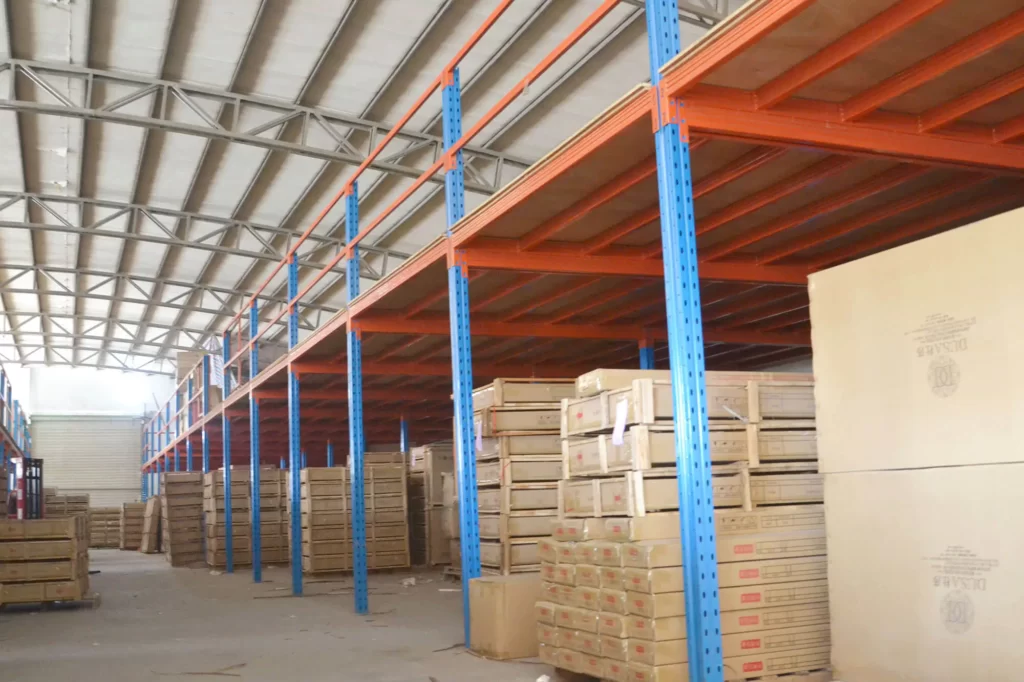
When ceilings are high but floor space is tight, mezzanine structures and multi-tier shelving add usable area without expanding the footprint, often creating dedicated piece-picking levels. For the long tail of slow-moving SKUs, industrial shelving and bin storage provide organized, accessible space. The art lies in matching each system to product velocity, size, and rotation needs so the building stores as much as possible while keeping the right product accessible.

FIFO and FEFO in FMCG Warehousing
Two rotation principles dominate FMCG warehousing, and understanding the difference is essential for managing perishable and date-sensitive goods.
FIFO (First In, First Out) dispatches the oldest received stock first. It works on the logical assumption that goods received earlier should ship earlier, and it suits products where receiving order closely tracks production date. Pallet flow and carton flow racking enforce FIFO automatically by design.
FEFO (First Expired, First Out) dispatches stock with the nearest expiry date first, regardless of when it was received. This matters when batches with different shelf lives arrive together — a later delivery might actually expire sooner. FEFO is critical for food, beverages, pharmaceuticals, and health products, and it depends on batch and expiry data tracked in the warehouse management system.
| Aspect | FIFO | FEFO |
|---|---|---|
| Basis | Date received | Date of expiry |
| Best for | Goods where receipt order ≈ age | Goods with variable shelf life |
| Key requirement | Sequential storage flow | Batch/expiry tracking in WMS |
| Typical systems | Pallet flow, carton flow | Selective racking + WMS control |
In practice, many FMCG operations run a hybrid model: gravity-fed flow racking handles physical FIFO movement, while the WMS overlays FEFO logic to direct pickers to the nearest-expiry batch when shelf lives differ. This combination minimizes both spoilage and waste.
FMCG Warehousing Trends in 2026 and Beyond
The FMCG logistics sector is large and growing, with the broader market valued at well over a trillion dollars and expanding at a steady mid-single-digit annual rate. The FMCG logistics market is projected to grow at a CAGR above 5% to reach roughly USD 1.75 trillion by 2030. Several forces are reshaping how warehouses operate. Mordor Intelligence
Automation and Robotics
Automation has moved from luxury to necessity. Around 46% of warehouses now use automation technologies to improve efficiency. In FMCG specifically, the pressure of shrinking delivery windows and rising labor costs is driving rapid adoption. AI-powered robotics, automated guided vehicles (AGVs), and autonomous mobile robots (AMRs) are being deployed to streamline picking, sorting, and inventory accuracy. These technologies work alongside conventional racking rather than replacing it, automating movement between storage and pick zones. Global Growth InsightsMaersk
AI Forecasting and Real-Time Visibility
Data intelligence is becoming central to FMCG operations. AI for demand forecasting, IoT for real-time tracking, and warehouse automation are no longer a luxury but a necessity for enhancing efficiency. Beyond simple tracking, advanced operators are adopting predictive tools: IoT sensors enable real-time visibility, digital twins allow operators to simulate bottlenecks before they occur, and cloud-supported warehouse management systems provide predictive insights for allocating labor and space. Cognitive Market ResearchMaersk
Quick Commerce and Forward-Positioned Stock
The rise of e-commerce and quick commerce is changing where inventory sits. As delivery windows shrink, fulfillment centers are moving closer to consumption centers. Same-day and rapid-delivery expectations are pushing brands toward micro-fulfillment and forward-positioned stock near urban populations, adding a layer of smaller, faster nodes on top of traditional regional distribution centers. Maersk
Cold Chain and Sustainability
Demand for sophisticated cold chain logistics continues to climb, driven by fresh food, frozen goods, and imported products that require temperature-controlled storage and transport. At the same time, sustainability is becoming a core design priority. Warehousing in 2026 is increasingly defined by intelligence, agility, and sustainability, with operators investing in energy-efficient buildings, eco-friendly equipment, and greener fulfillment networks. For warehouse design, this means racking layouts and storage systems chosen not only for throughput but also for energy efficiency and long-term adaptability. Maersk
How to Choose the Right Storage System for Your FMCG Warehouse
Selecting the right FMCG storage solutions comes down to matching each product group to the system that fits its velocity, size, and rotation profile. A practical approach follows a few clear steps.
Start by classifying your SKUs by velocity using ABC analysis, then identify which products are date-sensitive and require FIFO or FEFO discipline. Fast-moving, perishable goods are natural candidates for pallet flow racking and carton flow racking, which enforce rotation automatically. High-volume, non-perishable SKUs can be stored densely in drive-in or push-back racking. The broad middle of your range — the many SKUs that need frequent, flexible access — belongs on selective pallet racking, while the slow-moving tail fits well on shelving or in a mezzanine pick module.
Next, weigh density against accessibility for your specific operation. If floor space is your constraint, lean toward high-density and multi-tier systems; if picking speed and rotation discipline dominate, prioritize accessibility and flow racking. Finally, plan for change. FMCG demand and product mix evolve constantly, so choose modular, reconfigurable racking that can be adjusted as your business grows. The strongest FMCG warehouses are not built around a single storage system but around an intelligent blend, each component matched to the products it stores best.
Conclusion
FMCG warehousing is a discipline defined by speed, freshness, accuracy, and flexibility. Where traditional storage optimizes for long-term density, the FMCG warehouse is engineered for constant movement — receiving bulk inbound stock, rotating it rigorously through FIFO and FEFO discipline, and dispatching a relentless stream of precise orders to retailers and online customers. Every element, from the U-shaped or through-flow layout to ABC slotting and the carefully chosen mix of pallet racking, flow racking, and shelving, exists to keep fast-moving goods flowing efficiently toward the consumer. For broader industry context, Inventory is a useful reference.
As automation, AI-driven forecasting, quick commerce, and sustainability reshape the sector through 2026 and beyond, the fundamentals remain the same: a well-designed warehouse with the right storage systems is one of the most powerful levers an FMCG business has for cutting cost, reducing waste, and delivering on customer expectations. Investing in the right racking and layout today builds the foundation for a faster, leaner, and more resilient supply chain tomorrow.