


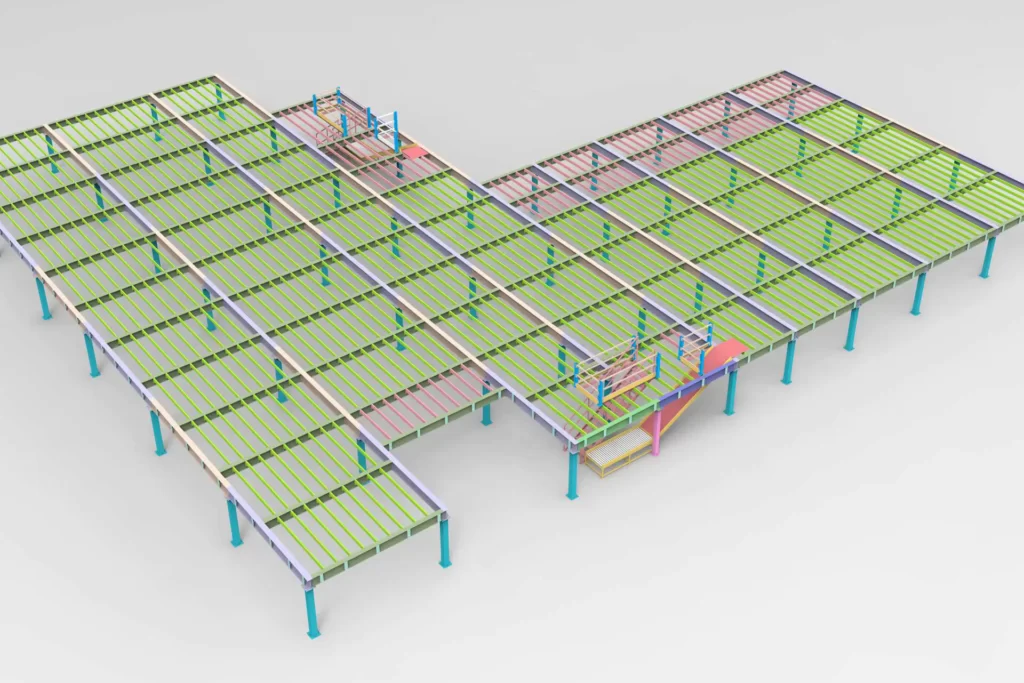
A warehouse mezzanine typically costs between $50 and $150 per square foot, with most standard storage projects landing close to $70 per square foot once decking, stairs, and railings are included. A basic steel platform can start around $30 per square foot, while a heavy-duty or multi-level system loaded with conveyors and special equipment access can climb past $200 per square foot. That single range answers the first question most facility managers ask, but it rarely tells the whole story. The reason warehouse mezzanine cost varies so widely is that a mezzanine is not a catalog product. It is a custom steel structure engineered around your building, your inventory, and your operation, and every one of those variables moves the price. For a closer comparison, see Rack-Supported vs Steel Structure Mezzanine.
This guide breaks down what you are actually paying for when you buy a mezzanine floor, the factors that push the cost up or down, the expenses that quotes often leave out, and how the numbers compare to the alternatives. By the end you should be able to look at any quote and understand whether it is fair, complete, and right for your warehouse.
What a Warehouse Mezzanine Is and Why the Price Range Is So Wide
A warehouse mezzanine is an intermediate steel platform built within an existing high-ceiling space to create a second usable level. Instead of expanding the building footprint or relocating, you build upward into the vertical air that most warehouses leave empty. That platform can hold pallet racking, shelving, picking modules, offices, packing stations, or production equipment, effectively doubling or even tripling the working square footage of the same building.

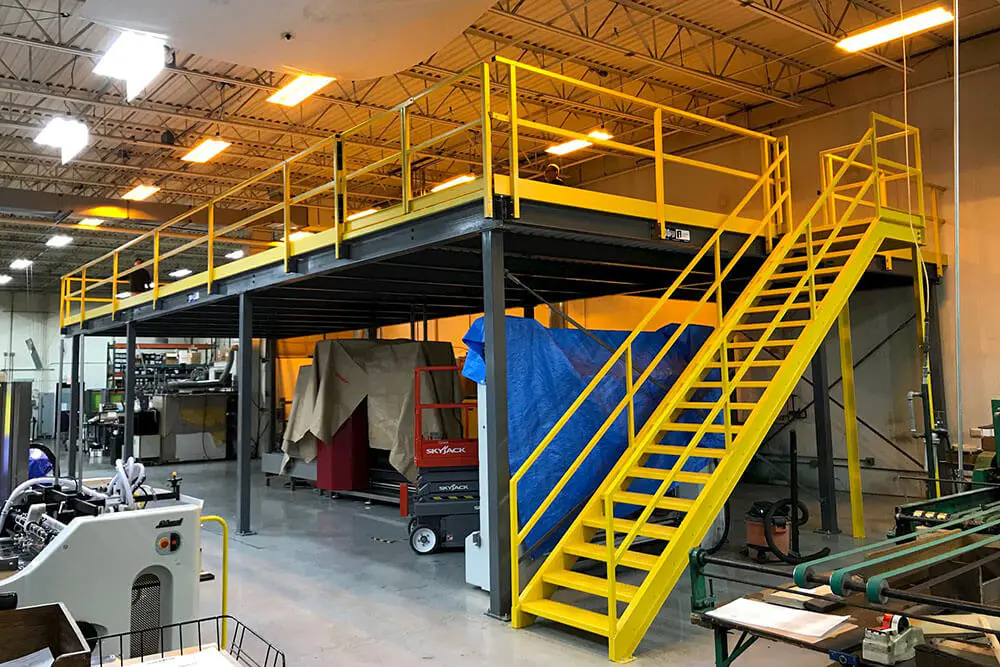
Because the structure is engineered to order, no two mezzanines cost the same. A lightweight office platform carrying a few desks is a completely different object from an industrial mezzanine floor designed to support forklifts, automated equipment, and tons of stored goods. The steel sections, column spacing, footings, and decking all scale with the load, and so does the price. Add to that the local cost of labor, the complexity of the site, and the safety systems the building code requires, and you can see why two facilities of identical size can receive quotes that differ by hundreds of thousands of dollars. A related guide on Mezzanine Floor Office Design gives more detail for this part of the planning work.
Understanding the cost, then, is really about understanding the inputs. The more clearly you can define what you need the platform to do, the more accurate and competitive your pricing becomes.
How Much Does a Warehouse Mezzanine Cost on Average
For budgeting purposes, it helps to anchor on the per-square-foot figure and then adjust for your specific situation. Across the North American and international markets, a structural steel mezzanine for storage generally falls in the $50 to $150 per square foot range, and the often-quoted industry average sits around $70 per square foot for a complete, installed system. For a small to medium project this usually means a total spend somewhere between $10,000 and $50,000, while larger or more complex installations comfortably exceed $100,000.
Those numbers are most useful when you break them down by the type of mezzanine and the load it is built to carry, because those two variables explain most of the spread.
Cost by Mezzanine Type
Different mezzanine systems are built in different ways, and the construction method has a direct effect on price.
A free-standing structural steel mezzanine is the most common warehouse solution. It stands on its own columns, is independent of your racking, and can be dismantled and relocated. A basic, no-frills version often runs $30 to $60 per square foot, while a fully specified storage platform with quality decking and safety equipment is closer to the $60 to $100 per square foot band.

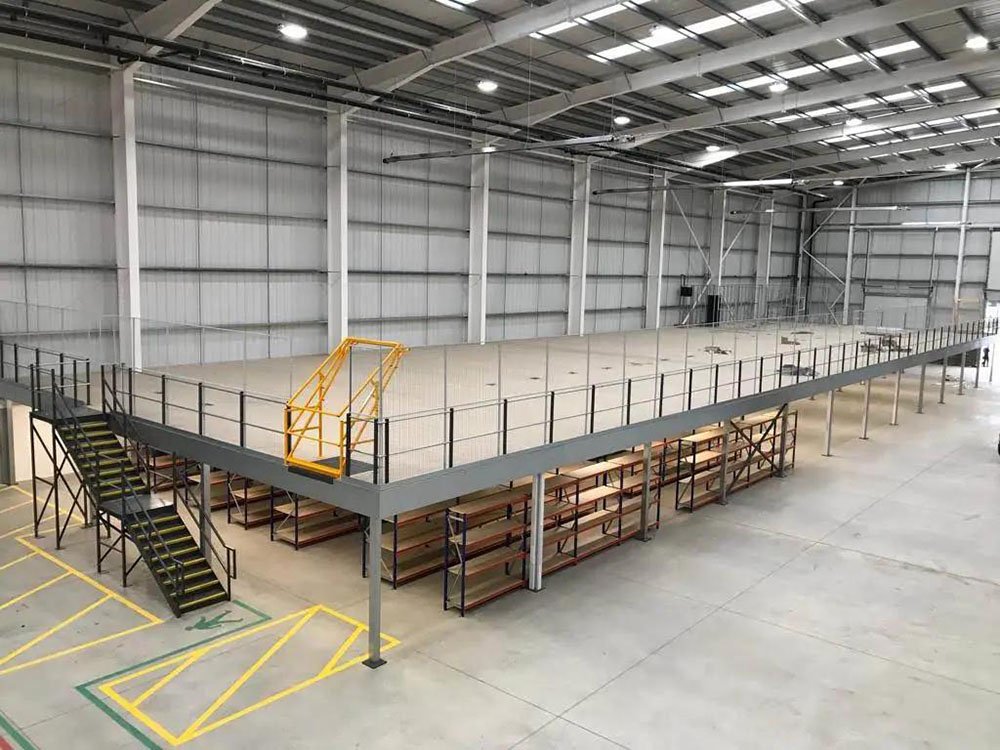
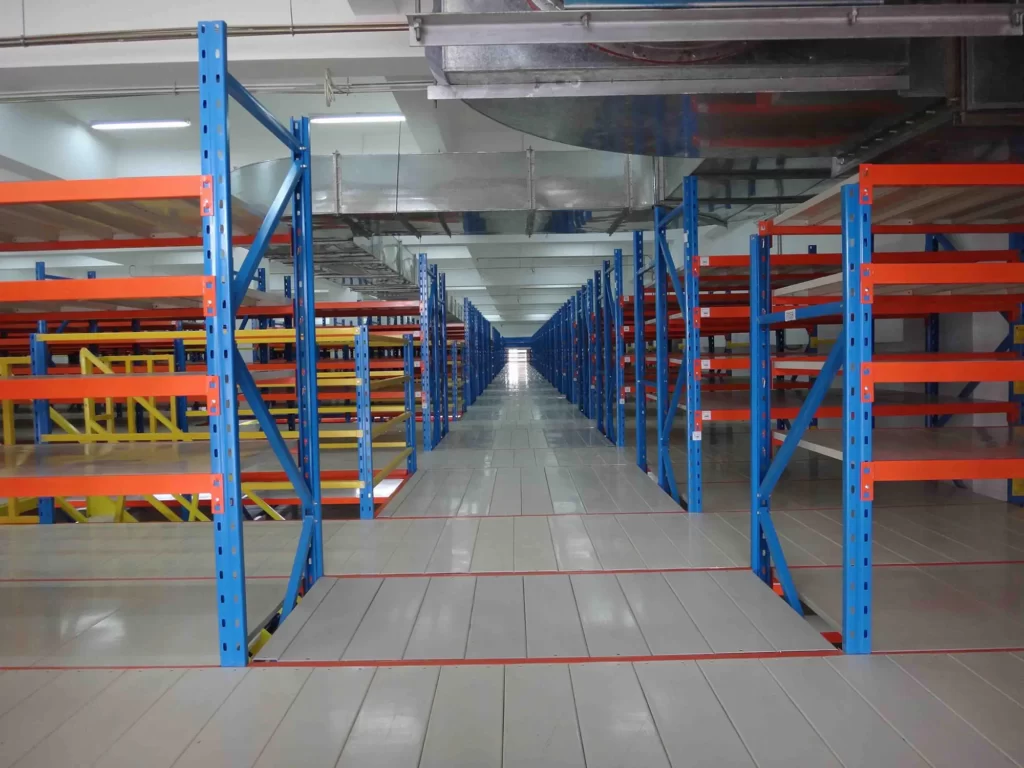
A rack-supported mezzanine, sometimes called a structural pick module, uses the upright frames of pallet racking or shelving as the support structure for the floor above. Because the racking does double duty as both storage and structural support, this approach can be highly material-efficient for high-density picking operations, though the engineering and decking still add cost on top of the racking itself. For broader industry context, Rack Manufacturers Institute (RMI) is a useful reference.
A shelving-supported or modular mezzanine uses lighter shelving uprights to carry a platform intended for hand-loaded goods. These tend to sit at the more affordable end for light-duty applications.
At the top of the scale, multi-level and automated mezzanine systems with integrated conveyor access, equipment platforms, or custom architectural features can reach $120 to $250 per square foot. Wooden or hybrid platforms exist as a budget option in the $20 to $50 per square foot range, but they offer far less durability and load capacity than steel and are rarely suitable for genuine warehouse storage.

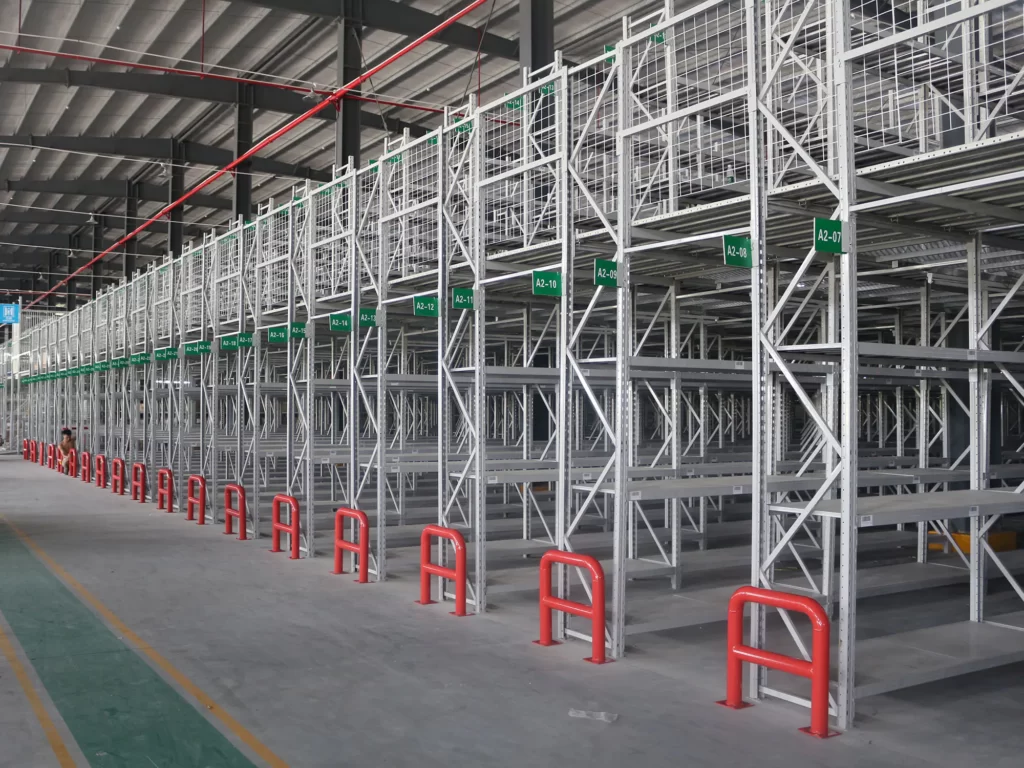
Cost by Load Capacity
The intended use of the platform determines its load rating, measured in pounds per square foot (PSF), and load rating is one of the single biggest cost levers. An office mezzanine is usually engineered for around 75 PSF. A platform for light retail or light storage is built for roughly 100 to 150 PSF, while most general-purpose storage mezzanines are designed for 125 to 150 PSF. Heavy storage, pallet loads, or equipment can push the requirement to 200 PSF or more.
Every step up in load capacity means heavier beams, more columns, stronger connections, and thicker decking, all of which add material and labor. This is why defining your real storage needs accurately matters so much: over-specifying the load rating wastes money, while under-specifying it creates a safety and compliance problem that is expensive to fix later.
The Main Factors That Drive Warehouse Mezzanine Cost
Beyond type and load, a handful of project variables consistently shape the final number. Understanding them helps you read a quote critically and identify where savings are realistic.
Total Square Footage and Economies of Scale
Larger mezzanines are cheaper per square foot than small ones. Fixed costs such as engineering, mobilization, and design are spread across more area, and material purchasing becomes more efficient. As a rule of thumb, projects above roughly 2,000 square feet often see the cost per square foot drop by 15 to 25 percent compared with a small platform. This does not mean you should build more than you need, but it does mean that if expansion is likely, designing the structure to accommodate a future phase can be more economical than building two separate small platforms later.
Intended Use and Load Capacity
As covered above, what the platform will hold dictates how it is engineered. A storage mezzanine carrying palletized goods needs a fundamentally stronger frame than an office platform of the same size. The presence of moving equipment, point loads from machinery, or seismic requirements in your region all increase the structural demand and therefore the cost. The clearer you are about exactly what will sit on the floor, the tighter your quote will be.
Structural Design and Height
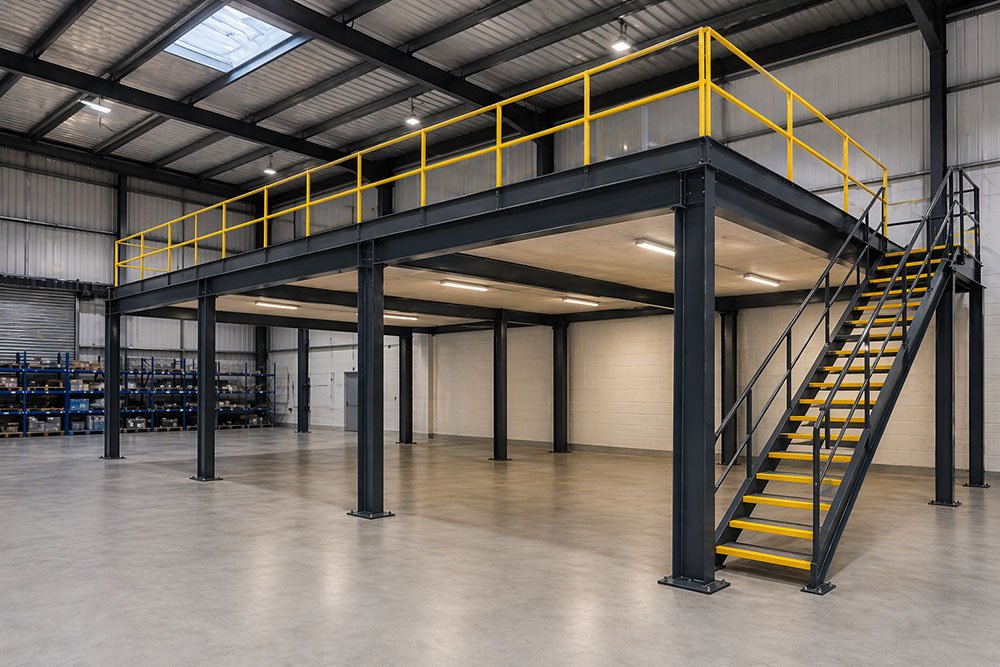
Simple rectangular layouts are the most cost-effective shapes to build. Once you introduce cut-outs for existing columns, angled edges, L-shapes, or openings for conveyors and lifts, fabrication becomes more complex and the price can rise by 20 to 40 percent. Clear height under and above the platform matters too. Standard clear heights of eight to ten feet are the most economical. When you need taller clearance, typically above twelve feet, the columns and beams must be heavier to remain stable, often adding $8 to $15 per square foot to the structure.
Decking and Flooring Materials
The deck is the surface you actually work on, and the choice has both a cost and a performance dimension. Bar grating is durable and allows light and sprinkler water to pass through, which can simplify fire protection. Resin-coated or composite board offers a smooth, solid surface ideal for carts and pallet jacks. Steel plate or diamond plate is the most robust and the most expensive. Each option carries a different price per square foot, and the right one depends on whether you are storing cartons, rolling equipment across the floor, or housing staff.
Stairs, Handrails, Gates, and Access Equipment
The platform itself is only part of the package. Safe and code-compliant access adds meaningful cost. Every staircase, every additional handrail run, and every safety gate adds to the total, and upgraded or architectural railings cost more than standard industrial guarding. Getting goods onto the upper level introduces another decision: a pivot or sliding pallet safety gate is relatively inexpensive, while a vertical reciprocating conveyor (a goods lift) or mezzanine lift is a substantial line item that can rival the cost of the platform structure in smaller projects. The number of access points multiplies these costs, so the layout of stairs and gates is worth optimizing early. This point also connects with Mezzanine Structure Design.
The Hidden and Often-Overlooked Costs
Many first-time buyers focus on the steel and the decking and are surprised when the final invoice is higher than the platform quote. These additional items are a normal part of nearly every project, and a complete budget should account for them from the start.
Engineering, Permits, and Code Compliance
A mezzanine is a structural addition to a building, and in most jurisdictions it requires stamped engineering drawings and a building permit. The cost of design, structural calculations, and permitting varies by location and project size, but it is rarely optional. Skipping it is not a saving; it is a liability. Reputable suppliers include engineering as a standard part of their scope, and the drawings are also what protect you in an inspection or an insurance review.
Fire Protection and Sprinkler Systems
Adding a floor inside a building changes how fire and smoke move through the space, so fire codes often require additional sprinkler coverage beneath and sometimes above the mezzanine. This can be one of the larger surprise costs in a project, particularly if the existing system needs to be extended or upgraded. The deck type interacts with this directly, since open grating sometimes allows existing overhead sprinklers to remain effective while a solid deck may demand sprinklers underneath. Involving a fire protection professional early prevents an expensive redesign later.
Lighting, Electrical, and HVAC
A new level needs its own lighting, and if the platform houses offices or workstations it will likely need power outlets, data cabling, and climate control. These trades are usually separate from the mezzanine supplier’s scope but are essential to the platform being usable. Even a pure storage mezzanine usually needs adequate lighting both on top of and beneath the new floor.
Installation and Site Conditions
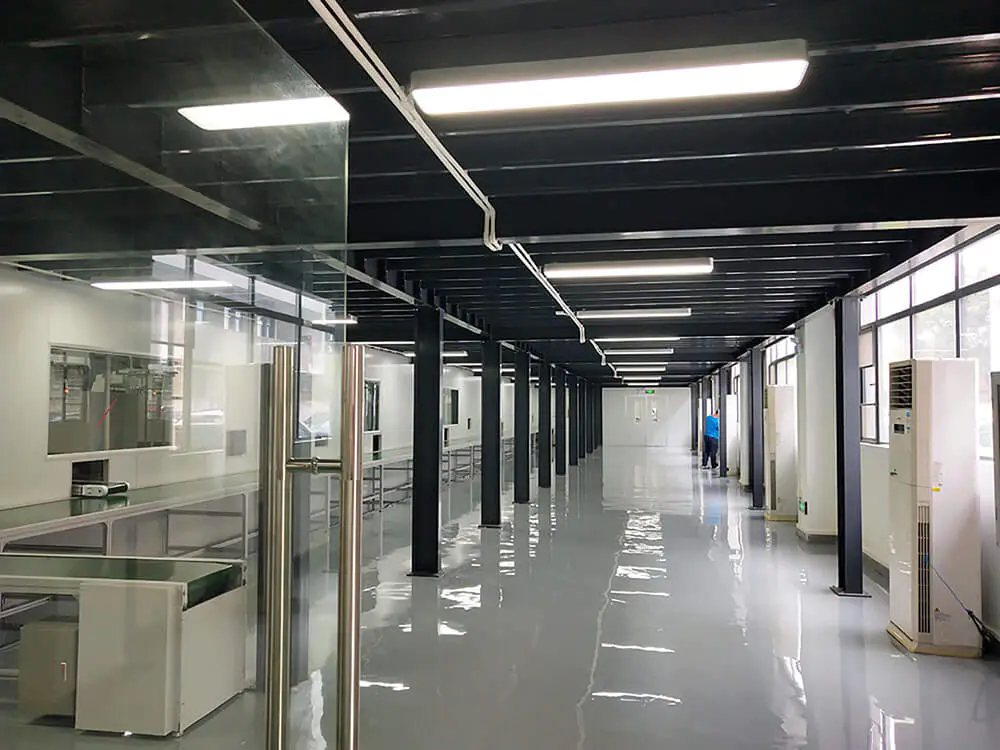
The platform price often quotes the structure delivered, but installation is its own line item, and site conditions move that number. Installing into a clean, empty building is fast and cheap. Installing into a busy, operating warehouse where the crew must work around inventory, forklifts, and live operations is slower and more expensive. Limited access, restricted working hours, and the need to maintain operations during the build all add labor time. Concrete footings or slab reinforcement may also be required if the existing floor cannot carry the new point loads.
Comparing Mezzanine Cost to the Alternatives
The strongest argument for a mezzanine is what you avoid by building one. Constructing a brand-new warehouse generally costs in the range of $55 to $70 per square foot for the building shell alone, and that figure excludes land acquisition, site work, permitting, and the very real cost of operational downtime during a relocation. When those factors are added, new construction is dramatically more expensive than adding a mezzanine to the building you already occupy.
Leasing additional space is the other common alternative, and it is a recurring cost rather than a one-time investment. Warehouse space commonly leases for somewhere around $8 to $15 per square foot per year in many markets, and that rent never stops. A mezzanine, by contrast, is paid for once and then continues to deliver capacity for the life of the structure. For a facility that is otherwise well located, expanding upward into existing air space is almost always cheaper over any meaningful time horizon than renting more floor somewhere else.
There is also a strategic dimension. A mezzanine keeps your operation consolidated under one roof, which preserves the efficiency of a single workflow, a single management team, and a single set of overheads. Splitting an operation across two buildings introduces transport, duplication, and coordination costs that rarely show up in a simple rent comparison but are felt every day.
Calculating the Return on a Mezzanine Investment
Cost only means something in relation to value, and this is where a mezzanine usually makes its case. Most warehouse mezzanines pay for themselves within roughly 18 to 36 months through the capacity they unlock and the more expensive alternatives they eliminate. The math is straightforward: compare the one-time, installed cost of the platform against the annual cost of the space you would otherwise have to rent or build to gain the same capacity.
Consider a 5,000 square foot mezzanine installed at $70 per square foot for a total of $350,000. That platform creates 5,000 square feet of new usable area. If renting equivalent space would cost $12 per square foot per year, you would be paying $60,000 annually in rent for the same capacity, meaning the mezzanine recovers its cost in under six years on rent avoidance alone, and considerably faster once you factor in moving costs and operational continuity.
There are financial advantages beyond the floor space too. Because a free-standing mezzanine can typically be dismantled and relocated, it is often classified as equipment rather than a permanent real estate improvement. That distinction can offer more favorable depreciation treatment and potential tax benefits compared with bricks-and-mortar construction, though the specifics depend on your jurisdiction and accounting situation, so it is worth confirming with a qualified advisor. The relocatable nature of the structure also protects the investment: if you move or reconfigure, the mezzanine can move with you rather than being abandoned.
How Sourcing Affects Cost: Buying from a China Mezzanine Manufacturer
Where you source the structure has a significant effect on the total warehouse mezzanine cost, and this is an area where many buyers leave savings on the table. Mezzanine systems manufactured in China are frequently substantially cheaper at the material and fabrication level than locally fabricated equivalents, thanks to scale, integrated steel supply, and competitive production. For buyers with a defined specification, ordering a prefabricated steel mezzanine floor system directly from an established manufacturer can reduce the structural portion of the budget meaningfully.

The trade-offs to weigh are freight, lead time, and engineering compliance. Shipping a large steel structure internationally adds container freight and inland transport, and you need to design the package so it nests efficiently into containers to control that cost. Lead times are longer than a local order, so the procurement has to be planned around your project schedule rather than treated as a last-minute purchase. Most importantly, the structure must be engineered to the codes and load standards that apply at the installation site, so working with a manufacturer who can provide proper engineering documentation and who understands your local requirements is essential. When those elements are handled well, sourcing a mezzanine floor from a capable manufacturer combines the lower material cost of overseas fabrication with a structure that still satisfies local inspection and safety standards.
This is also where the decking, racking, stairs, and gates can be bundled into a single coordinated supply, which simplifies the project and avoids the markups that accumulate when each component is bought separately. A manufacturer that produces both the mezzanine structure and the storage racking that will sit on it can deliver a system that is engineered to work together, which is harder to achieve when components come from unrelated suppliers.
Practical Ways to Reduce Your Warehouse Mezzanine Cost
Once you understand what drives the price, several levers become available to bring the number down without compromising safety or function.
Start by sizing the load rating to your real needs rather than the worst case. A platform built for 250 PSF when your goods only require 125 PSF carries a large premium in unnecessary steel. An honest assessment of what will actually sit on the floor is the most powerful cost control you have.
Keep the geometry simple. A clean rectangle is far cheaper to fabricate and install than an irregular shape with multiple cut-outs and angles. Where the building layout forces complexity, see whether minor adjustments to column placement or access points can recover a simpler footprint.
Choose the deck to match the job. Paying for heavy steel plate where bar grating or composite board would serve perfectly well is a common over-specification. Matching the surface to the actual use case saves money and can also simplify your fire protection requirements.
Plan for scale. If growth is likely, designing the structure so it can be extended in a future phase is usually cheaper than building a second standalone platform later. Buying slightly larger now, when the economies of scale are working in your favor, often costs less per square foot than expanding piecemeal.
Coordinate the trades early. The biggest budget surprises come from fire suppression, electrical, and permitting being treated as afterthoughts. Bringing those considerations into the design from the beginning prevents costly rework and lets you compare complete quotes rather than incomplete ones.
Finally, gather multiple quotes and make sure they cover the same scope. A low platform price that excludes engineering, installation, and safety equipment is not actually cheaper; it is simply less complete. Comparing fully loaded, like-for-like quotes is the only way to know which supplier truly offers the best value.
Putting Together a Realistic Mezzanine Budget
When you assemble your own budget, build it in layers rather than relying on a single per-square-foot figure. Begin with the structural platform priced against your square footage and load rating. Add the decking appropriate to your use. Add the access elements: stairs, railings, gates, and any lift you require. Then add the project costs that surround the structure, including engineering and permits, fire protection adjustments, lighting and electrical, and installation against the realistic condition of your site.
A useful approach is to take the industry average of roughly $70 per square foot as a starting anchor for a standard storage platform, then adjust upward for heavy loads, tall clearances, complex shapes, or extensive access equipment, and adjust for sourcing strategy. For a clean, simple, light-duty platform you may land below that anchor; for a tall, heavy-duty, multi-access system you should expect to land well above it. The goal is not a single number but a range you understand, so that when quotes arrive you can tell the difference between a fair price and a thin one.
Final Thoughts
Warehouse mezzanine cost comes down to a simple principle: you are buying engineered capacity, and the price reflects exactly how much capacity, how strong, how tall, how complex, and how safely you need it delivered. The headline range of $50 to $150 per square foot is real, but the figure that matters is the one built around your specific load, layout, and site. A mezzanine remains one of the most cost-effective ways to expand a warehouse, routinely beating new construction and recurring leases while keeping your operation consolidated and your investment recoverable. For product-level details, review Mezzanine Floor Cost.
The smartest spending decision is rarely the lowest quote. It is the quote that matches a well-defined specification, includes the engineering and safety elements in full, and comes from a manufacturer who can deliver a coordinated, code-compliant system. Define your needs precisely, account for the hidden costs honestly, and weigh the sourcing options carefully, and a mezzanine floor will return its cost many times over in the square footage it creates and the more expensive alternatives it lets you avoid.