


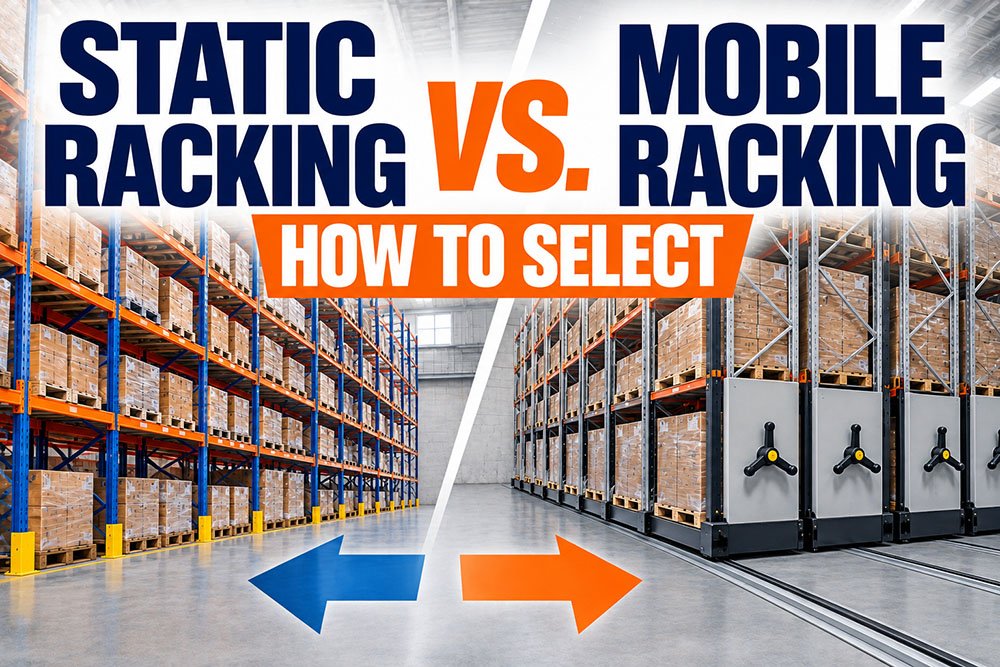
Static and mobile racking represent two fundamentally different approaches to warehouse pallet storage. Static racking — the fixed selective, drive-in, push-back, and VNA systems that dominate most warehouses — anchors permanently to the floor and provides continuous aisle access to every pallet position. Mobile racking mounts standard racking components on motorized bases that travel along floor-embedded rails, opening only one aisle at a time and converting all other aisle space into additional storage capacity. The choice between the two systems shapes storage density by 80–90%, capital cost by 3–5×, and throughput characteristics across the entire operating life of the warehouse. Yet buyers frequently choose between static and mobile racking based on partial information, either over-investing in mobile systems where static would perform better or missing the density opportunity that mobile systems provide in cold storage and high-value applications.
This article compares static and mobile racking in depth, examines the structural and economic differences, and outlines a structured framework for selecting between them.
What Is Static Racking?
Static racking is any warehouse pallet racking system in which the rack rows are permanently anchored to the floor and remain fixed in position throughout their service life, with dedicated aisles between rack rows providing continuous forklift access to every pallet position. Static racking includes selective and other pallet racking types, drive-in and drive-through racking, push-back racking, pallet flow racking, radio shuttle racking, and very narrow aisle (VNA) racking — all of which share the fixed-position characteristic despite their differences in density and access.

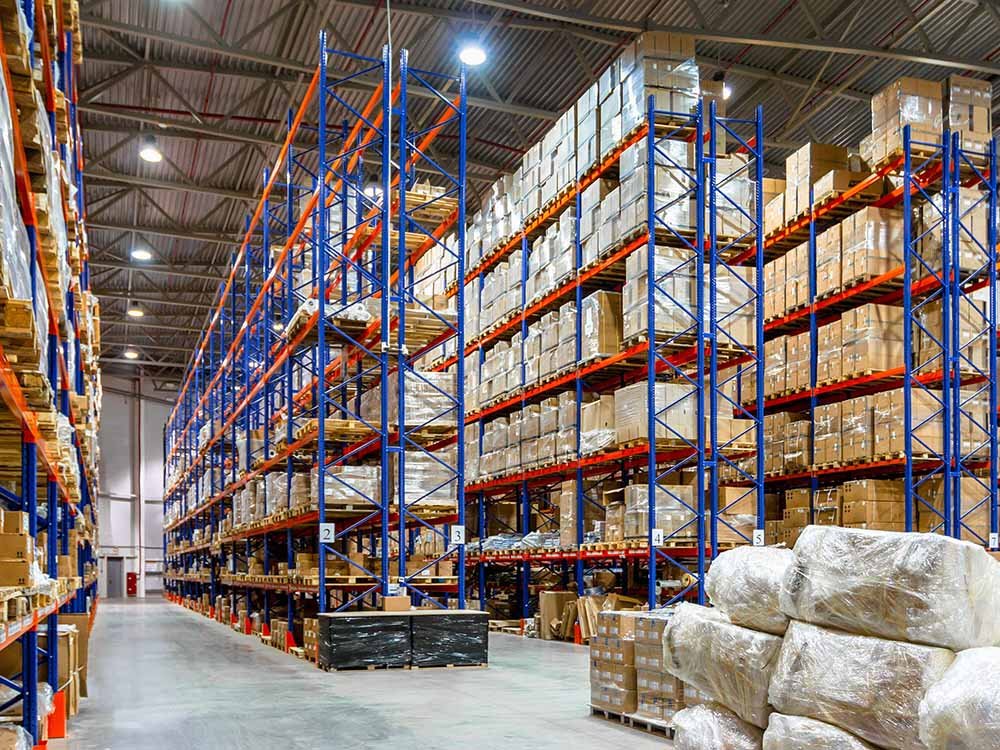
Selective pallet racking is the most common form of static racking and accounts for the majority of installations globally. It combines full pallet selectivity with the lowest capital cost and the fastest installation timeline of any pallet storage system, making it the default choice for warehouses where density is not the binding constraint. Detailed specifications for selective pallet racking systems illustrate the standard configuration principles that apply to static racking generally.
What Is Mobile Racking?
Mobile racking is a high-density pallet storage system in which standard racking rows are mounted on motorized carriages that travel laterally along floor-embedded rails — allowing only one aisle to be open at any given time while all other rack rows compress together, converting aisle space into additional storage capacity and increasing storage density by 80–90% compared to conventional static racking. When an operator requests access to a specific rack row, control software activates motors that shift adjacent rack rows sideways to open the required aisle.

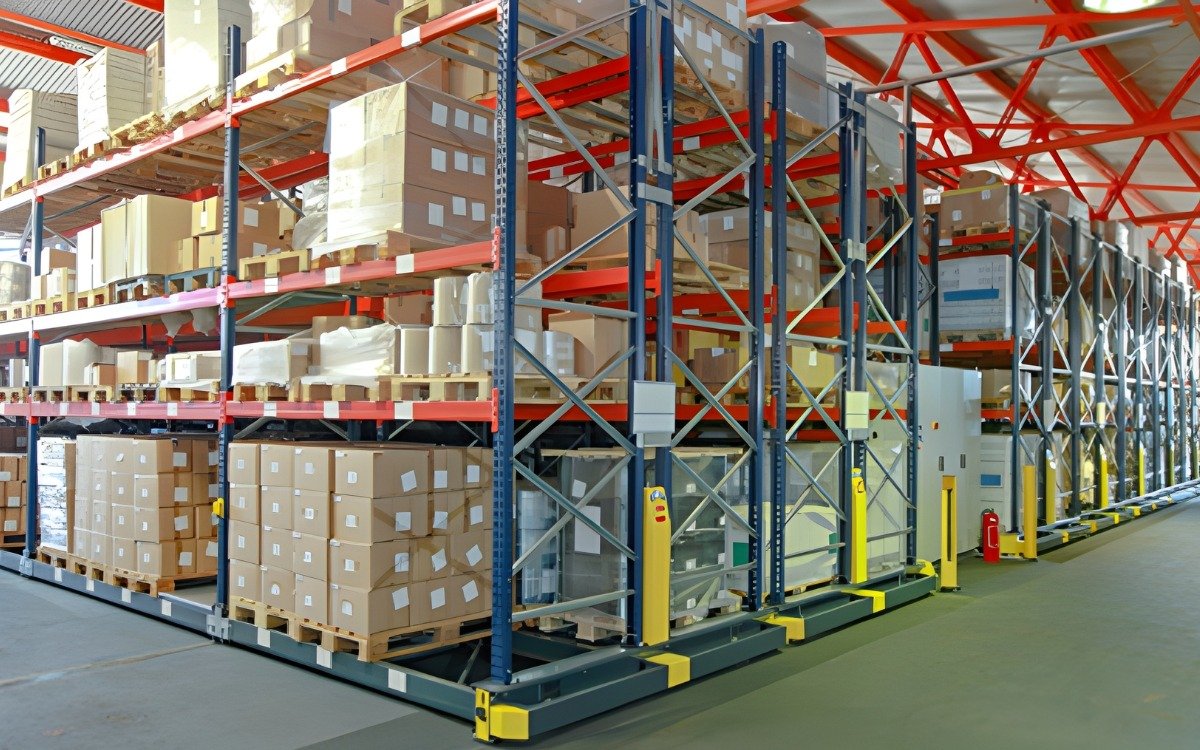
Mobile racking preserves full pallet selectivity — every pallet position remains directly accessible once the correct aisle is open — while dramatically reducing the floor area consumed by fixed aisles. Because refrigeration cost, land cost, or building envelope constraints often make cubic space extremely valuable, mobile pallet racking systems dominate cold storage, pharmaceutical, and archival applications where every square meter of unused floor space represents an ongoing operational cost.
Key Differences Between Static and Mobile Racking
Six technical dimensions define the practical differences between the two systems.
Structural Configuration. Static racking anchors to the floor and remains fixed. Mobile racking mounts racking on motorized carriages traveling on embedded rails, with electrical and control infrastructure integrated into the base.
Aisle Access. Static racking maintains a fixed aisle between every rack row, providing continuous forklift access. Mobile racking maintains only one open aisle at a time; other aisles must be created by shifting rack rows through motorized movement.

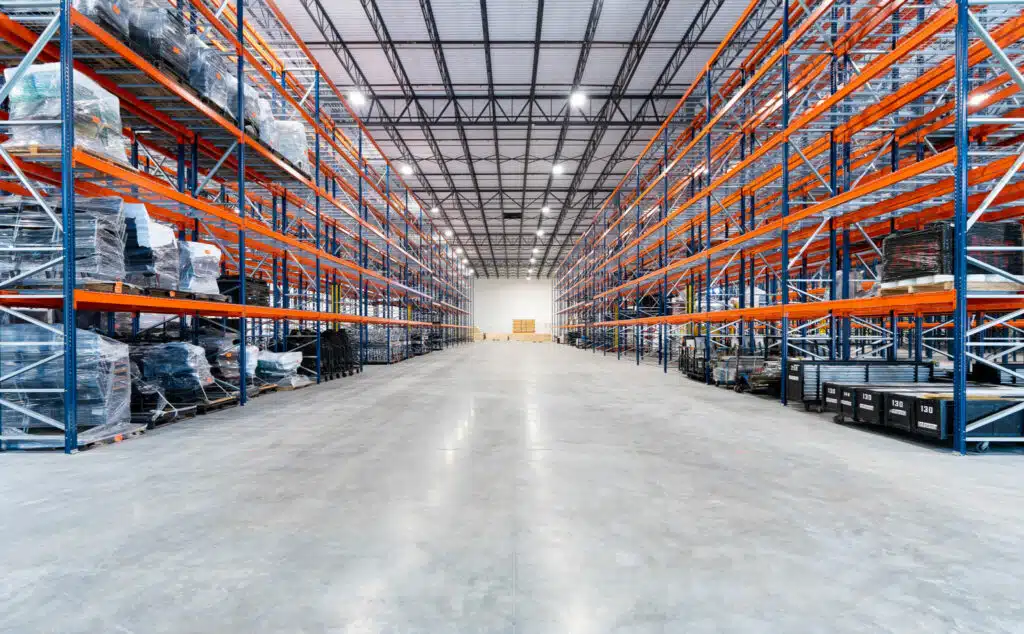
Storage Density. Mobile racking increases storage density by 80–90% compared to static selective racking on the same footprint, since aisles occupy 60–65% of floor area in static configurations and only 5–10% in mobile configurations.
Access Time. Static racking provides immediate access to any pallet position. Mobile racking requires 30–60 seconds to shift rack rows and open the required aisle, reducing throughput per lift.
Floor and Building Requirements. Static racking uses standard concrete floors and requires only anchor bolt installations. Mobile racking requires reinforced floors, embedded rails installed with strict flatness tolerance, and electrical connections at each rail bank.
Capital Cost. Mobile racking typically costs 3–5 times more per pallet position than equivalent static racking, driven by motors, rails, control systems, reinforced flooring, and safety infrastructure. The trade-off is smaller total footprint, which reduces land, building, and (in cold storage) refrigeration cost.
Comparison Table: Static vs Mobile Racking
| Feature | Static Racking | Mobile Racking |
|---|---|---|
| Structural Design | Fixed anchored framework | Motorized carriages on rails |
| Aisle Configuration | Fixed aisle between every row | Single open aisle at a time |
| Storage Density | Baseline | +80–90% |
| Pallet Selectivity | Full | Full (once aisle opens) |
| Access Time | Immediate | 30–60 seconds to open aisle |
| Throughput per Lift | High | Medium |
| Floor Requirements | Standard concrete + anchors | Reinforced + embedded rails |
| Power Requirements | None | Electrical supply required |
| Capital Cost | Baseline | 3–5× baseline |
| Installation Time | Weeks | Months |
| Best Suited For | General distribution, throughput | Cold storage, pharma, archival |
The comparison reflects trade-offs rather than absolute quality differences. Static racking is the correct choice for most standard warehouses; mobile racking becomes the correct choice when specific density or space constraints justify the additional investment.
Advantages and Limitations of Each System
Advantages of Static Racking
Lower capital cost per pallet position. Faster installation and simpler maintenance. Immediate access with no waiting for aisle changes. Compatible with a wide range of forklift types. Easier to reconfigure or expand as SKU profile changes. Long service life with minimal ongoing maintenance requirements.
Limitations of Static Racking
Lowest storage density among engineered racking systems. Aisles consume 60–65% of floor area. Higher land, building, and refrigeration cost per pallet position in space-constrained or expensive environments.
Advantages of Mobile Racking
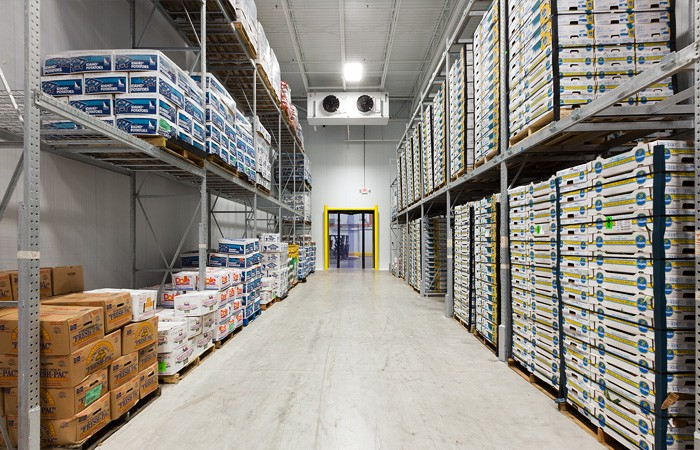
Highest storage density with full pallet selectivity. Significantly reduces floor area required for a given pallet count. Particularly effective in cold storage where refrigeration cost per cubic meter is high. Preserves the ergonomic access of selective racking within the compressed footprint.

Limitations of Mobile Racking
Significantly higher capital cost, longer installation timeline, and reinforced floor requirements. Access delay of 30–60 seconds per aisle change reduces throughput. Motor and rail systems require ongoing maintenance. Safety infrastructure — light curtains, emergency stops, personnel detection sensors — is more complex than in static systems. Reconfiguration after installation is difficult and costly. Detailed cost analysis of mobile systems is available in general references on whether mobile pallet racking is expensive, which examines the specific capital and operational cost drivers.

Best Use Cases for Each System
Static Racking Is Well-Suited For:
- General distribution warehouses with balanced throughput and density requirements
- High-SKU e-commerce fulfillment operations requiring rapid access
- Manufacturing plants with regular reconfiguration needs
- 3PL facilities serving multiple clients with variable requirements
- Buildings with limited electrical infrastructure or floor loading capacity
- Operations where installation timeline is a critical constraint
Mobile Racking Is Well-Suited For:
- Cold storage and freezer warehouses where refrigeration cost per cubic meter is high
- Pharmaceutical and biotechnology facilities storing high-value inventory in expensive climate-controlled environments
- Archival storage for records, documents, and historical materials in high-cost real estate locations
- E-commerce and retail warehouses in urban locations where land cost exceeds construction cost
- Operations expanding within an existing building envelope without construction budget
- Applications where throughput per lift is less critical than total storage capacity. Detailed cold chain considerations are covered in references on refrigerated warehousing design.
Cost Comparison
Mobile racking capital cost typically runs 3–5 times higher than equivalent static selective racking per pallet position, driven by motors, control systems, embedded rails, reinforced flooring, and safety infrastructure. However, total cost of ownership analysis frequently produces different rankings depending on the operating environment.
In a cold storage facility where refrigeration operating cost exceeds USD 40 per cubic meter per year, the reduced footprint of mobile racking often pays back within 5–7 years through refrigeration savings alone. In a high-cost real estate market, land savings from reduced footprint can pay back the mobile racking premium in similar timeframes. In an ambient distribution warehouse in a low-cost location, the same mobile racking premium may never pay back — static racking remains the correct choice throughout the operational life. Total cost of ownership analysis rather than capital cost comparison is the reliable basis for selection.
How to Choose Between Static and Mobile Racking
Step 1: Analyze Storage Density Constraints.
Assess whether the operation faces genuine density pressure — from land cost, refrigeration cost, building envelope constraints, or expansion limits — that would justify the additional investment in mobile racking.
Step 2: Evaluate Throughput Requirements.
Confirm whether throughput per lift matters more than total storage capacity. Time-critical operations (fast fulfillment, cross-dock, high-velocity SKUs) favor static racking; storage-focused operations tolerate mobile racking’s access delay.
Step 3: Assess Building Conditions.
Confirm floor loading capacity, floor flatness, electrical supply, and space for rail installation. Mobile racking’s building requirements are significantly more demanding than static racking’s.
Step 4: Calculate Total Cost of Ownership.
Include capital cost, installation, reinforced flooring, electrical infrastructure, ongoing motor and rail maintenance, and refrigeration or land cost savings. Compare over the expected 15–25 year operating life.
Step 5: Evaluate Operational Fit.
Consider forklift fleet compatibility, operator training requirements, safety infrastructure needs, and how future reconfiguration would affect the choice. Mobile racking is significantly harder to reconfigure than static systems.
Step 6: Confirm Safety and Standards Compliance.
Both systems must comply with rack design standards from the Rack Manufacturers Institute (RMI) and workplace safety guidance from OSHA, including its warehousing hazards and solutions. Mobile racking additionally requires safety infrastructure including light curtains, emergency stops, and personnel detection sensors.
Common Mistakes When Choosing Between Static and Mobile Racking
Several recurring errors distort the racking selection process. Choosing mobile racking based on density alone without confirming that specific density constraints (cold storage cost, land cost, envelope limits) actually justify the investment. Choosing static racking based on cost alone in operations where mobile racking’s density savings would pay back within 5–10 years. Underestimating mobile racking’s building and infrastructure requirements, discovering after commitment that floor remediation or electrical upgrades add significant cost. Assuming that mobile racking maintenance is equivalent to static racking — motors, controllers, sensors, and rail cleaning require ongoing service. Overlooking safety infrastructure requirements for mobile racking during initial cost estimation. Comparing capital cost only rather than total cost of ownership across the operating life.
Key Takeaways
- Static racking is any fixed-position pallet racking system, including selective, drive-in, push-back, pallet flow, radio shuttle, and VNA configurations.
- Mobile racking mounts standard racking rows on motorized carriages traveling on floor-embedded rails, opening only one aisle at a time.
- Mobile racking increases storage density by 80–90% compared to static selective racking on the same footprint.
- Mobile racking typically costs 3–5 times more per pallet position than equivalent static racking, offset by reduced floor area requirements.
- Static racking suits general distribution, throughput-critical operations, and buildings with standard infrastructure.
- Mobile racking suits cold storage, pharmaceutical, archival, and high-value operations where cubic space efficiency drives operating cost.
- Total cost of ownership analysis — not capital cost alone — is the reliable basis for selection between static and mobile racking.
Frequently Asked Questions
1. What is the main difference between static and mobile racking?
Static racking is anchored to the floor with fixed aisles providing continuous access. Mobile racking mounts rack rows on motorized carriages that travel along embedded rails, opening only one aisle at a time. Mobile racking achieves 80–90% higher storage density at 3–5× the capital cost of equivalent static racking.
2. Is mobile racking more expensive than static racking?
Yes. Mobile racking typically costs 3–5 times more per pallet position than equivalent static racking, driven by motors, rails, control systems, reinforced flooring, and safety infrastructure. However, total cost of ownership often favors mobile racking in cold storage, high-cost real estate, or space-constrained applications.
3. Where is mobile racking most commonly used?
Cold storage and freezer warehouses, pharmaceutical facilities, archival records storage, and high-value operations in expensive real estate markets. Any application where cubic space efficiency drives operating cost benefits from mobile racking’s density gains.
4. Does mobile racking reduce throughput?
Mobile racking introduces a 30–60 second delay when a new aisle must be opened for access, reducing throughput per lift compared to static racking. In storage-focused operations this delay is not significant; in time-critical throughput operations the delay may offset the density benefits.
5. What building requirements does mobile racking impose?
Mobile racking requires reinforced concrete flooring, embedded rails installed with strict flatness tolerance, electrical supply at each rail bank, and safety infrastructure including light curtains, emergency stops, and personnel detection sensors. Standard warehouse floors often need remediation before mobile racking installation.
6. Can existing static racking be converted to mobile racking?
Conversion is possible but usually not cost-effective. Mobile racking requires rail installation, reinforced flooring, and electrical infrastructure that typically dictate new installation rather than retrofit. Existing racking components may be reusable on the mobile carriages if compatible.
7. Which system has a longer service life?
Both systems achieve 15–30 year service life with proper maintenance. Static racking has fewer moving parts and typically requires less maintenance. Mobile racking includes motors, controls, and sensors that require ongoing service but do not shorten the overall service life when properly maintained.
8. Is mobile racking suitable for all pallet sizes?
Mobile racking accommodates standard pallet sizes (GMA, Euro, Australian, Asian) with the racking components matched to the selected pallet standard. Very heavy or oversized pallets may require structural upgrades to the mobile carriage design.
Conclusion
Static and mobile racking are not competing solutions for the same problem — they solve different problems. Static racking is the correct choice for the majority of warehouse operations where throughput, flexibility, and capital efficiency matter more than cubic space utilization. Mobile racking is the correct choice for cold storage, pharmaceutical, archival, and space-constrained operations where refrigeration cost, land cost, or building envelope constraints justify the 3–5× capital investment in exchange for 80–90% density gains. Total cost of ownership analysis — including capital cost, installation, ongoing maintenance, and the specific operating cost savings from reduced footprint — provides the reliable basis for selection rather than comparing capital cost alone.
For warehouse operators comparing static and mobile racking, the choice ultimately reflects a balance between storage density and access flexibility rather than any universal quality difference between the two systems. Mracking is one of the Chinese manufacturers producing both static and mobile pallet racking systems, with static configurations covering selective, drive-in, push-back, VNA, and structural options alongside mobile racking systems engineered for cold storage, pharmaceutical, archival, and high-density warehouse applications where cubic space utilization is the decisive design factor.