


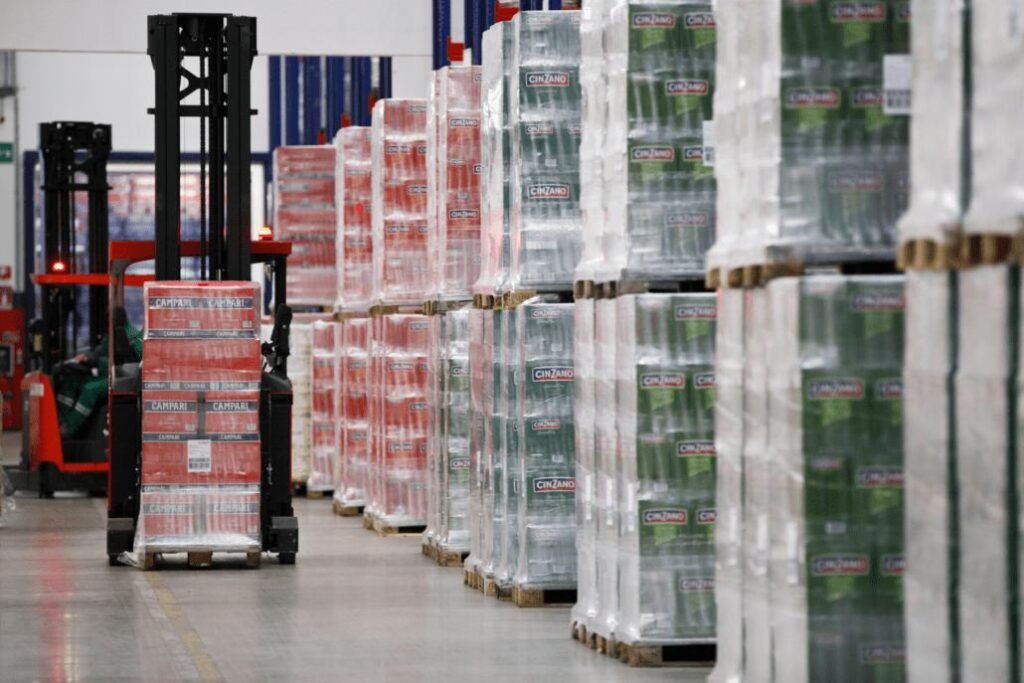
FEFO (First Expired, First Out) is one of the most important inventory rotation methods used in warehouses that handle perishable, time-sensitive, or expiration-dated goods. Industries such as pharmaceuticals, food and beverage, cosmetics, and chemicals rely on the FEFO principle to minimize waste, maintain product safety, and comply with regulatory requirements. Unlike traditional rotation methods that prioritize the order of receiving, FEFO focuses on the actual expiration date of each unit, ensuring that the goods closest to expiry leave the warehouse first.
This article explains what FEFO is, how it works, where it applies, and how warehouse operators can implement it effectively using the right storage equipment and inventory control systems.
What Is FEFO (First Expired, First Out)?
FEFO (First Expired, First Out) is an inventory management method in which goods with the earliest expiration date are dispatched, shipped, or consumed before items with later expiration dates, regardless of when each item was received into the warehouse. The system prioritizes the expiry timeline of each stock-keeping unit (SKU) rather than its arrival sequence. A related guide on FIFO VS LIFO, Which Is The Best Storage Method? gives more detail for this part of the planning work.


FEFO is widely used in industries where products lose value, safety, or regulatory compliance after a specific date. These include pharmaceutical distribution centers, cold storage facilities, food processing plants, dairy warehouses, cosmetics distributors, and chemical storage operators. For product-level details, review Food Warehousing.
The method is particularly relevant for sectors regulated by agencies such as the U.S. Food and Drug Administration and the World Health Organization, where expiration-based stock rotation is part of Good Distribution Practice (GDP) and Good Manufacturing Practice (GMP) requirements.
How FEFO Works in Warehouse Operations
The FEFO process depends on accurate expiration date tracking from the moment goods enter the warehouse until they are picked for shipment. Each pallet, carton, or unit is labeled with its expiry information at the receiving stage. A Warehouse Management System (WMS) or inventory tracking software then identifies the lot with the earliest expiration date whenever a picking order is generated.
When a picker receives a task, the system directs them to the location holding the soonest-to-expire batch, even if a newer shipment of the same SKU is also available. This ensures that products with shorter remaining shelf life move out first, reducing the risk of obsolete stock.
FEFO requires three core capabilities:
- Lot-level or batch-level traceability
- Expiration date capture at the goods-in stage
- Real-time inventory visibility across all storage locations
Without these capabilities, expiration-based rotation cannot be enforced reliably, which is why most FEFO operations rely on barcode scanning, RFID, or QR-coded labels integrated with a WMS.
FEFO vs FIFO vs LIFO: Comparison Table
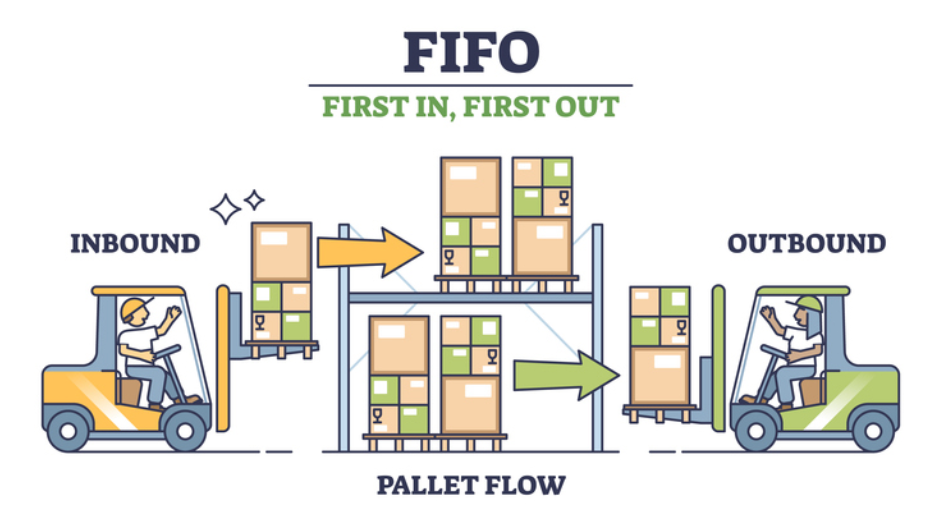
Although FEFO is sometimes confused with FIFO (First In, First Out), the two methods follow different logic. FIFO prioritizes the order of receiving, while FEFO prioritizes the order of expiration. LIFO (Last In, First Out) operates in the opposite direction and is generally used for non-perishable goods or accounting purposes rather than physical warehouse rotation. This point also connects with FIFO Racking.
| Feature | FEFO | FIFO | LIFO |
|---|---|---|---|
| Rotation Basis | Earliest expiration date | Earliest received date | Most recently received date |
| Suitable For Perishables | Yes | Partially | No |
| Waste Reduction | High | Medium | Low |
| Regulatory Use | Pharma, food, cosmetics | General distribution | Accounting, bulk materials |
| Requires Expiry Tracking | Mandatory | Optional | Not applicable |
| Common Industries | Cold chain, pharma, dairy | Retail, FMCG, electronics | Raw materials, commodities |
In practice, many warehouses operate FIFO and FEFO in parallel. FIFO governs general stock movement, while FEFO overrides FIFO whenever expiration dates conflict with the receiving sequence — for example, when a newer shipment carries an earlier expiry date than an older one already in storage.
Industries and Applications That Rely on FEFO
FEFO is most commonly applied in product categories where shelf life directly affects safety, efficacy, or marketability. Typical sectors include:
Pharmaceuticals and Medical Devices. Drug products and sterile medical supplies must be dispatched according to expiry date to meet GDP and GMP standards. Regulatory authorities including the U.S. Food and Drug Administration require expiration-based handling for finished pharmaceutical products.
Food and Beverage. Dairy, meat, packaged foods, baked goods, and beverages all carry best-before or use-by dates. Cold storage operators and food distribution centers apply FEFO to reduce spoilage and meet food safety regulations defined under frameworks such as ISO 22000.
Cosmetics and Personal Care. Skincare, sunscreens, and cosmetics carry Period After Opening (PAO) and expiration labels. FEFO ensures products reach retail shelves within their effective period.
Chemicals and Industrial Reagents. Many industrial chemicals lose stability over time. FEFO maintains product performance and compliance with material safety standards.
Cold Chain Logistics. Vaccine distribution, frozen food, and temperature-sensitive biologics depend on FEFO combined with strict temperature monitoring. For a closer comparison, see Low Temperature Cold Storage Racks.


Benefits of FEFO
Operators that implement FEFO consistently report measurable improvements in inventory performance:
- Reduced Product Write-Offs. Expired stock represents a direct financial loss. FEFO minimizes write-offs by ensuring near-expiry goods are dispatched first.
- Improved Regulatory Compliance. Pharmaceutical, food, and cosmetic regulations often mandate expiration-based dispatch. FEFO provides auditable evidence of compliance.
- Enhanced Customer Satisfaction. Buyers receive goods with sufficient remaining shelf life, reducing complaints and returns.
- Lower Inventory Carrying Costs. Faster rotation of expiring stock reduces the volume of slow-moving inventory.
- Better Traceability. FEFO requires lot-level tracking, which improves recall capability in case of safety incidents.
Limitations and Operational Challenges
FEFO is not suitable for every warehouse environment. Several limitations should be considered before adopting the method:
- Higher System Complexity. FEFO requires lot-level tracking and a capable WMS. Manual operations cannot enforce FEFO reliably at scale.
- Increased Labor for Receiving. Each incoming pallet must be inspected, labeled, and recorded with its expiration date.
- Storage Equipment Constraints. High-density systems such as drive-in racking are designed for LIFO flow and do not naturally support FEFO without partitioned lanes.
- Mixed-Date Pallets. When a single pallet contains units with different expiration dates, FEFO becomes harder to enforce without sub-pallet picking.
- Cost of Implementation. Initial investment in barcode systems, scanners, WMS modules, and staff training can be significant.
These challenges are not reasons to avoid FEFO, but they highlight the need for proper warehouse design, equipment selection, and software infrastructure.

How to Implement FEFO in a Warehouse: Step-by-Step
Implementing FEFO involves both physical warehouse setup and digital inventory control. The following steps outline a standard implementation path used in distribution centers handling perishable goods.
Step 1: Capture Expiration Data at Receiving.
Train receiving staff to record expiration dates for every incoming SKU. Use barcode or RFID labels to link physical units to digital inventory records.
Step 2: Configure the WMS for Expiry-Based Picking.
Set up the warehouse management system to sort available stock by expiration date during order allocation. Define rotation rules at the SKU or category level.
Step 3: Select Compatible Storage Equipment.
Choose racking systems that support selective access, such as selective pallet racking or shuttle racking systems with FIFO/FEFO lane configuration. High-density LIFO systems should be reserved for non-expiring stock.
Step 4: Organize Storage Locations by Lot.
Assign storage locations so that each lot occupies a clearly identified position. Avoid mixing different lots within the same pallet position whenever possible.
Step 5: Generate Picking Tasks by Expiration Logic.
Configure picking workflows so that the system always directs operators to the earliest-expiring lot first, even when newer stock is closer to the dispatch zone.
Step 6: Audit and Review Continuously.
Conduct periodic cycle counts focused on expiration accuracy. Identify slow-moving SKUs that may require markdown or redistribution before expiry.
Step 7: Integrate with Cold Chain and Temperature Monitoring.
For temperature-sensitive goods, combine FEFO with continuous temperature logging to ensure that both expiration and storage condition requirements are met.
Storage Equipment That Supports FEFO
The racking system used in a warehouse has a direct impact on how easily FEFO can be enforced. Operators typically choose from the following options:
- Selective Pallet Racking. Offers direct access to every pallet, making it the most flexible system for FEFO and lot-level rotation.
- Shuttle Racking with FIFO Configuration. Provides high density while still allowing earliest-expiry products to be picked when paired with WMS logic.
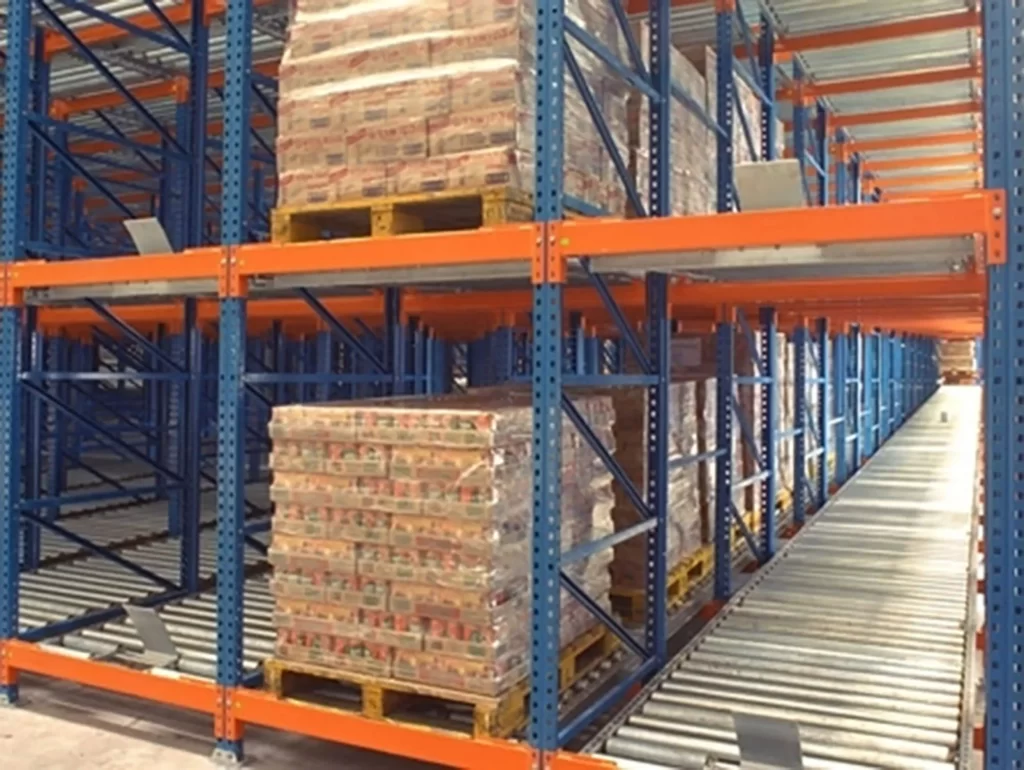
- Pallet Flow Racking. Uses gravity rollers to enforce automatic FIFO flow, which naturally supports FEFO when lots are loaded in expiration order.
- Carton Flow Racking. Suitable for case picking of perishable goods in food distribution and pharmaceutical fulfillment.
- Push-Back Racking. Operates on LIFO and is generally not recommended for FEFO unless used for non-perishable buffer stock.
Warehouse operators handling cold chain or pharmaceutical inventory often combine selective racking for fast-moving SKUs with shuttle or pallet flow racking for bulk perishable storage.

Key Takeaways
- FEFO (First Expired, First Out) prioritizes expiration date over receiving date when dispatching inventory.
- The method is essential for pharmaceutical, food, cosmetic, chemical, and cold chain warehouses.
- FEFO differs from FIFO, which is based on receiving order rather than expiry, and from LIFO, which is generally unsuitable for perishables.
- Successful FEFO implementation requires lot-level traceability, a capable WMS, and racking systems that allow selective or flow-based access.
- Selective pallet racking, shuttle racking, and pallet flow racking are the most compatible storage systems for FEFO operations.
Frequently Asked Questions About FEFO
1. What does FEFO stand for in warehouse management?
FEFO stands for First Expired, First Out. It is an inventory rotation method in which goods with the earliest expiration date are dispatched before items with later expiry dates, regardless of when they were received.
2. What is the difference between FEFO and FIFO?
FIFO rotates inventory based on the order it was received, while FEFO rotates inventory based on expiration date. A newer shipment with an earlier expiration date will be picked first under FEFO, but not under FIFO.
3. Which industries use FEFO most commonly?
Pharmaceutical distribution, food and beverage, dairy, cold chain logistics, cosmetics, and chemical storage are the primary industries that rely on FEFO due to expiration and regulatory requirements.
4. Can FEFO be implemented without a WMS?
Manual FEFO is possible for very small operations but becomes unreliable at scale. A Warehouse Management System with lot-level tracking is generally required to enforce FEFO across multiple SKUs and locations.
5. Is drive-in racking suitable for FEFO?
Drive-in racking operates on a LIFO basis and is not naturally suited to FEFO. It can only support FEFO if each lane holds a single lot with the same expiration date.
6. Does FEFO eliminate inventory waste completely?
FEFO significantly reduces expired stock losses but cannot eliminate them entirely. Slow-moving SKUs, forecasting errors, and demand fluctuations may still result in some product expiry.
7. How does FEFO support regulatory compliance?
Many regulators, including the FDA and WHO, require expiration-based dispatch for pharmaceutical and food products. FEFO provides documented evidence that earliest-expiring stock is shipped first, supporting Good Distribution Practice requirements.
8. What racking system is best for FEFO warehouses?
Selective pallet racking offers the greatest flexibility for FEFO because every pallet is directly accessible. Pallet flow racking is also effective when lots are loaded in strict expiration sequence.
Conclusion
FEFO (First Expired, First Out) has become a foundational inventory rotation method for warehouses handling perishable, regulated, or expiration-sensitive products. By prioritizing expiry over receiving date, FEFO reduces product waste, supports regulatory compliance, and improves customer satisfaction across pharmaceutical, food, cold chain, and cosmetics operations.
Effective implementation depends on three pillars: accurate expiration data capture, a capable warehouse management system, and racking equipment that allows selective or flow-based access to stored goods. Warehouses planning to adopt FEFO should evaluate their storage layout, software infrastructure, and labor processes together rather than in isolation.
Manufacturers such as Mracking represent the type of storage equipment supplier commonly evaluated by warehouse operators seeking racking systems compatible with FEFO, FIFO, and other expiration-based inventory rotation methods in pharmaceutical, food, and cold storage environments.