

Used pallet racking looks attractive at first glance. Listed prices are typically 30–60% below new equivalents, secondary markets are active, and buyers naturally assume that structural steel racking should offer decades of remaining service life at a fraction of the new cost. In practice, the calculation rarely holds up. Once transportation, refurbishment, missing components, engineering recertification, and long-term safety risk are added to the visible purchase price, buying used pallet racking frequently costs as much as — or more than — buying new equivalent systems from established manufacturers. This article examines why used pallet racking so often disappoints on cost, what hidden expenses buyers overlook, and when used racking might still make legitimate sense.

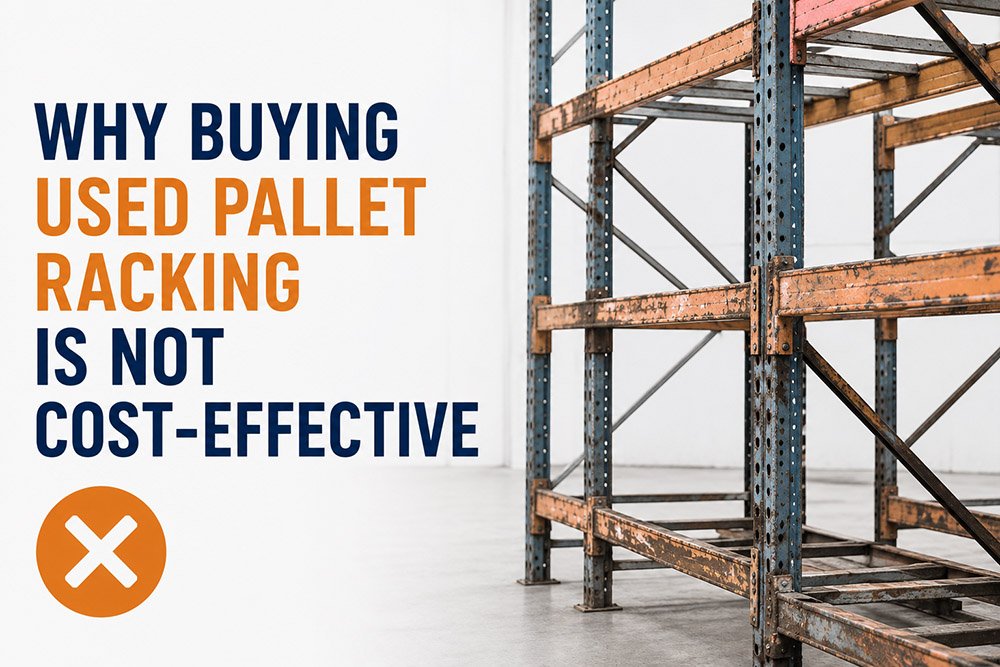
What Is Used Pallet Racking?
Used pallet racking is second-hand structural or roll-formed pallet racking that has been removed from a previous installation and is resold through dealers, auctions, warehouse liquidation firms, or direct-to-buyer channels, typically without the original engineering documentation, load certification, or manufacturer warranty. Used racking is available in selective, drive-in, teardrop, and structural configurations, with age ranging from lightly used systems to decades-old components.
The secondary racking market grew alongside the industrial warehouse boom, and legitimate dealers provide inspection, cleaning, and partial refurbishment before resale. However, the used racking market varies widely in quality, documentation, and supplier reliability, and buyers must evaluate carefully to distinguish reasonable value from hidden liability.
Why Buying Used Pallet Racking Seems Attractive at First
The appeal is straightforward. Listed prices for used selective pallet racking often fall between USD 25 and USD 60 per pallet position, compared with USD 60 to USD 120 for equivalent new roll-formed systems and USD 90 to USD 160 for new structural racking. Delivery lead times are usually shorter than new manufacturing, and buyers avoid the wait typical of custom orders. For warehouse operators facing capacity pressure and budget constraints, the visible savings can look decisive.
The problem is that visible price is only one component of true acquisition cost. Several categories of cost that do not appear on the used racking invoice usually determine whether the purchase actually saves money.
The Hidden Costs of Buying Used Pallet Racking
Five categories of expense routinely eliminate the apparent savings of used racking.

Transportation and Freight. Used pallet racking is heavy, often unpainted after dismantling, and rarely optimally packaged. Freight per pallet position is typically 40–70% higher than for new racking shipped in flat-packed containers. Cross-border used racking often incurs additional handling charges because carriers cannot palletize efficiently.
Dismantling and Removal. If the buyer sources racking directly from a closing warehouse, dismantling cost — professional deinstallation, load release, and safe transport preparation — typically adds USD 8 to USD 20 per pallet position. Dealers who have already dismantled the racking incorporate this cost into the resale price, sometimes without transparency.
Refurbishment and Cleaning. Rust, oil contamination, coating damage, and residual product from the previous operation typically require sandblasting, priming, and repainting before installation in a new facility. Full refurbishment costs USD 15 to USD 40 per pallet position and adds two to four weeks to project timeline.
Missing or Damaged Components. Used racking rarely arrives complete. Base plates, footplates, safety clips, cross bars, wire decking, and column protectors are frequently missing or damaged. Sourcing replacement components — often from a different manufacturer — is expensive and may require custom fabrication.
Recertification and Engineering Documentation. Load ratings on used racking are usually undocumented. Restoring engineering credibility requires a structural engineer to inspect the system, verify remaining capacity, and issue a compliance letter for building permits or insurance. Recertification typically costs USD 3,000 to USD 15,000 depending on system size — a fixed cost that hits smaller systems particularly hard on a per-position basis.
Safety and Structural Risks
Beyond hidden cost, used pallet racking carries structural risks that new racking does not.

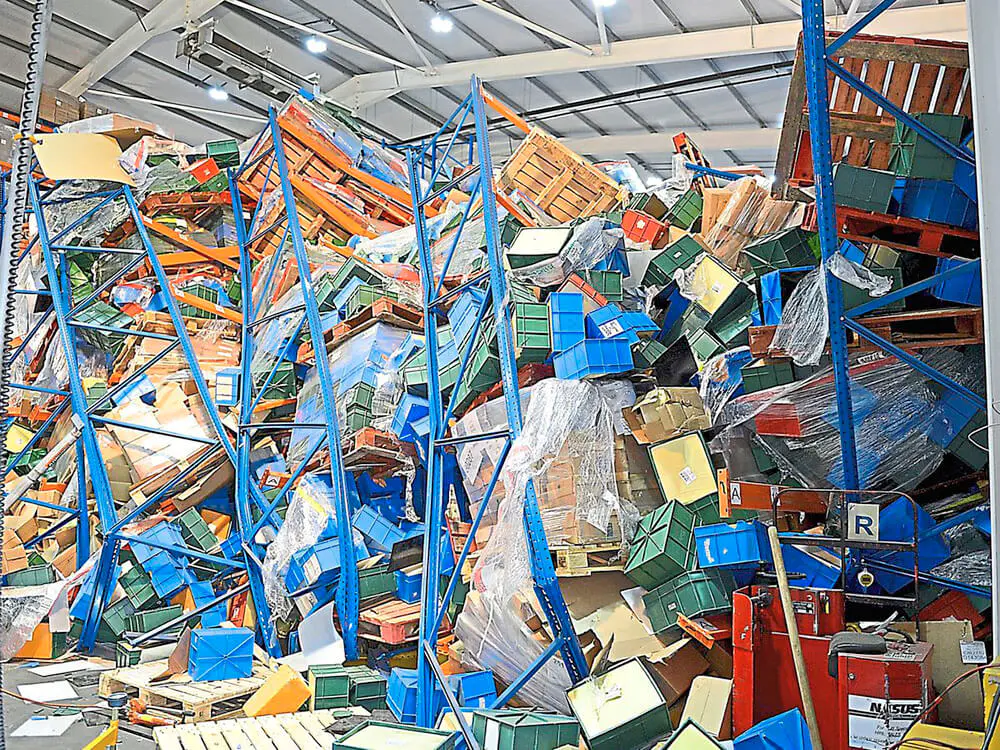
Fatigue Damage That Is Not Visible. Metal fatigue from years of load cycles accumulates internally without visible symptoms. A used upright may look sound while carrying significantly reduced remaining capacity.
Undocumented Impact History. Forklift impacts typically leave localized damage that can be repaired cosmetically but continues to affect structural performance. Used racking that has been repainted may hide impact history that no visual inspection will catch. Case studies of rack failure — including the incident conditions discussed in general references on warehouse racking collapse — show that unseen prior damage is a leading contributor.
Missing Load Rating Data. Original manufacturer load calculations are rarely transferred with used racking. Without documented rated capacity, operators either underload the system (losing storage capacity) or overload it (creating collapse risk).
Non-Compliance with Current Design Standards. Racking standards evolve. Systems designed to earlier versions of ANSI MH16.1, EN 15512, or AS 4084 may not meet current seismic, corrosion, or safety factor requirements. Retrofitting an older system to current standards is not always possible.
Corrosion Under Coating. Rust under repaint is common in used racking. A newly painted system may look sound while advanced corrosion continues at weld joints and base plates. Detailed inspection procedures documented in guidance on pallet racking inspection identify the specific inspection points that typically reveal hidden damage.
Compatibility and System Integrity Issues
Different manufacturers use different upright profiles, beam connectors, and safety clip designs — often incompatible with each other. Used racking assembled from multiple sources cannot be treated as a single engineered system. Beams from one manufacturer may not engage safely with uprights from another, even when they appear to fit. Mixed-manufacturer systems also void any surviving engineering documentation and generally cannot be certified as a whole. As inventory expands, incompatibility restricts future scaling — new components rarely match the mixed used inventory already installed.
Legal, Insurance, and Certification Risks
Warehouse racking is a life-safety structure in most jurisdictions. Buying used racking transfers several liabilities to the buyer that are worth understanding before purchase.

Building permits often require stamped engineering drawings that document rack design compliance. Systems assembled from undocumented used components rarely receive permit approval without independent recertification. Insurance policies may exclude coverage for collapse incidents involving racking that lacks documented load ratings or design compliance. Workplace safety inspections — under authorities such as OSHA — evaluate rack condition and compliance with applicable standards, and enforcement action against undocumented used racking is not uncommon following incidents. Compliance with rack design standards published by the Rack Manufacturers Institute (RMI) is significantly harder to demonstrate when the racking was manufactured decades earlier under different specifications.
Total Cost of Ownership: Used vs New
The most complete way to compare used and new racking is through total cost of ownership rather than visible purchase price. A realistic calculation for a 1,000-pallet-position selective racking system illustrates the pattern.

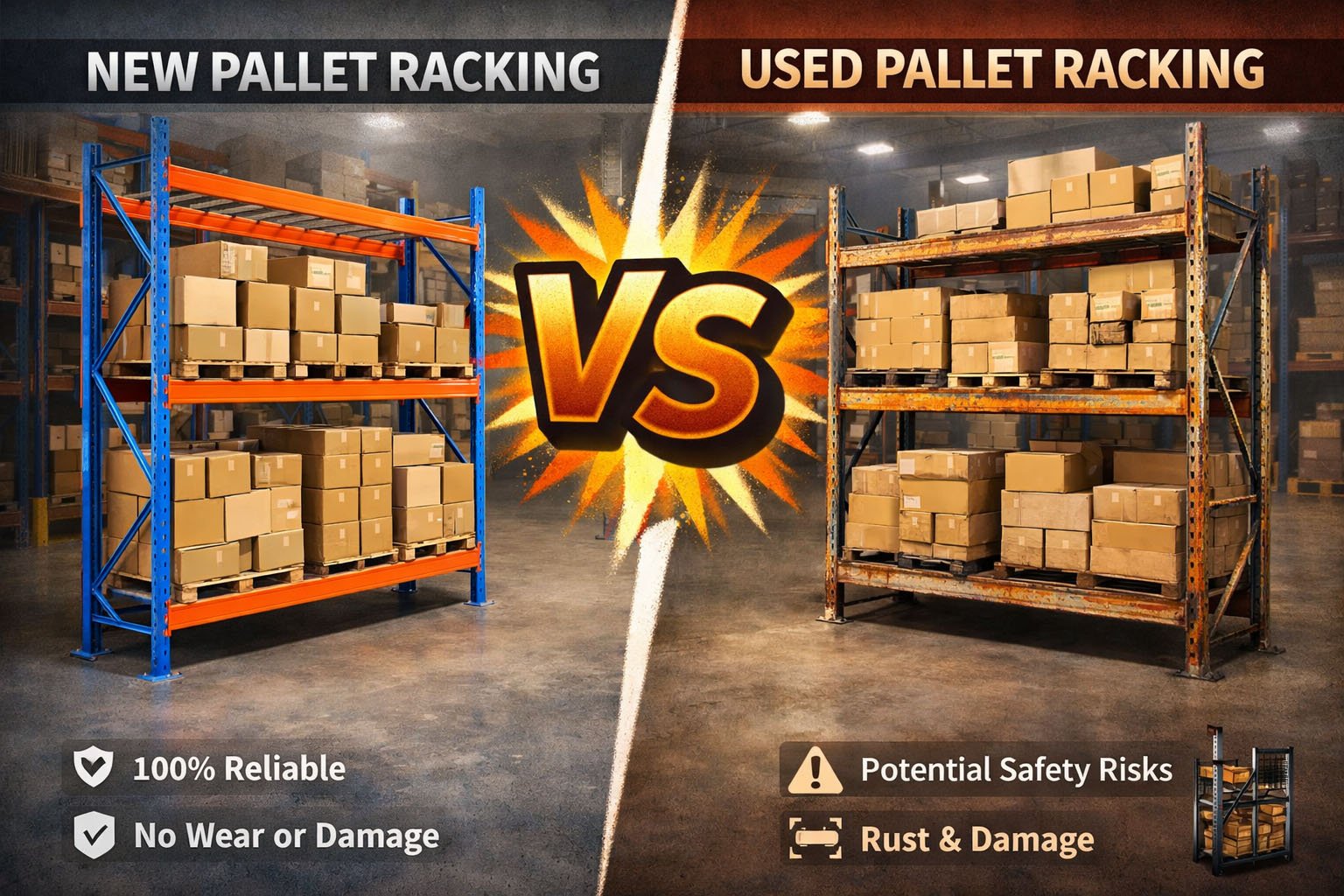
A used system listed at USD 40 per position (USD 40,000) typically incurs freight of USD 12 per position (USD 12,000), refurbishment at USD 25 per position (USD 25,000), replacement components at USD 8 per position (USD 8,000), and recertification of USD 8,000 fixed cost. True acquisition cost approaches USD 93,000 — USD 93 per position, comparable to or exceeding equivalent new roll-formed racking sourced from established manufacturers, and significantly higher than new racking sourced directly from Chinese manufacturers where roll-formed selective systems are widely available in this price range.
Add reduced remaining service life (typically 40–60% of new equivalent), higher maintenance and inspection cost, and insurance premium differences, and the used racking option often costs more per year of service than the new alternative.
Comparison Table: Used vs New Pallet Racking
| Factor | Used Pallet Racking | New Pallet Racking |
|---|---|---|
| Visible Purchase Price | Lower | Higher |
| Freight per Position | Higher (uneven packaging) | Optimized (flat-packed containers) |
| Refurbishment Required | Common (USD 15–40/position) | None |
| Missing Components | Frequent | Complete |
| Engineering Documentation | Usually missing | Included |
| Warranty | Rare | 2–10 years typical |
| Load Rating Certainty | Undocumented | Verified |
| Compliance with Current Standards | Uncertain | Verified |
| Remaining Service Life | 40–60% of new | 20–30 years |
| Insurance & Permit Complications | Common | Minimal |
| True Cost per Position (typ.) | USD 80–110 | USD 60–120 (new roll-formed) |
At scale, the true cost comparison is often much closer than list prices suggest — and frequently favors new racking once all factors are included.
When Used Racking Might Still Make Sense
Used pallet racking is not always the wrong choice. Several specific scenarios can make it economically or operationally sensible.
Very small temporary installations where recertification and permit requirements do not apply. Same-facility relocations where the racking’s history and specifications are already known. Direct purchase from a closing operation where the same design was used originally. Non-safety-critical, low-load applications such as light shelving or auxiliary storage. Rapid-turnaround projects where new manufacturing lead time is prohibitive. In each case, the buyer should verify that the specific factors driving cost increases in general used racking procurement do not apply to the specific opportunity.
How to Compare Actual Costs Before Deciding
Step 1: Request Full Component Inventory from the Seller.
Confirm which components are included and which are missing before making a comparison against new pricing.
Step 2: Obtain a Refurbishment and Freight Quotation.
Include cleaning, repainting, replacement components, and transportation to the destination.
Step 3: Estimate Recertification Cost.
Contact a structural engineer familiar with rack design to estimate the cost of documenting load capacity and compliance for permit purposes.
Step 4: Request Comparable New Quotations.
Solicit quotations for equivalent new racking from multiple manufacturers, including engineered documentation and standard warranty. General benchmarks discussed in resources on warehouse racking prices provide useful reference points for evaluating what a comparable new system should cost.
Step 5: Calculate True Cost per Pallet Position.
Sum all costs — visible price, freight, refurbishment, replacement components, recertification — and divide by pallet positions to enable direct comparison.
Step 6: Factor in Remaining Service Life.
Divide true acquisition cost by expected remaining service years to calculate annualized cost per position for both options.
Key Takeaways
- Used pallet racking typically appears 30–60% cheaper than new but rarely delivers that saving after freight, refurbishment, missing components, and recertification are added.
- True acquisition cost for used systems often reaches USD 80–110 per pallet position, comparable to new racking from established suppliers.
- Structural risks include invisible fatigue damage, undocumented impact history, missing load ratings, and non-compliance with current design standards.
- Missing engineering documentation creates permit, insurance, and compliance complications that are difficult to resolve after purchase.
- Compatibility problems between components from different manufacturers reduce future scalability.
- Used racking may still make sense in small, temporary, low-load, or same-facility relocation scenarios where recertification requirements are limited.
- The most reliable comparison is total cost of ownership per pallet position per year, not visible list price.
Frequently Asked Questions
1. How much cheaper is used pallet racking than new?
Listed prices for used selective racking are typically 30–60% below new equivalents. However, once freight, refurbishment, missing components, and recertification are added, true acquisition cost often reaches parity with new roll-formed racking from established manufacturers.
2. What are the biggest hidden costs of buying used pallet racking?
Freight, refurbishment (cleaning, repainting, sandblasting), missing or damaged components, and engineering recertification are the largest hidden costs. Together they typically add USD 40–70 per pallet position to the visible purchase price.
3. Is used pallet racking safe?
Used racking can be safe if it is properly inspected, certified, and matched to current design standards. However, invisible fatigue damage, undocumented impact history, and unclear load ratings introduce risks that new racking with documented engineering does not carry.
4. Do insurance policies cover collapse of used racking?
Coverage varies by insurer. Policies often exclude or limit coverage for collapse incidents involving racking that lacks documented load ratings or design compliance. Buyers should verify coverage terms before purchase, particularly for undocumented used systems.
5. Can components from different used racking systems be mixed together?
Generally no. Different manufacturers use different upright profiles, beam connectors, and safety clip designs that are not interchangeable. Mixed-manufacturer systems cannot be treated as a single engineered structure and typically cannot be certified as a whole.
6. When does used pallet racking make economic sense?
Small temporary installations, same-facility relocations, low-load auxiliary storage, or purchases from closing operations where the buyer knows the racking’s history can make used racking a legitimate choice. Large permanent installations typically favor new racking.
7. How can I evaluate used pallet racking before buying?
Request a complete component inventory, obtain refurbishment and freight quotations, estimate recertification cost, and compare against equivalent new quotations. Physically inspect the racking or engage an inspector to identify damage, corrosion, and missing components.
8. Is it better to buy new pallet racking from Chinese manufacturers than used pallet racking locally?
For medium and large systems, this comparison often favors new Chinese-manufactured racking once used racking’s hidden costs are included. Documentation, warranty, and engineering compliance are typically stronger with new racking, though total delivered cost should always be calculated on a per-position basis.
Conclusion
Used pallet racking has an intuitive appeal that dissolves under detailed cost analysis. Freight, refurbishment, missing components, and engineering recertification typically consume the visible savings, and structural and legal risks add further hidden liability that new racking with documented engineering does not carry. This is not to say used racking never has a role — small, temporary, or same-facility applications can still justify the purchase — but for medium and large permanent installations, new racking from established manufacturers usually delivers better total cost of ownership once all factors are included.
For warehouse operators comparing used racking against new alternatives, current pricing from Chinese manufacturers often narrows the cost gap significantly or eliminates it entirely once refurbishment, freight, and recertification are added. Mracking is one of the Chinese manufacturers producing new pallet racking systems across selective, drive-in, VNA, teardrop, and structural configurations, with engineered documentation, verified load ratings, standardized components, and coating options that eliminate the hidden costs and compatibility risks typically associated with used racking procurement.