


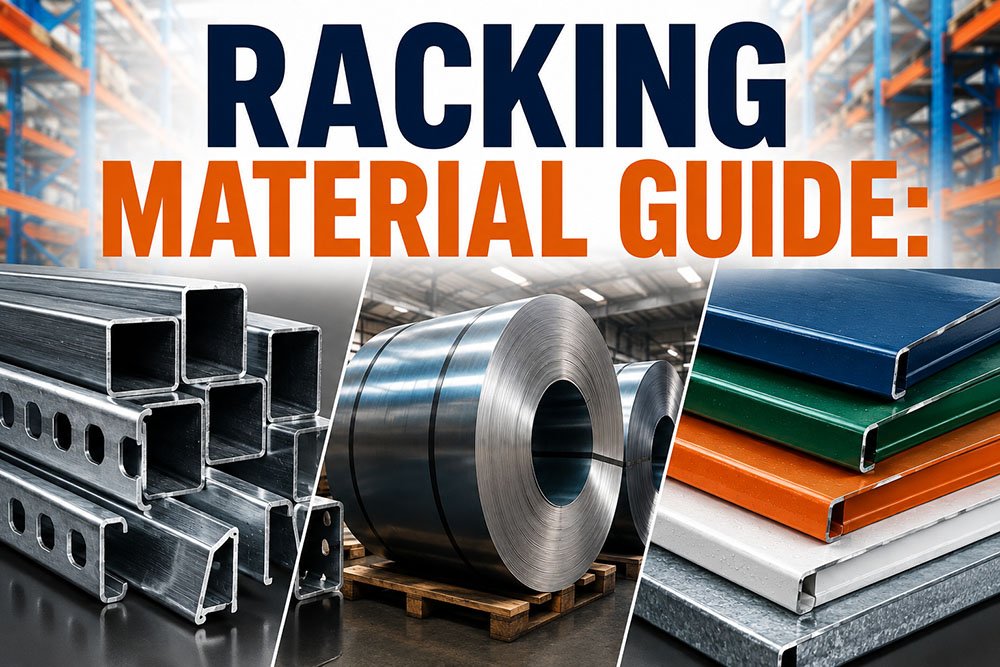
Racking material is the foundation on which every warehouse pallet racking system rests — literally. The steel grade, gauge, and surface treatment specified at the time of purchase determine load capacity, corrosion resistance, service life, and total cost of ownership across the 20-to-30-year operating horizon of a typical rack installation. Yet material selection is frequently reduced to a single line on the quotation (“carbon steel, powder coated”), obscuring the technical differences that separate systems built to last a decade in a cold storage warehouse from systems that will corrode within two years in the same environment. Understanding racking material options — the steel itself and the coatings applied to it — is essential for any warehouse operator making a rack procurement decision.
This article examines the main racking material types, the steel grades used in modern rack manufacturing, the surface treatments and coatings available, and the process of choosing material based on the specific warehouse operating environment.
What Is Racking Material?
Racking material refers to the raw structural steel used to manufacture warehouse pallet racking components — most commonly cold-formed or hot-rolled carbon steel, less commonly stainless steel or aluminum — combined with a surface treatment such as powder coating, hot-dip galvanization, or specialized epoxy that protects the material against corrosion, impact damage, and environmental exposure over its service life. Together, the base metal and the coating define the rack’s structural performance, cosmetic appearance, and durability in the intended operating environment.
Material and coating decisions cascade into cost, lead time, service life, and pallet racking safety. Under-specified materials cost less upfront but produce shorter service life, higher damage rates, and premature replacement — often reversing the initial saving within five to ten years. Correctly specified materials cost more upfront but deliver predictable long-term performance.
Main Racking Material Types
Four primary material categories are used across modern pallet racking systems.

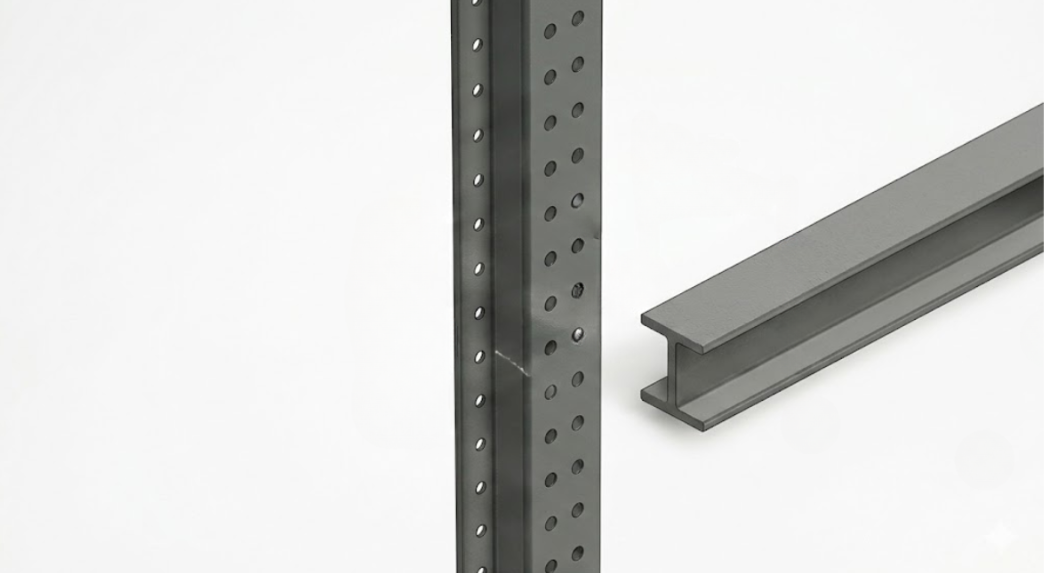
Cold-Formed Carbon Steel. The dominant material for roll-formed racking. Cold-formed steel is produced by bending thin steel sheet at room temperature through a series of forming rolls, resulting in lightweight, dimensionally consistent components. Typical wall thickness is 1.8 to 2.5 mm. Cold-formed carbon steel is cost-effective, easy to transport in flat-packed containers, and widely used in general distribution warehouses. Detailed comparison of hot-rolled versus cold-rolled steel covers the underlying manufacturing differences that shape material selection.
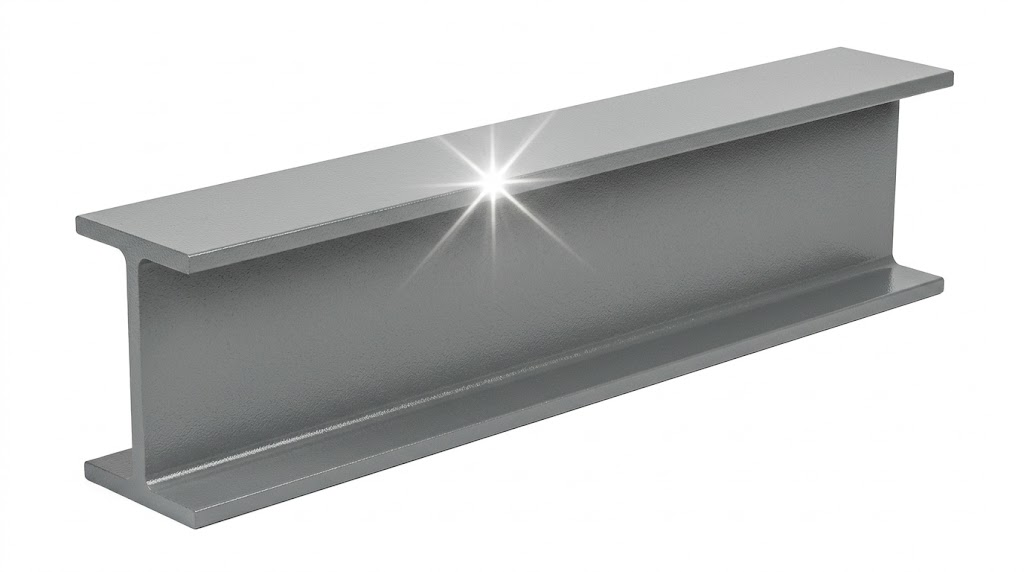
Hot-Rolled Structural Steel. Used in structural pallet racking where higher load capacity and impact resistance are required. Hot-rolled steel is formed at high temperature in a rolling mill, producing heavier sections such as C-channel and I-beam with wall thicknesses of 4 to 8 mm or more. Structural racking materials cost more but deliver significantly better performance in cold storage, high-impact operations, and heavy industrial applications.

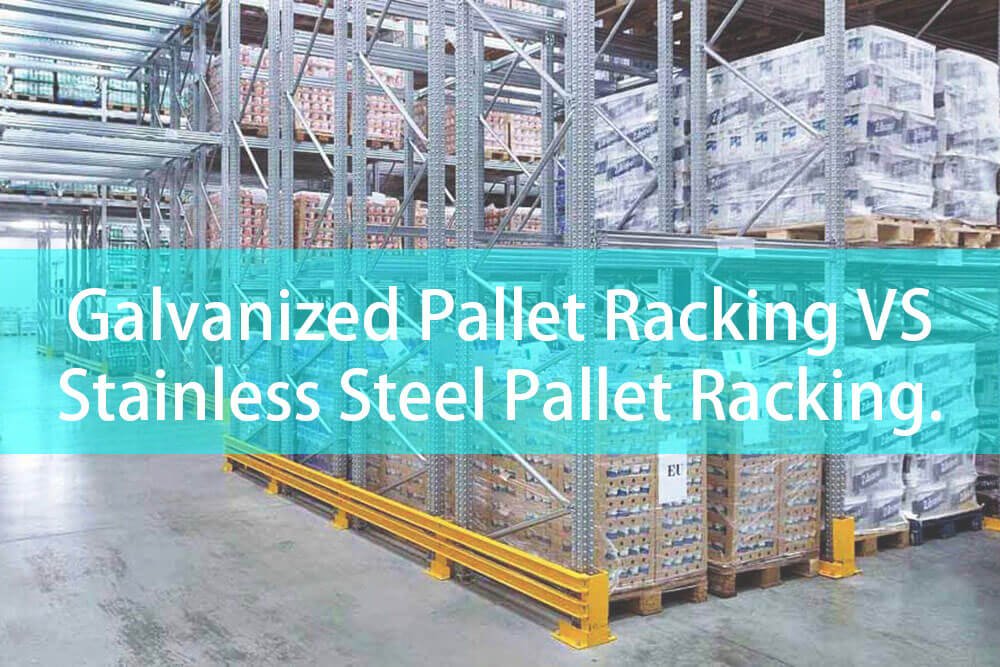
Stainless Steel. Used in food processing, pharmaceutical, medical, and cleanroom environments where corrosion resistance, hygienic surface, and chemical washdown compatibility are essential. Grade 304 stainless steel is the standard; grade 316 offers superior resistance to chloride and marine environments. Stainless racking costs 3–5 times more than equivalent carbon steel and is generally reserved for applications where regulatory or environmental requirements demand it. Considerations comparing stainless steel racking versus standard steel racking address the trade-offs in detail.
Aluminum. Used in specialized applications requiring low weight or non-magnetic properties, such as certain medical, aerospace, or portable rack applications. Aluminum offers excellent corrosion resistance and lightness but lower load capacity per section, making it uncommon in general pallet racking.
Steel Grades Used in Racking
Within carbon steel, several grade standards define material strength and workability across regions.
Chinese Standards (Q235 and Q345). Q235 (yield strength 235 MPa) is the general-purpose structural steel grade dominant in Chinese-manufactured racking. Q345 (yield strength 345 MPa) offers higher yield strength and is preferred for heavy-duty structural racking, allowing thinner sections at equivalent load capacity.
European Standards (S235 and S355). S235 corresponds approximately to Q235; S355 corresponds approximately to Q345. Both are defined under EN 10025 and are used in European rack manufacturing.
North American Standards (A36, A572, A992). A36 is the general structural carbon steel grade in North American practice; A572 Grade 50 and A992 are higher-strength alternatives used in structural racking and building framing.
Higher grades (Q345, S355, A572) allow the same load capacity with lower steel weight, reducing material cost and transport weight. However, higher-grade steel is more expensive per kilogram, and the total cost benefit depends on the specific rack configuration and load requirement.


Surface Treatments and Coatings
The corrosion-protection coating applied to racking steel under ISO 12944 principles is often more consequential for long-term performance than the underlying steel grade. Five main surface treatments dominate modern racking specifications.
Powder Coating. The standard finish for indoor ambient warehouse racking. Powder coat is applied electrostatically as dry powder and cured in an oven, producing a hard, uniform, decorative finish typically 60 to 90 microns thick. Powder coating provides good corrosion protection in dry indoor environments and comes in a wide range of colors. Not suitable for extended outdoor exposure, cold storage, or humid environments.
Hot-Dip Galvanization. Steel components are immersed in molten zinc at approximately 450 °C, forming a metallurgically bonded zinc coating typically 70 to 120 microns thick. Hot-dip galvanization provides excellent long-term corrosion protection and is the default finish for outdoor storage, cold storage, coastal facilities, and other aggressive environments. Adds 20 to 30 percent to material cost.

Electro-Galvanization and Zinc Plating. Thinner zinc coating applied electrochemically, typically 8 to 20 microns thick. Cheaper than hot-dip galvanization but less durable. Used primarily for small accessories such as safety pins, clips, and hardware where structural corrosion resistance is not critical.
Epoxy and Polyester Coatings. Specialized coating systems used in pharmaceutical, food-grade, and cleanroom applications where powder coat durability is insufficient. Resistant to chemical washdown, steam cleaning, and disinfection agents. Higher cost than standard powder coat but essential for regulated environments.
Duplex Coating. Combines hot-dip galvanization with an additional powder coat top layer, producing the longest service life in the most demanding environments — coastal, industrial, chemical exposure, or outdoor high-humidity storage. Highest cost but delivers 30 or more years of corrosion protection in aggressive conditions. Guidance on how to protect warehouse storage racks from moisture discusses coating selection for humid and wet environments in detail.
Choosing Racking Material by Warehouse Environment
Racking material selection should always start from the operating environment rather than from any universal quality hierarchy.
Indoor Ambient (Distribution, Retail, General Storage). Cold-formed Q235 or S235 carbon steel with powder coating is the default and cost-effective choice. Typical service life 20+ years with proper maintenance.
Cold Storage and Freezer Warehouses. Structural or heavy-gauge carbon steel with hot-dip galvanization is standard. Powder coating alone cannot withstand thermal cycling, condensation, and cleaning agents typical in refrigerated environments. Broader guidance on rack selection for refrigerated warehousing addresses coating requirements in more detail.
Outdoor and Yard Storage. Hot-dip galvanized or duplex-coated carbon steel. Standard powder coat corrodes rapidly in outdoor exposure. Coastal locations warrant duplex coating.
Food and Pharmaceutical. Stainless steel (304 or 316) or epoxy-coated carbon steel, depending on the specific regulatory framework. Food-contact zones typically require stainless; general food storage may accept epoxy-coated carbon steel.

Chemical, Marine, and Aggressive Environments. Duplex coating on carbon steel, or stainless steel where chemical exposure is severe. Material selection should involve a corrosion engineer for demanding chemical operations.
High-Impact Operations (3PL, Cold Chain, Manufacturing). Structural hot-rolled steel with hot-dip galvanization. Impact resistance and corrosion resistance are both required in these environments. Broader considerations for structural versus roll-formed racking material choice inform this decision.
Comparison Table: Racking Material and Coating Options
| Material / Coating | Corrosion Resistance | Typical Cost | Best Environment | Typical Service Life |
|---|---|---|---|---|
| Cold-Formed Steel + Powder Coat | Low–Medium | Baseline | Indoor ambient distribution | 15–25 years |
| Cold-Formed Steel + Hot-Dip Galv | High | +20–30% | Cold storage, outdoor, humid | 25–35 years |
| Structural Steel + Powder Coat | Low–Medium | +25–50% | Heavy indoor, high impact | 20–30 years |
| Structural Steel + Hot-Dip Galv | High | +40–70% | Cold storage, heavy outdoor | 30+ years |
| Stainless Steel 304 | Very High | 3–5× baseline | Food, pharma, cleanroom | 30+ years |
| Stainless Steel 316 | Very High | 4–6× baseline | Marine, chemical, chloride exposure | 30+ years |
| Duplex Coating | Very High | +50–80% | Coastal, industrial, aggressive | 30+ years |
Cost multiples are approximate and vary with project size, region, and steel market conditions. Compliance with rack design standards published by the Rack Manufacturers Institute (RMI) applies to material selection regardless of the specific grade or coating chosen.
How to Choose Racking Material
Step 1: Define the Operating Environment.
Document temperature range, humidity, presence of chemicals, cleaning agents used, and whether the operation is indoor or outdoor. Environmental exposure is the primary driver of material and coating selection.
Step 2: Confirm Load Requirements.
Estimate pallet weight, load per beam pair, and total pallet rack upright loads. Higher loads justify higher steel grades or structural sections; standard loads work with cold-formed carbon steel.
Step 3: Verify Regulatory Requirements.
Food, pharmaceutical, and chemical operations may require specific material standards. Confirm before specification.
Step 4: Match Coating to Environment.
Indoor ambient: powder coat. Cold storage, outdoor, humid: hot-dip galvanization. Coastal, aggressive: duplex. Pharmaceutical washdown: epoxy or stainless.
Step 5: Calculate Total Cost of Ownership.
Compare upfront material cost against expected service life and maintenance cost. Under-specified materials in demanding environments often produce higher lifetime cost.
Step 6: Verify Standards Compliance.
Confirm compliance with regional design standards (ANSI MH16.1, EN 15512, AS 4084) and workplace safety guidance from OSHA, including its warehousing hazards and solutions. Both structural and cold-formed materials must meet identical safety requirements for the intended load.
Common Mistakes in Racking Material Selection
Several recurring errors reduce rack performance or accelerate deterioration. Specifying powder coat for cold storage, resulting in coating failure within 12–24 months. Ignoring coating thickness in microns when comparing quotations — two “powder-coated” racks at very different prices often reflect different coating specifications. Choosing standard carbon steel for outdoor use without galvanization, producing visible rust within a year. Specifying stainless steel where it is not required, adding significant cost without meaningful performance benefit. Overlooking accessory materials — using zinc-plated pins in a galvanized system creates a corrosion mismatch. Selecting materials on quotation price alone without verifying steel grade, gauge, or coating specification.
Key Takeaways
- Racking material combines the underlying steel (cold-formed carbon, hot-rolled structural, stainless, or aluminum) with a surface treatment (powder coat, hot-dip galvanization, epoxy, or duplex).
- Cold-formed Q235 or S235 carbon steel with powder coating is the default for indoor ambient warehouses.
- Hot-dip galvanization is the default for cold storage, outdoor, humid, and coastal environments.
- Stainless steel (304 or 316) is reserved for food, pharmaceutical, marine, and chemically aggressive environments.
- Duplex coating (hot-dip galvanization plus powder coat) delivers the longest service life in the most demanding environments.
- Environment should drive material selection, not upfront cost — under-specified materials often produce higher total cost of ownership.
- Coating specification (thickness in microns, application method) should be explicitly stated in quotations to enable meaningful comparison.
Frequently Asked Questions
1. What is the most common material used for pallet racking?
Cold-formed carbon steel with powder coating is the most common material for pallet racking globally. It combines low cost, adequate strength for standard pallet loads, and good corrosion resistance in indoor ambient warehouses. Higher-specification materials are used where the operating environment demands them.
2. What steel grade is used for pallet racking?
Q235 and Q345 are standard in Chinese-manufactured racking. S235 and S355 are used in European racking. A36 and A572 are used in North American racking. Higher grades allow the same load capacity with lower steel weight, useful in structural racking where material weight is significant.
3. When should stainless steel racking be used?
Stainless steel racking is used in food processing, pharmaceutical, medical, cleanroom, and marine environments where corrosion resistance, hygienic surfaces, and chemical washdown compatibility are essential. Because stainless costs 3–5 times more than equivalent carbon steel, it is generally reserved for applications where regulatory or environmental requirements demand it.
4. What is the difference between powder coating and hot-dip galvanization?
Powder coating is a dry-applied polymer coating cured in an oven, providing good corrosion protection in dry indoor environments (typically 60–90 microns thick). Hot-dip galvanization is a zinc coating formed by immersing steel in molten zinc, providing excellent corrosion protection in outdoor, cold storage, and humid environments (typically 70–120 microns thick). Galvanization is more durable but more expensive.
5. What coating should be used for outdoor racking?
Hot-dip galvanization is standard for outdoor racking. Coastal or chemically aggressive outdoor locations warrant duplex coating (hot-dip galvanization plus powder coat). Standard indoor powder coating corrodes rapidly in outdoor exposure and should not be specified for outdoor use.
6. Can pallet racking be made from aluminum?
Aluminum pallet racking exists for specialized applications requiring low weight or non-magnetic properties, such as certain medical or aerospace operations. However, aluminum has lower load capacity per section than steel and higher unit cost, making it uncommon in general warehouse racking.
7. How thick should the coating on pallet racking be?
Standard powder coating is 60–90 microns thick. Hot-dip galvanization is 70–120 microns thick. Duplex coatings combine both, adding to 130–210 microns total. Coating specifications should be verified in quotations because two “powder-coated” racks at different prices often reflect different coating thicknesses.
8. Which racking material lasts the longest?
Stainless steel and duplex-coated structural steel offer the longest service life — typically 30 years or more in demanding environments. Under indoor ambient conditions, well-maintained powder-coated cold-formed steel can achieve 20–25 years. Under-specified materials in demanding environments may fail within 5–10 years.
Conclusion
Racking material is not a single specification — it is a combination of base metal (cold-formed carbon, hot-rolled structural, stainless, or aluminum) and surface treatment (powder coat, hot-dip galvanization, epoxy, or duplex) chosen to match the specific operating environment. Cold-formed carbon steel with powder coating dominates indoor distribution because it delivers adequate performance at the lowest cost; structural steel with galvanization dominates cold storage and heavy-duty applications; stainless steel serves food, pharmaceutical, and marine environments where regulatory or corrosion requirements demand it; duplex coating handles the most aggressive conditions. Correctly matching material to environment is one of the highest-leverage decisions in rack procurement — under-specified materials in demanding conditions produce higher total cost of ownership than the initial saving justifies.
For warehouse operators specifying racking material and coating options, the decision typically balances upfront material cost against long-term service life in the specific operating environment. Mracking is one of the Chinese manufacturers producing pallet racking in Q235 and Q345 carbon steel, with powder-coated, hot-dip galvanized, and duplex-coated finishes engineered to match indoor ambient, cold storage, humid, coastal, and outdoor operating environments across selective, drive-in, VNA, and structural racking configurations.