


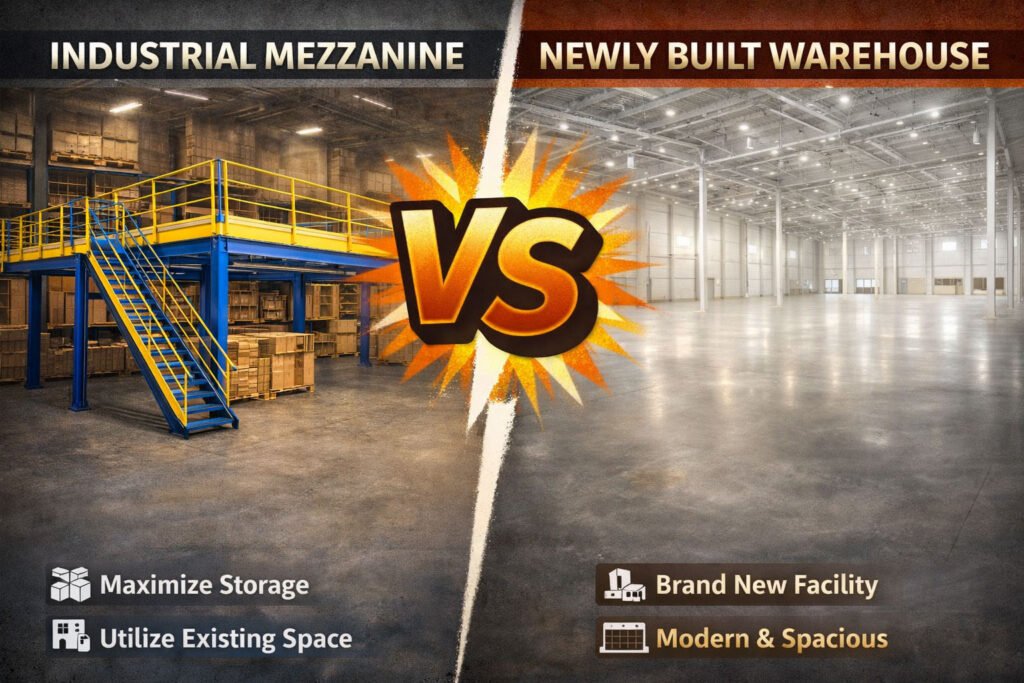
When companies in manufacturing, logistics, e-commerce, 3PL, food & beverage, pharmaceuticals, automotive parts, or any inventory-intensive industry need more storage space, two paths usually emerge:
- Build a brand-new, larger warehouse (Newly Built Warehouse)
- Install an industrial mezzanine (multi-tier steel platform system) inside the existing building
Both options can solve the same problem — lack of storage capacity — but they differ dramatically in capital investment, timeline, ROI, operational disruption, scalability, flexibility, tax implications, and long-term cost of ownership.
In 2026 China, with industrial land and construction costs still high in most Tier-1 & Tier-2 cities, rising interest rates, stricter environmental approvals, longer permitting timelines, and continued pressure to improve ROI and asset turnover, the question “Industrial mezzanine vs. newly built warehouse — which is wiser?” has become one of the most strategic facility decisions. A related guide on Best Mezzanine Floor Materials gives more detail for this part of the planning work.
At Mracking, we have designed, manufactured, and installed hundreds of industrial mezzanine systems across China — from 500 m² light-duty platforms to 8,000+ m² heavy-duty multi-tier distribution centers — and we regularly help clients model both paths. This point also connects with Mezzanine Structure Design.
This extremely detailed guide compares industrial mezzanine vs newly built warehouse across every meaningful dimension in the 2026 context: For product-level details, review Mezzanine Floor Office Design.
- Capital expenditure (CAPEX) comparison
- Timeline from decision to operational readiness
- Return on investment (ROI) and payback period math
- Total cost of ownership (TCO) over 5 / 10 / 15 years
- Storage density & cubic utilization achieved
- Operational disruption during implementation
- Flexibility & future scalability
- Tax, depreciation & financial incentives
- Safety, seismic & regulatory compliance
- Energy consumption & sustainability
- Real-world case examples (anonymized)
- Common decision traps and how to avoid them
- Decision checklist & final recommendation framework
By the end of this article you will have all the data, calculation templates, risk assessment tools, and practical insights needed to confidently decide whether an industrial mezzanine or a newly built warehouse is the wiser choice for your specific business in 2026. For broader industry context, Rack Manufacturers Institute (RMI) is a useful reference.
1. Quick Executive Summary – Which Is Usually Wiser in 2026?
| Criterion | Industrial Mezzanine (Winner) | Newly Built Warehouse | Winner in Most Cases (2026 China) |
|---|---|---|---|
| Upfront CAPEX | 30–60% lower | Much higher | Mezzanine |
| Time to operational | 2–6 months | 12–36 months | Mezzanine |
| Payback period (typical) | 1.8–4.2 years | 5–12 years | Mezzanine |
| Storage density gain | 80–200% of original footprint | 100% (but larger building) | Mezzanine (faster) |
| Disruption during implementation | Moderate (phased) | Very high (new site) | Mezzanine |
| Flexibility / future reconfig | High (modular) | Medium (fixed building) | Mezzanine |
| Tax & depreciation benefit | Faster depreciation | Longer depreciation | Mezzanine (cash flow) |
| Energy & sustainability | Lower HVAC volume | Higher overall footprint | Mezzanine |
| Risk (permitting, delay, cost overrun) | Lower | Very high | Mezzanine |
Short verdict for 2026 China market For 70–85% of mid-sized and large existing facilities that still have ≥4.5–5 m clear height and structurally sound floors, industrial mezzanine is usually the wiser, faster, cheaper, lower-risk, and more flexible choice compared to building a new warehouse.
Only when you have already maxed out vertical space (mezzanine already installed or building height <4.5 m), face severe site constraints (no more land expansion possible), or need a fundamentally different building specification (ultra-high clear height >15 m, heavy-duty floor loading >10 t/m², special cleanroom/ESD requirements), does a newly built warehouse usually become the better long-term decision.

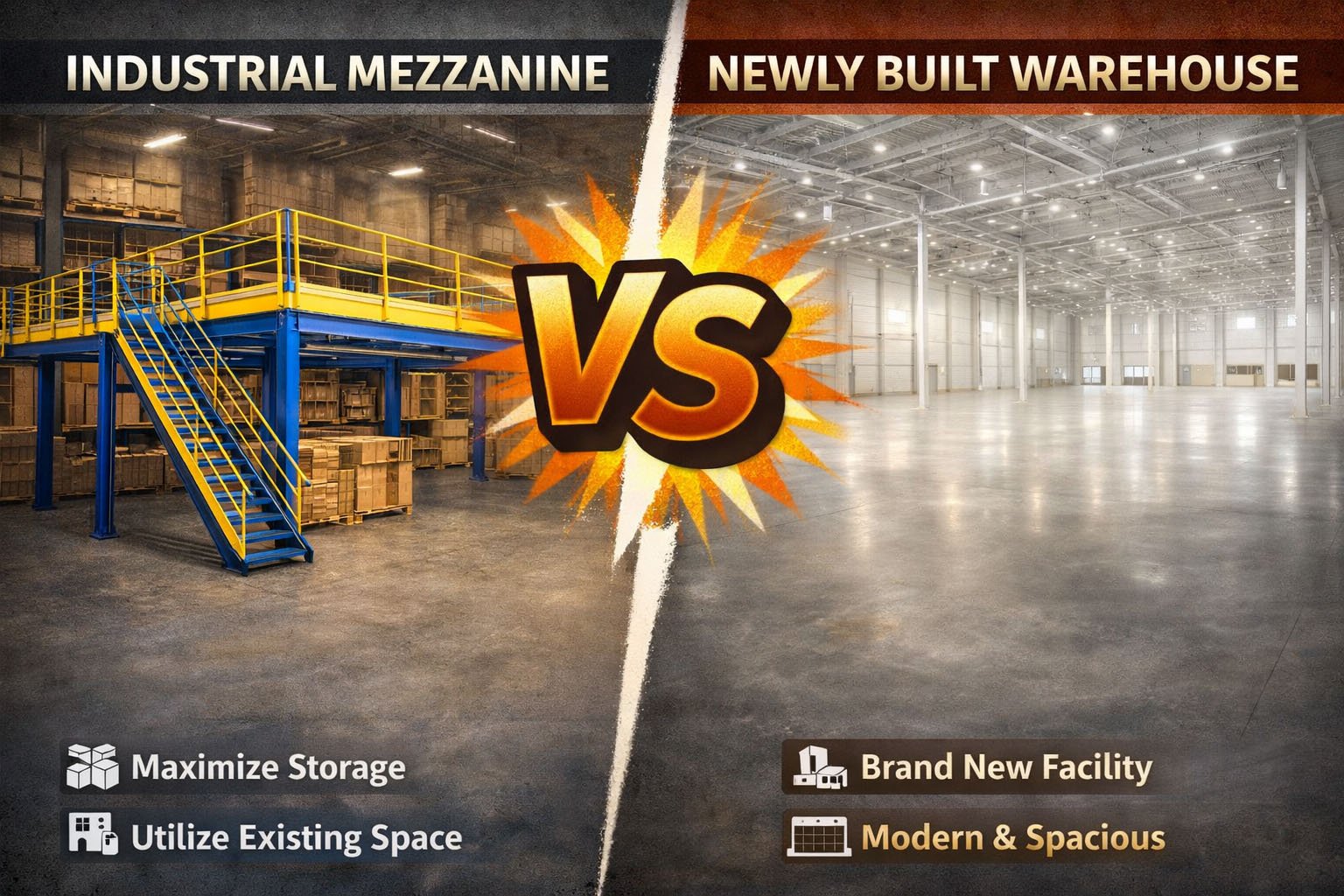
The rest of this article explains exactly why — with real numbers, math, case comparisons, and checklists.
2. What Is an Industrial Mezzanine? Definition & Core Components
An industrial mezzanine (also called raised platform, multi-tier racking platform, steel mezzanine floor, or storage platform) is a structural steel platform system erected inside an existing industrial building to create one or more additional usable floors without constructing a new building. For a closer comparison, see Rack-Supported vs Steel Structure Mezzanine.
Core Structural Components of a Modern Industrial Mezzanine
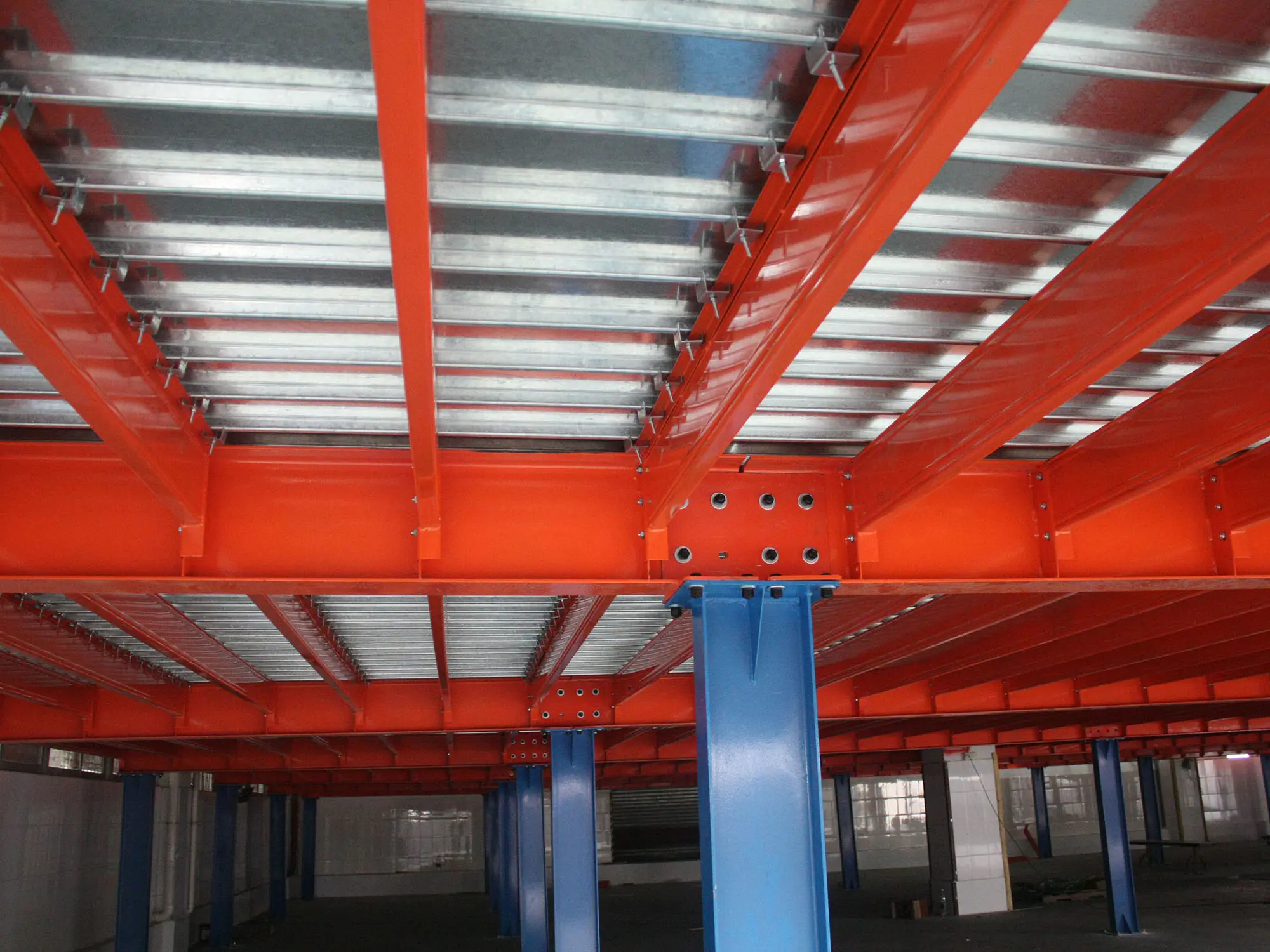
- Main Support Columns — H-beam or square tube steel posts anchored to the existing floor slab
- Primary Beams (Main Girders) — Heavy I-beams or H-beams spanning between columns
- Secondary Beams / Joists — C-channel or Z-purlins supporting the decking
- Decking / Flooring — Steel checker plate, bar grating, plywood with steel edge banding, or composite panels
- Staircases & Handrails — OSHA/GB-compliant stairs, safety gates, guardrails
- Pallet Drop Gates / Loading Gates — Hinged gates for safe pallet transfer between levels
- Column Guards & Safety Netting — Protect columns from forklift impact and prevent falling objects
- Racking Integration — Selective, cantilever, light-duty shelving, carton flow, etc. installed on mezzanine levels
Typical Clear Height Requirements for Mezzanine
- Single-tier mezzanine: need ≥5.5–6.0 m clear height (to achieve usable 2.5–3.0 m clearance on both levels)
- Two-tier mezzanine: need ≥9.0–11.0 m clear height
- Three-tier mezzanine: need ≥12.5–15.0 m clear height
Mracking designs and manufactures all structural components in-house with Q345B/Q235B steel, full welding or bolted connections, hot-dip galvanizing or high-build powder coating, and complete structural calculations certified by licensed engineers.
3. What Is a Newly Built Warehouse? Definition & Key Characteristics
A newly built warehouse means constructing a brand-new industrial building specifically designed for warehousing or light manufacturing use.
Typical Features of a 2026 Modern Newly Built Warehouse in China
- Clear height: 9–15 m (common range for new builds)
- Floor loading: 3–10 t/m² (higher for heavy manufacturing)
- Column spacing: 10–12 m × 18–24 m (column-free bays)
- Roof: Single-ply membrane or sandwich panel with good insulation
- Floor slab: Reinforced concrete, laser-leveled to FM2/3 flatness
- Docks: 1 dock per 800–1,200 m²
- Power supply: 200–800 kVA (for refrigeration, conveyors, automation)
- Fire protection: ESFR sprinklers, smoke vents
- Energy efficiency: LED lighting, insulated panels, solar-ready roof
Typical Timeline for New Warehouse Construction in China (2026)
- Land acquisition & permitting: 6–18 months
- Design & approval: 3–6 months
- Construction (steel structure + envelope): 6–12 months
- Fit-out (racking, M&E, fire protection): 3–6 months
- Total from land purchase to operational: 18–42 months (average ~24–30 months)
4. Head-to-Head Comparison: Industrial Mezzanine vs Newly Built Warehouse
4.1 Capital Expenditure (CAPEX) Comparison
Industrial Mezzanine
- Typical cost: 1,200–2,800 RMB/m² of mezzanine floor area (including structure, decking, stairs, gates, railings, basic racking)
- Example: 2,000 m² ground floor + single-tier mezzanine of 1,800 m² → total mezzanine cost ≈ 2.5–5.0 million RMB
- No land acquisition or new building shell cost
Newly Built Warehouse
- Land cost: 800–5,000 RMB/m² (industrial land price varies hugely by city/province)
- Construction cost (steel structure + envelope + basic M&E): 1,200–2,200 RMB/m² of building footprint
- Example: 4,000 m² new building → land + construction ≈ 8–30 million RMB (land dominates in Tier-1 areas)
- Racking & fit-out: additional 3–8 million RMB
Winner: Industrial mezzanine (usually 60–85% lower CAPEX)
4.2 Time to Operational Readiness
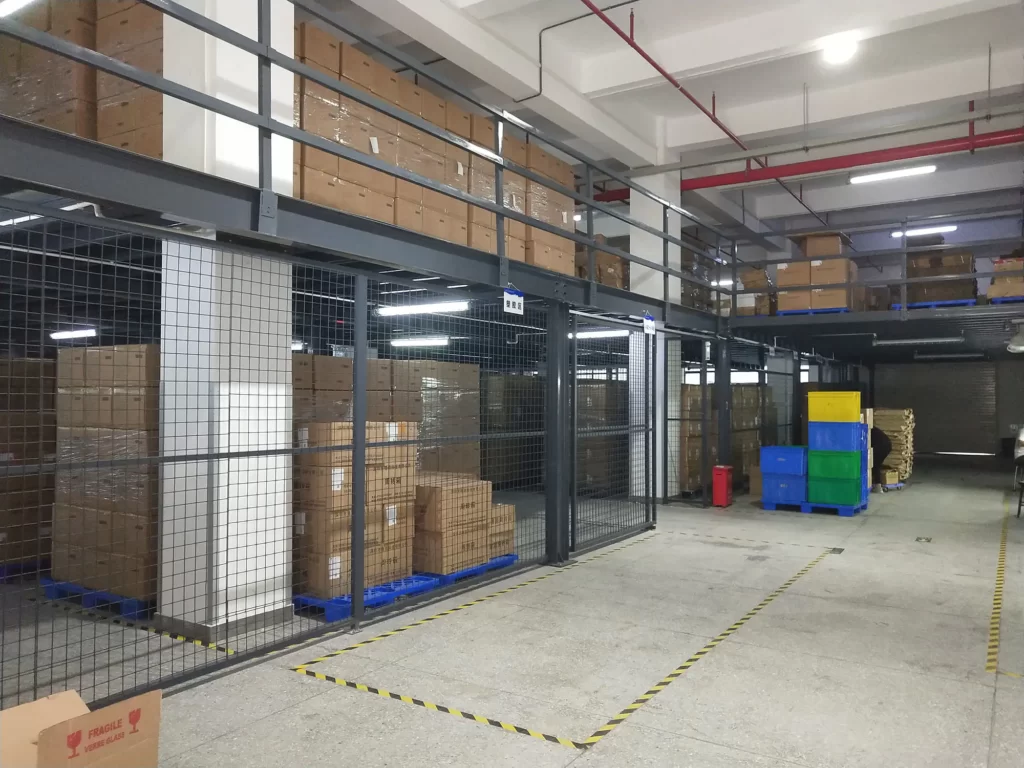
Industrial Mezzanine
- Design & approval: 1–3 months
- Manufacturing: 1–2 months
- Installation: 1–3 months (phased, can keep part of warehouse running)
- Total: 3–8 months (average 4–6 months)
Newly Built Warehouse

- Land acquisition & permitting: 6–24 months
- Design & construction approval: 4–8 months
- Construction: 8–18 months
- Fit-out & commissioning: 4–8 months
- Total: 18–48 months (average 24–36 months)
Winner: Industrial mezzanine (4–6× faster)
4.3 Storage Density & Capacity Gain
Industrial Mezzanine
- Single-tier: 80–120% capacity increase
- Two-tier: 180–250% increase
- Three-tier: 250–400% increase (if building height allows)
Newly Built Warehouse
- 100% increase in footprint (but you pay for the entire new building)
- Can achieve higher clear height (12–15 m), but mezzanine on existing building often matches or exceeds effective density when rent is considered
Winner: Tie or slight edge to mezzanine (faster and cheaper capacity gain)
4.4 Operational Disruption During Implementation
Industrial Mezzanine
- Phased installation possible (build one section while rest operates)
- Downtime usually limited to weekends or night shifts
- Existing inventory can stay in place during most of construction
Newly Built Warehouse
- Complete relocation required (or dual-site operation during transition)
- 6–18 months of double rent or split operations
- High disruption to supply chain
Winner: Industrial mezzanine (much lower business interruption)
4.5 Flexibility & Future Scalability
Industrial Mezzanine


- Fully modular — add/remove sections, change racking type on upper levels
- Easy to relocate or sell if business needs change
- Can be disassembled and reinstalled in new building later
Newly Built Warehouse
- Fixed building footprint and column grid
- Harder and more expensive to modify later
- Resale value depends on location and market conditions
Winner: Industrial mezzanine (higher flexibility)
4.6 Tax, Depreciation & Financial Incentives
Industrial Mezzanine
- Classified as equipment/fixture → faster depreciation (5–10 years)
- Eligible for many local “equipment upgrade” subsidies in China
- Lower fixed asset base → better ROI metrics
Newly Built Warehouse
- Classified as real estate → 20-year depreciation
- Land appreciation tax, construction tax, higher property tax
- Large fixed asset on balance sheet
Winner: Industrial mezzanine (better cash flow & tax treatment)
4.7 Energy Consumption & Sustainability
Industrial Mezzanine
- Same building volume to heat/cool → lower HVAC energy
- LED lighting on upper levels more efficient
- Less land footprint = smaller environmental impact
Newly Built Warehouse
- Larger volume to condition (especially for cold chain)
- Higher overall energy consumption unless ultra-insulated
Winner: Industrial mezzanine (usually 30–50% lower energy cost)
Real-World ROI & Payback Examples (2026 China Numbers)
Example 1: E-commerce 3PL (2,000 m² existing warehouse)
- Current capacity: 4,200 pallet positions (selective racking)
- Needed: 7,500–8,000 positions
- Option A – New 3,500 m² warehouse CAPEX: 28–45 million RMB (land + construction + racking) Payback: 7–12 years
- Option B – Single-tier industrial mezzanine + denser racking CAPEX: 4.8–7.2 million RMB Payback: 2.1–3.4 years (rent savings + higher throughput)
Winner: Mezzanine

Example 2: Cold Chain Pharma Distributor (1,800 m²)
- Current: 3,200 pallet positions (2–8°C)
- Needed: 6,000 positions
- New building cost: 35–55 million RMB + high energy cost
- Mezzanine + mobile racking: 6.5–11 million RMB Energy savings (smaller cooled volume): 1.2–2.0 million RMB/year Payback: 2.8–4.2 years
Winner: Mezzanine
Example 3: Manufacturing Plant (low clear height 5.8 m)
- Current: 2,800 pallet positions
- Needed: 4,200 positions
- Mezzanine not feasible (height too low)
- New building required → higher CAPEX, longer timeline
Winner: New warehouse (only viable option)
Common Decision Traps & How to Avoid Them
- “We’ll just add more racking later” — leads to overloaded, unsafe layouts
- Choosing lowest price per ton — ignores safety, seismic, and TCO
- Ignoring future automation — expensive retrofit later
- Underestimating permitting time — new building can delay 12–36 months
- Not modeling rent + labor savings — misses the real ROI story
How Mracking Helps You Make the Right Choice
At Mracking we don’t just sell racking — we help you decide between industrial mezzanine and newly built warehouse with:
- Free site survey & 3D modeling
- Multiple layout options with density & ROI comparison
- Full seismic & structural calculations
- Professional installation teams
- 25-year structural warranty on all systems
- Nationwide support
Final Decision Framework: Industrial Mezzanine vs Newly Built Warehouse
Use this checklist to decide:
Rule of thumb 2026: If your existing building has ≥5.5 m clear height and structurally sound floor, start with industrial mezzanine. Only go for a newly built warehouse if mezzanine is physically impossible or your long-term needs require a fundamentally different building specification.
Conclusion – Choose Wisely, Choose Once
Industrial mezzanine vs newly built warehouse is rarely a 50/50 decision. In the majority of real-world cases in China in 2026, industrial mezzanine is faster, cheaper, less disruptive, more flexible, and financially superior — especially when you calculate rent savings, labor reduction, energy efficiency, and accelerated ROI.
At Mracking, we help businesses make this exact decision every week. Our team provides free initial assessments, multiple 3D layout comparisons, detailed cost & ROI modeling, full engineering certification, and professional installation — so you can choose the wiser path with complete confidence.
Ready to evaluate whether an industrial mezzanine or a newly built warehouse is right for your business? Contact Mracking today for a no-obligation consultation and custom analysis.
Your next storage expansion decision deserves the best data and the best partner — let Mracking help you choose wisely.