


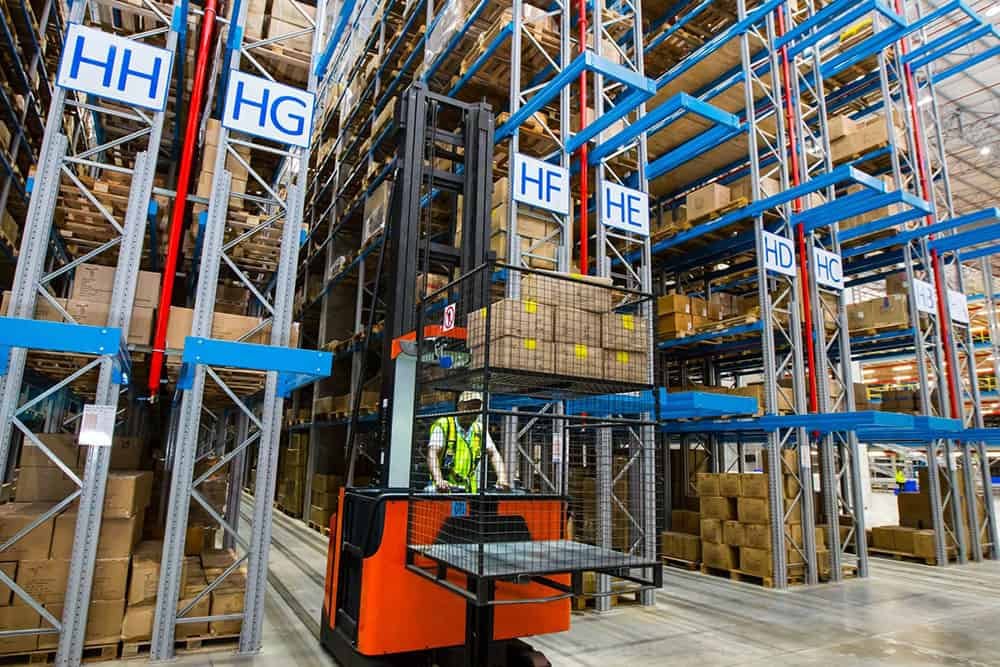
Narrow aisle pallet racking (also known as very narrow aisle racking or VNA racking) is one of the most powerful storage solutions available today for warehouses that need to maximize cubic space while maintaining direct access to every pallet. In 2026, with rising warehouse rental costs in China, exploding e-commerce demand, and increasing pressure to store more inventory in less floor area, narrow aisle pallet racking has become a standard choice for medium to large distribution centers, manufacturing plants, cold storage facilities, and 3PL operations. A related guide on Vna Very Narrow Aisle Racking gives more detail for this part of the planning work.
At Mracking, we design and install narrow aisle pallet racking systems that consistently achieve 40–60% higher storage density than conventional selective racking while keeping 100% selectivity and excellent safety records. For a closer comparison, see Narrow Aisle Racking.
This in-depth guide answers the question “How do narrow aisle pallet racking work?” in complete detail. We explain the core working principle, different types of narrow aisle pallet racking and very narrow aisle racking systems, required equipment, aisle widths, structural requirements, safety features, advantages and limitations, real-world applications, cost breakdown, and step-by-step decision-making process. By the end of this article, you will fully understand what is narrow aisle racking, how it operates, and whether it is the right choice for your warehouse in 2026. This point also connects with Wide Aisle Racking.
What Is Narrow Aisle Pallet Racking?
Narrow aisle pallet racking is a high-density storage system that reduces aisle widths to the minimum safe distance needed for specialized forklifts or automated equipment to operate, allowing warehouses to store significantly more pallets per square meter compared to standard selective racking.
Definition and Core Principle
The defining characteristic of narrow aisle pallet racking is aisle width: typically 1.6–2.0 meters for narrow aisle and 1.4–1.8 meters for very narrow aisle racking (compared to 3.0–3.5 meters in conventional selective systems). This reduction in aisle space is achieved by using specialized reach trucks, turret trucks, or automated guided vehicles (AGVs) that can operate in very tight spaces while still providing 100% direct access to every pallet position.
The core working principle is simple but powerful:
- Upright frames are installed closer together.
- Beams are positioned at precise heights to match pallet dimensions.
- Specialized handling equipment reaches into the racking structure to store and retrieve pallets without needing wide maneuvering aisles.
Because aisles are narrower, the saved floor space can be used to add more racking rows, dramatically increasing storage density — often by 40–60% compared to standard selective racking.
Key Terminology Clarification
- Narrow aisle pallet racking — generally refers to aisles 1.6–2.0 meters wide, served by man-up or stand-on reach trucks.
- Very narrow aisle racking (VNA racking) — aisles 1.4–1.8 meters wide, usually served by turret trucks or articulated forklifts that rotate the load inside the aisle.
- Conventional selective racking — aisles 3.0–3.5 meters, using counterbalance forklifts.
At Mracking, we manufacture both narrow aisle pallet racking and very narrow aisle racking systems with precision tolerances that meet the strict requirements of these specialized handling machines.
How Narrow Aisle Pallet Racking Actually Works in Real Operations
Basic Working Mechanism
- Storage Operation
- Forklift driver positions the truck in the narrow aisle.
- The load is lifted to the required beam level.
- The forks extend sideways into the racking bay (reach trucks) or rotate 90° (turret trucks).
- The pallet is placed on the beams.
- The truck retracts and moves to the next location.
- Retrieval Operation
- Driver positions the truck in the aisle facing the desired pallet.
- Forks extend or rotate to pick the pallet.
- Pallet is brought back to the center of the aisle.
- Truck travels to the dispatch area or another storage location.
The entire process relies on extremely precise racking alignment — uprights must be perfectly plumb and beams level to within 2–3 mm across the entire height. That is why quality narrow aisle pallet racking from Mracking is manufactured to tight tolerances (±1 mm) and installed with laser-guided alignment.


Required Equipment for Narrow Aisle and Very Narrow Aisle Racking
Narrow aisle pallet racking (1.6–2.0 m aisles) is typically served by:
- Stand-on reach trucks
- Man-up reach trucks (operator platform rises with the load)
Very narrow aisle racking (1.4–1.8 m aisles) requires:
- Turret trucks (load rotates inside the aisle)
- Articulated forklifts
- Automated guided vehicles (AGVs) in fully automated systems
All these machines need guide rails, induction loops, or wire guidance to operate safely in such tight aisles.
Structural Requirements of Narrow Aisle Pallet Racking
Narrow aisle pallet racking must be stronger and more precise than conventional systems:
- Uprights are deeper and braced more frequently.
- Beams are reinforced to handle dynamic loads from reach equipment.
- Base plates are larger with more anchors.
- Aisle protection rails and column guards are mandatory.
- Seismic bracing is critical in China (GB 50011 compliance).
Mracking designs every narrow aisle pallet racking system with these requirements built in from the start.
Advantages of Narrow Aisle Pallet Racking
Narrow aisle pallet racking offers several powerful benefits that make it a popular choice in 2026:
Significant Increase in Storage Density
By reducing aisle width from 3.5 m to 1.6–1.8 m, you can add 40–60% more pallet positions in the same floor area. In many cases, businesses double their storage capacity without moving to a larger facility.
100% Selectivity Maintained
Unlike drive-in or push-back systems, every pallet remains directly accessible — a critical advantage for operations with high SKU variety. For broader industry context, Rack Manufacturers Institute (RMI) is a useful reference.
Better Vertical Utilization
Narrow aisle pallet racking is commonly installed up to 12–15 meters (and sometimes higher), taking full advantage of building height.
Cost-Effective Compared to Full Automation
While more expensive than standard selective racking, narrow aisle pallet racking costs significantly less than AS/RS or fully automated shuttle systems while delivering similar density gains.
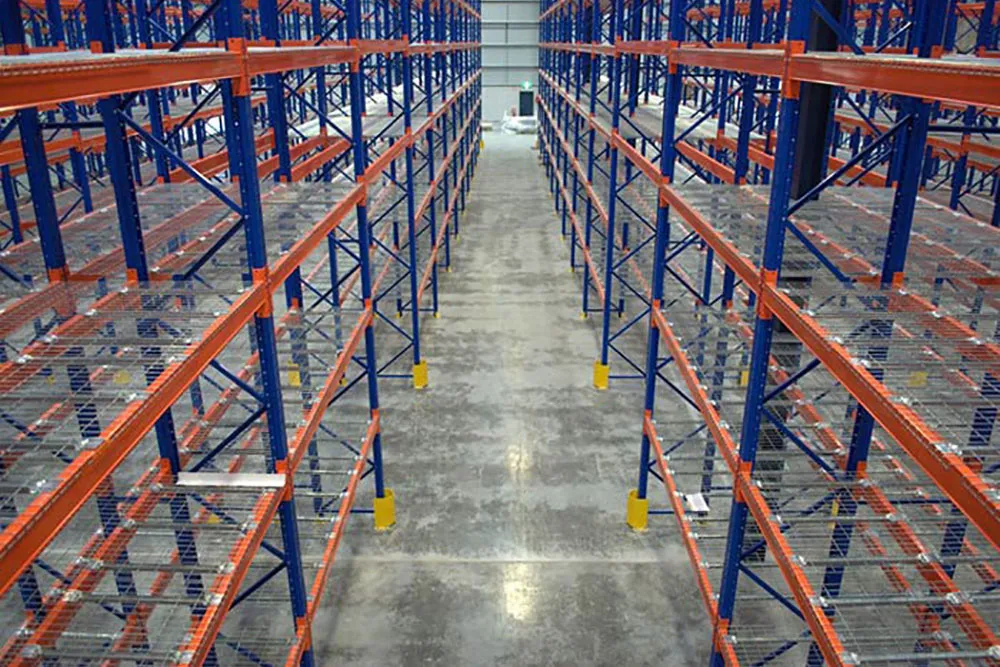
Future-Proof for Gradual Automation
Many companies start with narrow aisle pallet racking using reach trucks, then later upgrade to turret trucks or AGVs without replacing the racking structure — a huge cost saving.
Safety Improvements When Properly Designed
Modern narrow aisle pallet racking includes integrated aisle protection rails, column guards, and safety netting, reducing collision damage compared to wide-aisle layouts.
Limitations and Challenges of Narrow Aisle Pallet Racking
While powerful, narrow aisle pallet racking also has important limitations that must be considered:
Higher Equipment Cost
Specialized reach trucks or turret trucks cost 2–4 times more than standard counterbalance forklifts.
Slower Handling Speed
Narrow aisles limit forklift maneuverability, reducing handling speed compared to wide-aisle systems (though this is offset by reduced travel distance).
Precision Installation Required
Uprights must be perfectly plumb and beams level. Poor installation causes major operational problems.
Reduced Operator Comfort
Man-up reach trucks require operators to work at height for extended periods.
Higher Safety Risk if Not Properly Maintained
Narrow aisles increase the chance of collisions if guidance systems or training are inadequate.
Not Suitable for Very Low Buildings
Requires at least 8–10 m clear height to justify the investment.
Mracking engineers every narrow aisle pallet racking system to minimize these limitations while maximizing the benefits.
Narrow Aisle Pallet Racking vs Very Narrow Aisle Racking: Detailed Comparison
Many people use the terms interchangeably, but there are important differences:
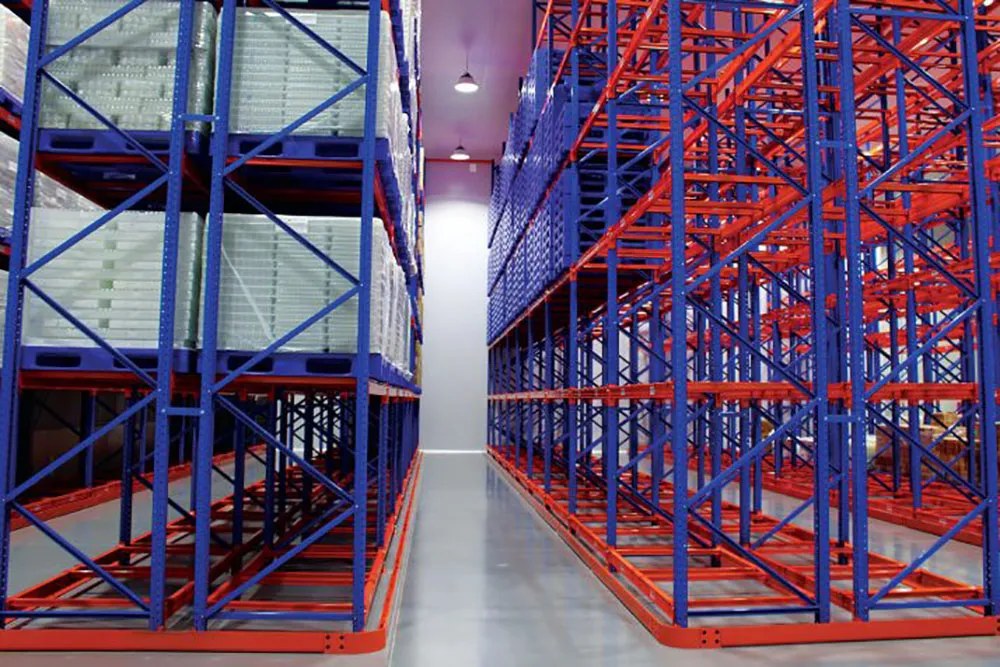
Aisle Width
- Narrow aisle: 1.6–2.0 m
- Very narrow aisle: 1.4–1.8 m (sometimes as low as 1.3 m)
Handling Equipment
- Narrow aisle: Stand-on or man-up reach trucks
- Very narrow aisle: Turret trucks or articulated forklifts
Density Gain
- Narrow aisle: 40–50% more storage than standard selective
- Very narrow aisle: 50–65% more storage
Cost
- Narrow aisle racking: Moderate premium over standard selective
- Very narrow aisle racking: Higher precision required, slightly more expensive
Operator Skill Level
- Narrow aisle: Moderate training
- Very narrow aisle: High skill required (turret truck operation is more complex)
Mracking manufactures both narrow aisle pallet racking and very narrow aisle racking systems, giving you the flexibility to choose the best fit for your space and budget.
How to Design a Narrow Aisle Pallet Racking Layout
Designing an effective narrow aisle pallet racking layout requires careful planning.
Step 1: Determine Aisle Width
Choose based on handling equipment:
- 1.8 m aisles → standard reach trucks
- 1.5–1.6 m aisles → advanced reach trucks or turret trucks
Step 2: Calculate Bay and Upright Spacing
- Bay width = pallet width + 200–300 mm clearance
- Upright depth = pallet depth + 150–250 mm overhang allowance
Step 3: Maximize Height
Use the full clear height of your building (minus safety clearance for sprinklers/lights). Mracking can install up to 15 m in many cases.
Step 4: Plan Aisle Protection
Include full-length aisle rails, column guards, and end-of-aisle protection.
Step 5: Integrate Guidance Systems
Wire guidance, rail guidance, or induction loops ensure precise operation.
Step 6: Add Safety Features
- Rack-mounted safety netting
- Pallet back stops
- Load plaques with clear weight ratings
- Aisle lighting
Mracking provides complete 3D layout designs that optimize every dimension for maximum density and safety.
Safety Requirements for Narrow Aisle Pallet Racking
Narrow aisle pallet racking operates in tight spaces, so safety standards are non-negotiable.
GB 50011 Seismic Compliance
All narrow aisle pallet racking in China must meet seismic requirements. Mracking systems include cross-bracing, base anchoring, and reinforced connections certified to GB 50011.
Operator Training
Drivers of reach trucks and turret trucks require specialized training and certification.
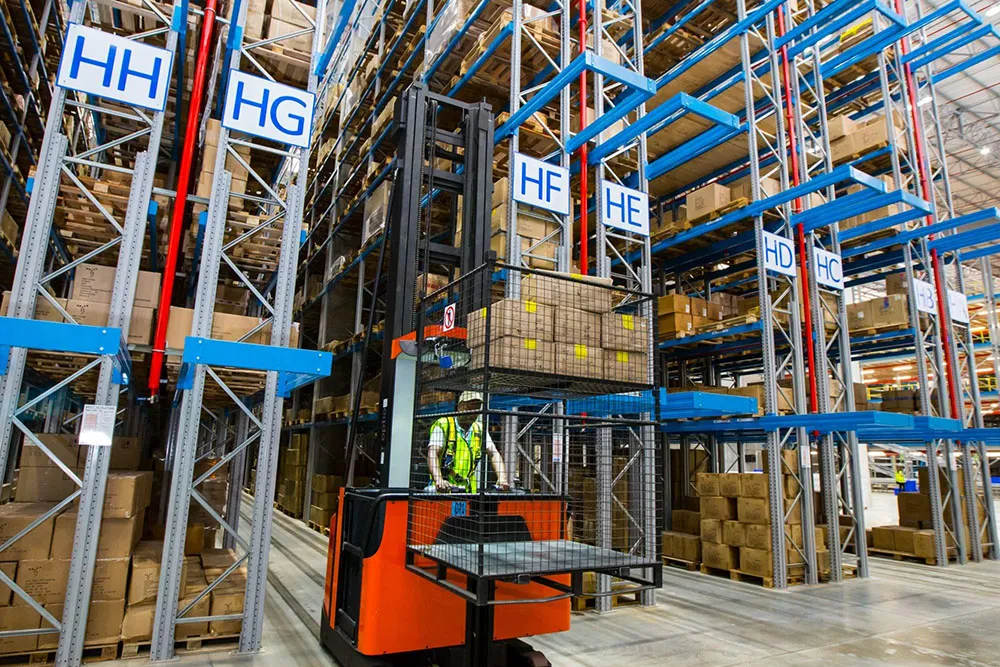
Aisle Protection
- Full-length steel rails at floor level
- Column guards at end of aisles
- Overhead netting for upper levels
Load Monitoring
Many modern systems include load sensors and overload alarms.
Regular Inspections
Annual professional inspections are mandatory for narrow aisle pallet racking systems.
Cost Analysis of Narrow Aisle Pallet Racking in 2026 (China Market)
Approximate installed cost per pallet position (including design, delivery, and installation):
- Selective racking (wide aisle): 280–650 RMB
- Narrow aisle pallet racking: 450–850 RMB
- Very narrow aisle racking: 600–1,100 RMB
Additional costs:
- Specialized reach trucks or turret trucks: 400,000–800,000 RMB per unit
- Guidance systems: 50,000–150,000 RMB per aisle
- Safety features (netting, guards): 30,000–80,000 RMB per aisle
Although the initial investment is higher than conventional racking, narrow aisle pallet racking typically achieves payback in 2–4 years through increased storage capacity and faster operations.
Why Choose Mracking for Your Narrow Aisle Pallet Racking Project
When selecting a supplier for narrow aisle pallet racking, quality, precision, and support are critical. Mracking stands out among pallet racking brands in China for several reasons:
- Precision Engineering — Manufactured to ±1 mm tolerance for perfect equipment compatibility
- Seismic Compliance — Full GB 50011 certification for all systems
- Automation-Ready Design — Pre-drilled channels and precise alignment for AGVs/AS/RS
- Professional Installation — Laser-guided alignment and torque-controlled bolting
- 25-Year Structural Warranty — Industry-leading protection
- Competitive Pricing — European quality at Chinese manufacturing costs
- Nationwide Support — Fast delivery and service across China
Thousands of Chinese companies trust Mracking for their narrow aisle pallet racking and very narrow aisle racking projects.
Conclusion: Make the Right Choice for Your Warehouse
How to choose warehouse racking — especially narrow aisle pallet racking — requires careful evaluation of your inventory, building constraints, handling equipment, safety needs, and future growth plans. The right system will transform your warehouse into a highly efficient, safe, and scalable operation.
At Mracking, we specialize in helping businesses select and install the perfect narrow aisle pallet racking and very narrow aisle racking solutions. Our team provides free consultations, detailed 3D layouts, precise load calculations, professional installation, and ongoing support across China.
Ready to maximize your warehouse density and efficiency? Contact Mracking today for a free site assessment and custom quotation. Let us help you choose the right warehouse racking system that will serve your business for decades to come.