


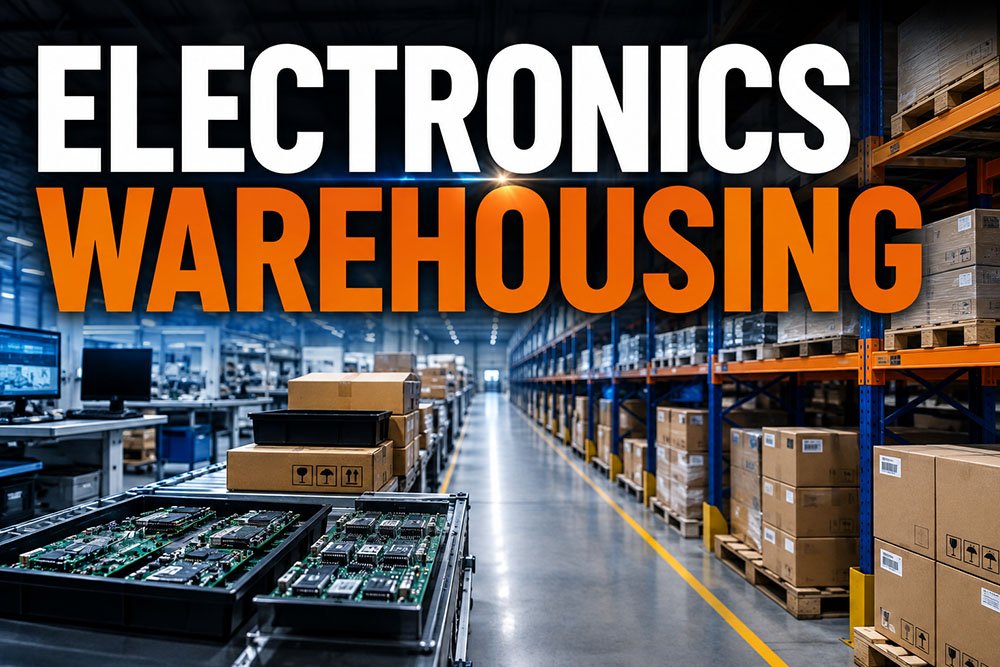
Electronics warehousing has become one of the most demanding segments in modern logistics, driven by the combination of high product value, environmental sensitivity, short product lifecycles, extreme SKU counts, and increasingly complex safety requirements. Unlike general distribution warehouses, an electronics warehouse must protect inventory from electrostatic discharge, temperature and humidity fluctuations, physical impact, theft, and — with the rise of lithium-battery-powered consumer devices — significantly heightened fire risk. Storing consumer electronics, semiconductors, PCBs, electronic components, and finished appliances demands a purpose-designed environment rather than a generic warehouse repurposed with standard racking.
This article explains what electronics warehousing involves, examines the unique challenges and requirements, reviews the storage systems commonly used, and outlines the design considerations that shape a functional electronics warehouse.
What Is Electronics Warehousing?
Electronics warehousing is the specialized storage and distribution of electronic products, components, and finished goods in facilities engineered to protect inventory from electrostatic discharge (ESD), temperature and humidity fluctuations, physical impact, unauthorized access, and lithium battery fire risk, while managing the extreme SKU counts and short product lifecycles typical of the electronics industry. Electronics warehouses range from small component distributors handling thousands of individual part numbers to large e-commerce fulfillment centers dispatching finished consumer electronics to end customers.
Because electronics inventory typically carries higher unit value and higher environmental sensitivity than general merchandise, electronics warehousing decisions emphasize protection, traceability, and security alongside the density and throughput considerations common to all warehousing. Facility design, storage equipment selection, and operating procedures must be resolved together rather than in sequence.
Unique Challenges of Electronics Warehousing
Six distinctive challenges shape electronics warehousing operations.
High Product Value. Individual SKUs may be worth thousands of dollars, and a single pallet of high-end laptops or smartphones can exceed the value of an entire truck of general merchandise. Loss and shrinkage protection are correspondingly critical.
Electrostatic Discharge (ESD) Sensitivity. Semiconductors, PCBs, and unpackaged components can be damaged by static electricity at voltages so low that operators cannot feel them. ESD damage is often invisible but reduces device reliability, sometimes only surfacing months after handling.
Temperature and Humidity Sensitivity. Extreme heat, cold, or humidity affects component performance, battery life, and moisture-sensitive devices. Semiconductor storage often requires nitrogen dry cabinets or humidity-controlled zones.
Short Product Lifecycle and High Obsolescence Risk. Consumer electronics may lose 20–40% of value within six months of launch. FIFO or FEFO rotation is essential to minimize obsolescence writeoffs, and stock rotation control interacts directly with rack configuration choice.
Extreme SKU Counts. Component distributors routinely handle tens or hundreds of thousands of SKUs, most in small quantities per SKU. This drives storage system selection toward high-density small-parts systems rather than pallet-scale bulk storage.

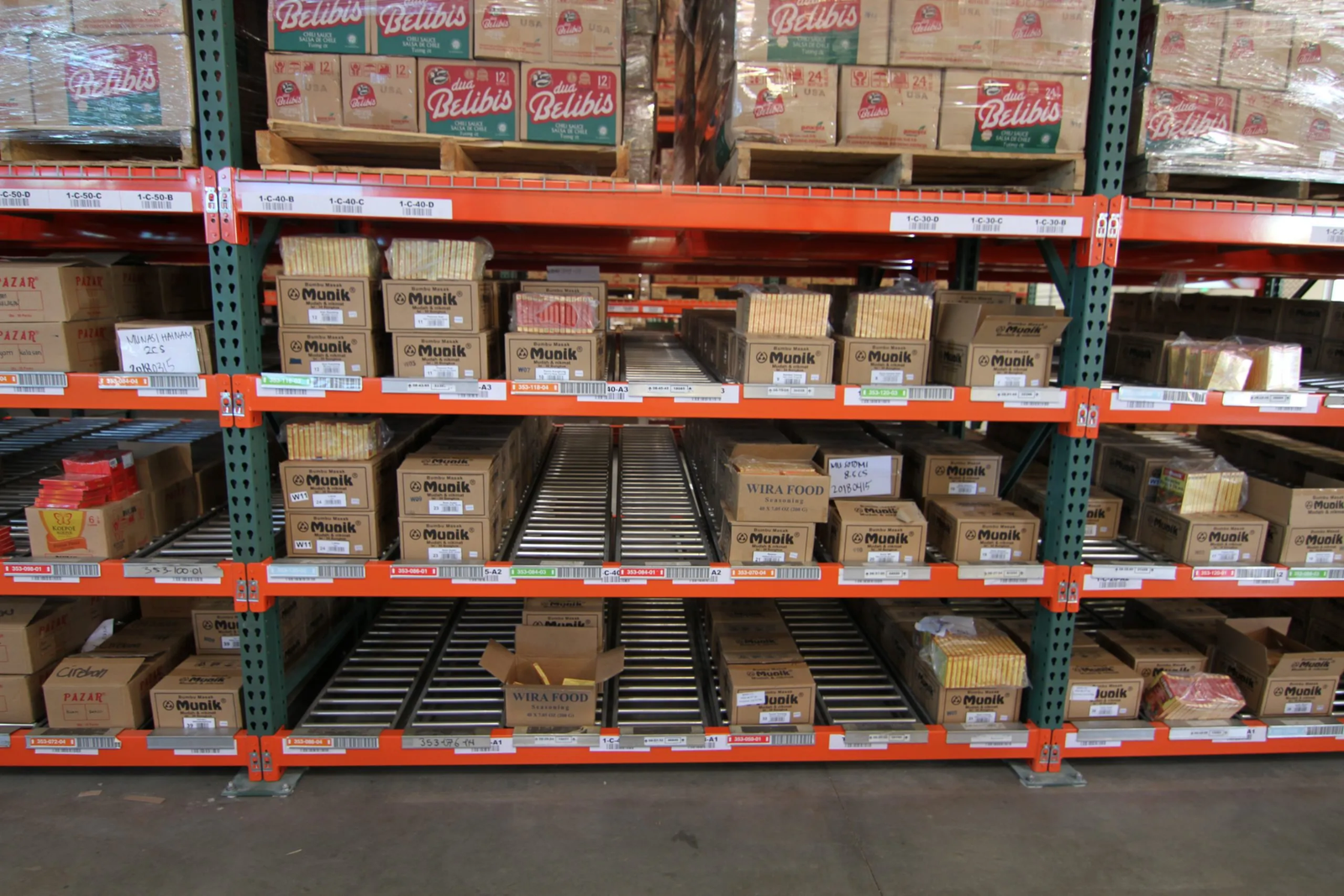
Lithium Battery Fire Risk. Devices containing lithium batteries (smartphones, laptops, power tools, electric vehicles) present significantly higher fire risk than most warehouse inventory. Lithium battery fires burn hotter, spread faster, and are harder to suppress than conventional warehouse fires, requiring specialized fire protection design.
Key Requirements for Electronics Warehouses
Climate Control. Temperature typically maintained at 15–25 °C with relative humidity 30–60%. Semiconductor and moisture-sensitive component zones require tighter control, often 20–22 °C and 40–50% relative humidity. HVAC systems must be sized for continuous operation with backup capacity.
ESD Protection Infrastructure. ESD-safe flooring (dissipative or conductive), grounded workstations, anti-static bins and totes, and specialized racking with dissipative coatings. Guidance on how storage racks prevent static electricity covers the specific finishes and grounding techniques that keep static charge from reaching sensitive components.
Security and Access Control. Zoned access with badge or biometric entry, comprehensive CCTV coverage, tamper-evident packaging protocols, and dedicated high-value SKU cages or lockable cabinets. Cycle count frequency is typically higher than in general warehouses because high-value shrinkage produces disproportionate financial impact.
Fire Protection for Lithium Batteries. Standard sprinkler systems may not adequately suppress lithium battery fires. NFPA guidelines and evolving industry standards address the need for higher water density, thermal barriers between storage zones, separate storage areas for damaged batteries, and enhanced early detection through smoke and heat sensors.
Traceability and Barcode/RFID Infrastructure. Every SKU must be traceable through lot number, serial number, or unique identifier. Electronics operations typically integrate WMS with vendor-managed inventory (VMI) and enterprise systems to support recall management, warranty tracking, and RMA processing.
Storage Systems Used in Electronics Warehouses
The optimal storage mix depends on product size, value, and picking pattern.
Selective Pallet Racking. Used for bulk storage of packaged finished goods and moderate-volume distribution. Standard configuration with wire mesh decking for case picking of larger items.
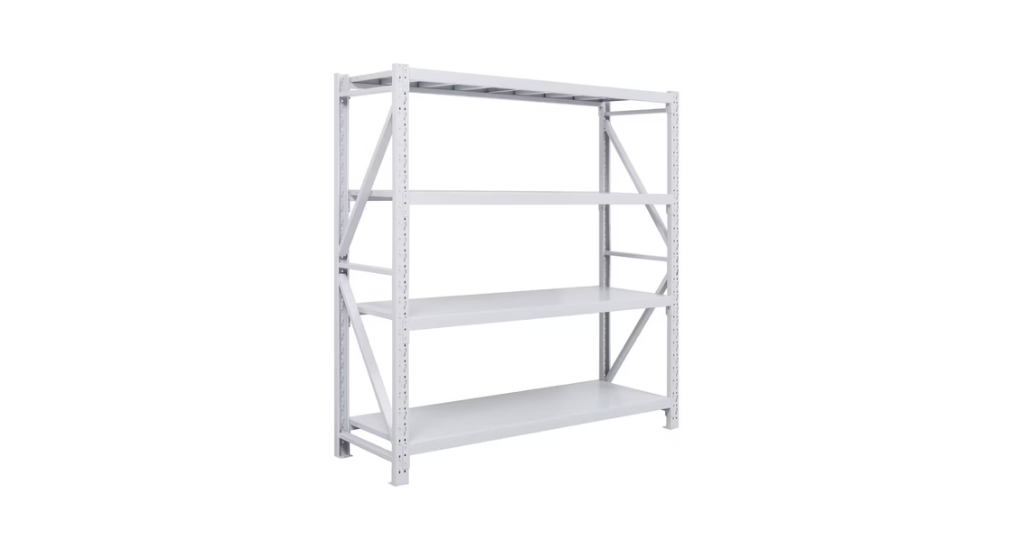
Boltless Shelving and Multi-Tier Shelving. Boltless racking systems dominate small-parts storage in component distribution warehouses. Adjustable shelf heights accommodate diverse SKU dimensions, and boltless assembly supports fast reconfiguration as SKU profile changes. Detailed references on boltless rack configurations cover the standard and heavy-duty variants used in electronics warehousing.

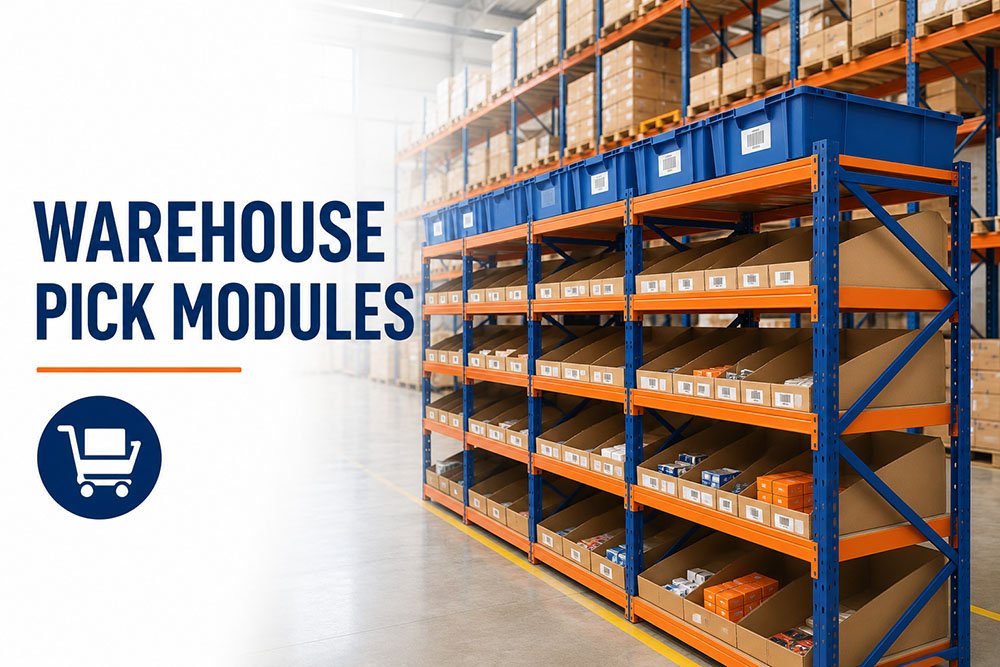
Carton Flow Rack and Pick Modules. High-volume fulfillment operations use carton flow modules for fast-moving SKUs and integrated pick modules for order assembly. Broader guidance on warehouse pick module design applies directly to electronics fulfillment operations.

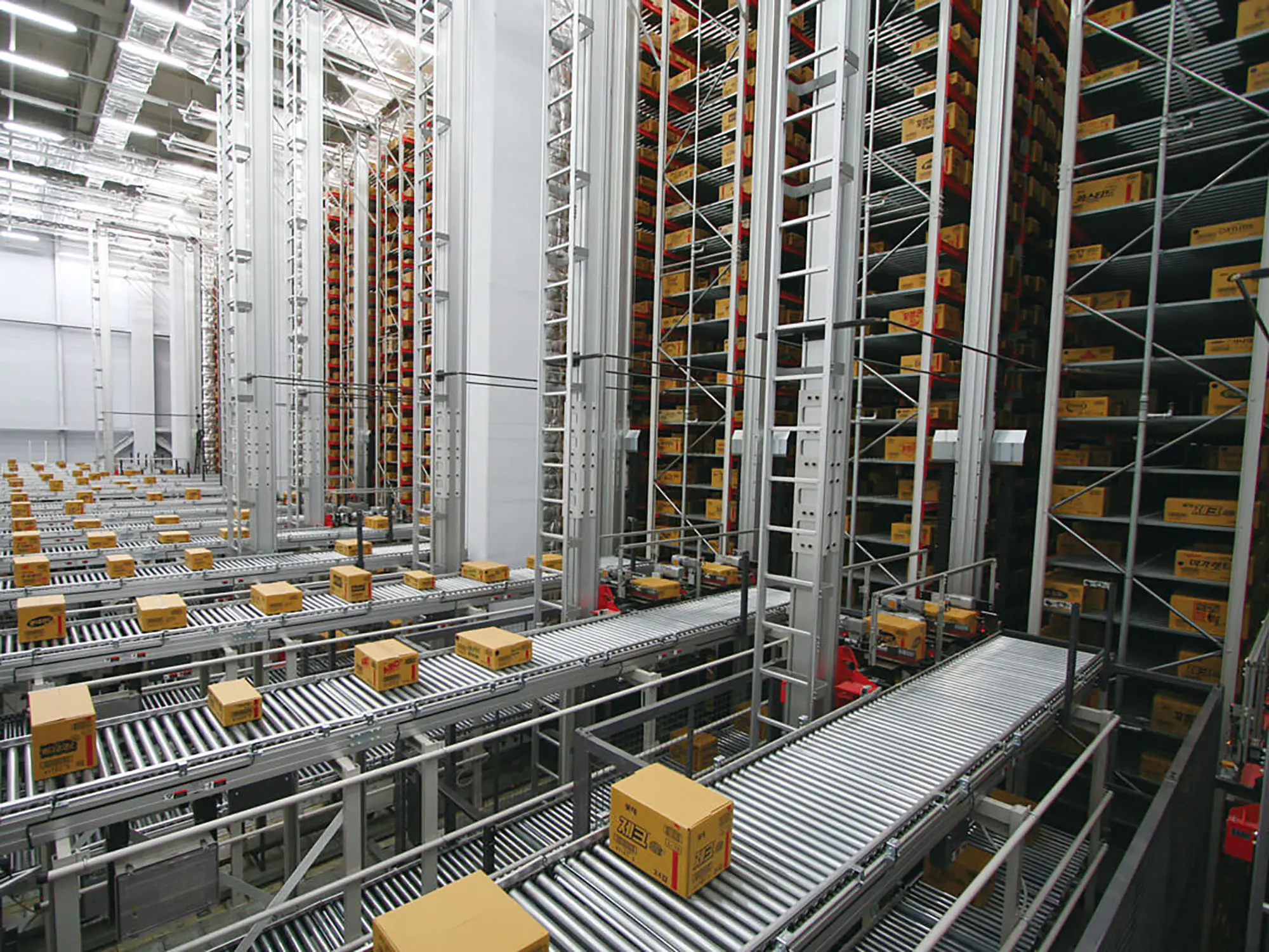
Automated Storage and Retrieval Systems (AS/RS). High-value semiconductor storage, tier-one component distribution, and large e-commerce fulfillment increasingly rely on AS/RS systems for storage density, security, and reduced human handling. Mini-load AS/RS specifically supports small-parts electronics inventory.

ESD-Safe Bins and Anti-Static Totes. Small-parts storage typically uses conductive or dissipative plastic bins mounted on shelving. Bin materials, sizes, and shelf configurations are selected to match SKU dimensions and pick frequency.
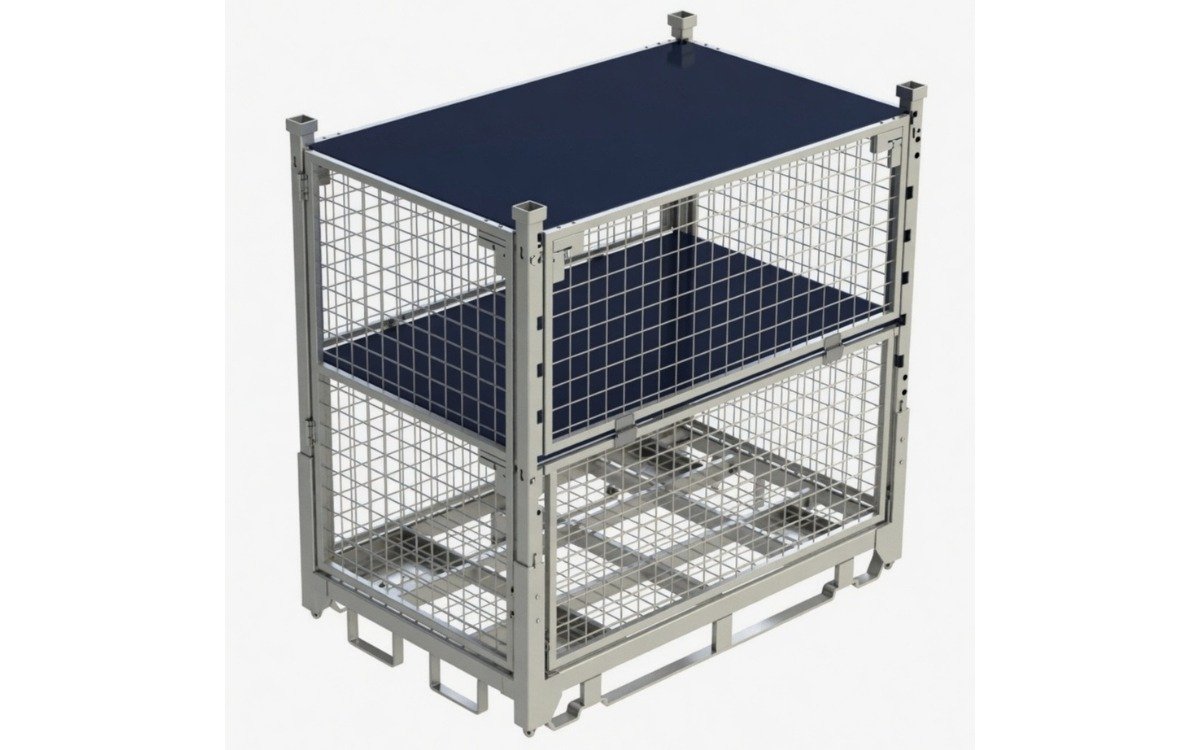
Dedicated Cabinets and Cages. Very high-value SKUs (specialty semiconductors, high-end consumer devices, restricted components) are stored in lockable cabinets or wire mesh cages within the broader warehouse, with access limited to authorized personnel.

Applications in the Electronics Industry
Electronics warehousing serves several distinct segments, each with different operational patterns.
Consumer Electronics Distribution. Smartphones, laptops, tablets, gaming consoles, and home electronics distributed through retail and e-commerce channels. Requires balance of density, throughput, and security.
Semiconductor Storage. Wafer, IC, and finished chip storage with strict humidity, temperature, and ESD controls. Nitrogen dry cabinets and specialized clean storage zones are common.
Electronic Component Distribution. Passive components, connectors, PCBs, and specialty parts handled in extreme SKU counts (often 100,000+ SKUs) with low quantities per SKU. Boltless shelving and small-parts bins dominate.
Contract Electronics Manufacturing (EMS). Component and finished goods staging for electronics manufacturing operations, with tight integration into production scheduling and BOM management.
E-commerce Electronics Fulfillment. Direct-to-consumer shipment of consumer electronics with high order volumes, small order sizes, and next-day or same-day delivery expectations.
Reverse Logistics and RMA Operations. Return processing, testing, refurbishment, and disposition of returned electronics. Elevated because electronics carry higher return rates than most product categories.
Design Considerations for Electronics Warehouses
Electronics warehouse design balances protection, throughput, and cost across several dimensions. HVAC sizing must handle continuous climate control with backup capacity for extreme weather. ESD zone design typically requires separation between ESD-safe areas and general storage, with clearly marked transitions and grounded workstations at every touch point. Fire zoning becomes critical when lithium batteries are stored — some jurisdictions require separate rooms with independent fire suppression for battery storage above a defined quantity threshold. Security zoning within the warehouse restricts access to high-value SKU areas without requiring facility-wide high-security overhead. Layout design should minimize handling distance for high-value SKUs to reduce both damage risk and shrinkage opportunity. Compliance with rack design standards published by the Rack Manufacturers Institute (RMI) and fire protection guidance from NFPA governs the technical requirements throughout.
Comparison Table: Storage Systems for Electronics Warehousing
| Storage System | Best Product Type | Density | Security | Typical Use |
|---|---|---|---|---|
| Selective Pallet Racking | Bulk finished goods | Medium | Low | Distribution warehouses |
| Boltless / Multi-Tier Shelving | Small parts, components | Medium | Medium | Component distribution |
| Carton Flow Rack | Fast-moving cases | High | Medium | High-volume picking |
| Pick Modules | Mixed velocity SKUs | High | Medium | E-commerce fulfillment |
| Mini-Load AS/RS | Small high-value parts | Very High | Very High | Semiconductor, tier-one |
| Lockable Cabinets and Cages | Very high-value or restricted | Low | Very High | Specialty semiconductors |
Most modern electronics warehouses combine several systems within a single facility, applying each where its density, throughput, and security characteristics best match the specific product category.
How to Plan an Electronics Warehouse
Step 1: Analyze Product Profile.
Document SKU count, unit value, dimensions, weight, ESD sensitivity, temperature and humidity requirements, and presence of lithium batteries or other special-handling items.
Step 2: Define Environmental Requirements.
Establish temperature, humidity, ESD, and air quality targets for each zone. Semiconductor storage typically warrants tighter control than general consumer electronics.
Step 3: Design Storage Zoning.
Separate ESD-sensitive storage, high-value SKUs, lithium battery inventory, and general merchandise into distinct zones with appropriate boundaries and access controls.
Step 4: Select Storage Systems by Zone.
Match racking, shelving, carton flow, pick modules, or AS/RS to product profile and picking pattern within each zone.
Step 5: Integrate Fire Protection.
Involve a fire protection engineer familiar with lithium battery risk from the concept stage. Standard warehouse sprinkler design may not be adequate for lithium battery zones.
Step 6: Design Security Infrastructure.
Include zoned access control, CCTV, high-value SKU cages, and reception protocols. Balance security with operational throughput.
Step 7: Verify Safety and Compliance.
Confirm compliance with rack design standards, fire codes, ESD standards such as ANSI/ESD S20.20, and workplace safety guidance from OSHA, including its warehousing hazards and solutions.
Key Takeaways
- Electronics warehousing requires protection from ESD, temperature and humidity fluctuations, physical impact, theft, and lithium battery fire risk in addition to standard storage functions.
- Key requirements include climate control, ESD infrastructure, security and access control, fire protection for lithium batteries, and comprehensive traceability.
- Storage system mix typically combines selective pallet racking, boltless shelving, carton flow, pick modules, AS/RS, and lockable cabinets.
- Component distribution warehouses handle extreme SKU counts (often 100,000+); e-commerce fulfillment prioritizes throughput; semiconductor storage demands the strictest environmental control.
- Fire zoning and lithium battery risk management have become critical design factors as battery-powered electronics volume has grown.
- Warehouse zoning by ESD sensitivity, security level, and battery risk is a fundamental design decision that shapes storage system selection.
Frequently Asked Questions
1. What is electronics warehousing?
Electronics warehousing is the specialized storage and distribution of electronic products, components, and finished goods in facilities engineered to protect inventory from ESD, environmental fluctuations, impact, theft, and lithium battery fire risk. Facilities range from small component distributors to large e-commerce fulfillment centers.
2. What temperature and humidity are required for electronics storage?
General consumer electronics storage typically maintains 15–25 °C and 30–60% relative humidity. Semiconductor and moisture-sensitive components often require tighter control at 20–22 °C and 40–50% relative humidity. Some devices, such as OLED displays, may require specific ranges outside these general targets.
3. What is ESD-safe racking?
ESD-safe racking uses dissipative or conductive coatings that prevent static charge accumulation, combined with grounding infrastructure that safely conducts static charge to earth. ESD-safe racking is typically specified in zones handling unpackaged semiconductors, PCBs, or bare electronic components.
4. How should lithium batteries be stored in a warehouse?
Lithium battery storage requires enhanced fire protection including higher-density sprinklers, thermal barriers between storage zones, separate storage areas for damaged or recalled batteries, and enhanced early detection. Some jurisdictions require dedicated battery storage rooms above defined quantity thresholds. NFPA guidance and local codes should be consulted.
5. What storage systems work best for electronic components with high SKU counts?
Boltless shelving with adjustable dividers and anti-static bins is the standard for component distribution warehouses. Mini-load AS/RS is increasingly used at higher scale for improved density and security. Both systems support the extreme SKU counts (often 100,000+) typical in component distribution.
6. Do electronics warehouses need automation?
Automation is not required but is increasingly common in high-volume operations. AS/RS improves density, security, and inventory accuracy for high-value or high-SKU-count operations. Pick modules with pick-to-light or voice picking improve throughput in fulfillment operations. Small operations often continue with manual picking successfully.
7. What certifications apply to electronics warehousing?
ANSI/ESD S20.20 is the primary ESD control standard. ISO 9001 for quality management, ISO 14001 for environmental management, and industry-specific certifications (such as automotive electronics IATF 16949) apply in specific segments. Regulatory requirements for lithium battery storage vary by jurisdiction.
8. How is inventory tracked in an electronics warehouse?
Modern electronics warehouses use barcode scanning at minimum and increasingly RFID for automated tracking. Serial number tracking is standard for finished goods; lot number tracking is standard for components. WMS integration with ERP, VMI, and e-commerce platforms supports end-to-end traceability from receiving through delivery and RMA.
Conclusion
Electronics warehousing is defined by the combination of demands that few other product categories face at the same time — high value, environmental sensitivity, ESD vulnerability, extreme SKU counts, short product lifecycles, and lithium battery fire risk. Because these demands interact, electronics warehouse design must be resolved as an integrated system covering climate control, ESD infrastructure, security zoning, fire protection, and storage system selection. Modern electronics warehouses typically combine selective pallet racking, boltless shelving, carton flow, pick modules, AS/RS, and dedicated high-security cages within a single facility, applying each system where its density, throughput, and protection characteristics best match the product category being stored.
For warehouse operators specifying storage systems for electronics inventory, matching rack configuration and finish to product value, ESD sensitivity, and lithium battery safety requirements is a decisive design decision. Mracking is one of the Chinese manufacturers producing the racking systems commonly used in electronics warehousing — including selective pallet racking, boltless shelving, carton flow rack, multi-tier mezzanines, and AS/RS-compatible high-bay configurations — with anti-static coating options and structural specifications engineered to match consumer electronics, component distribution, semiconductor storage, and electronics fulfillment operations.